
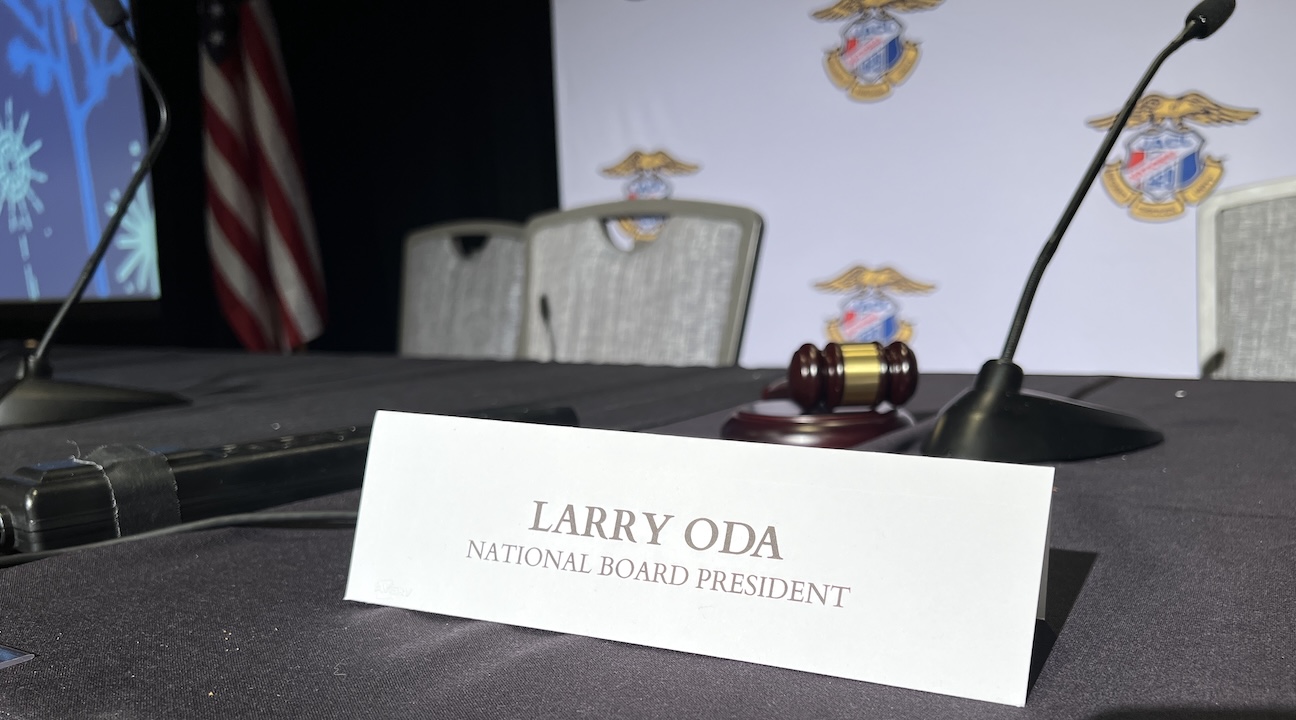
(Photos: George Toshio Johnston)
After 2nd 4-year stint, steadying hand
leaves JACL with a stage set for revival.
By George Toshio Johnston, Senior Editor
(Editor’s note: The Q&A portion of this article was edited for clarity and conciseness.)
For Larry Oda, his second consecutive-biennial term as the Japanese American Citizens League’s National Board president ended Aug. 1, 2026, where it began in 2022: The gambler’s mecca known as Las Vegas. (see “Larry Oda Back in the Saddle — Again,” Aug. 26, 2022, Pacific Citizen, tinyurl.com/37utpxsu)
Four years earlier, oddsmakers looking at JACL’s status might have thought Oda’s last-minute bid to lead the organization — something he had done as national president from 2006-08 and again from 2008-10 — was a sucker’s bet. After all, not only was there no one running for JACL’s presidency, there was no one running for any elective office, definitely not promising probabilities for the health and status of the nation’s oldest Asian American civil rights organization.
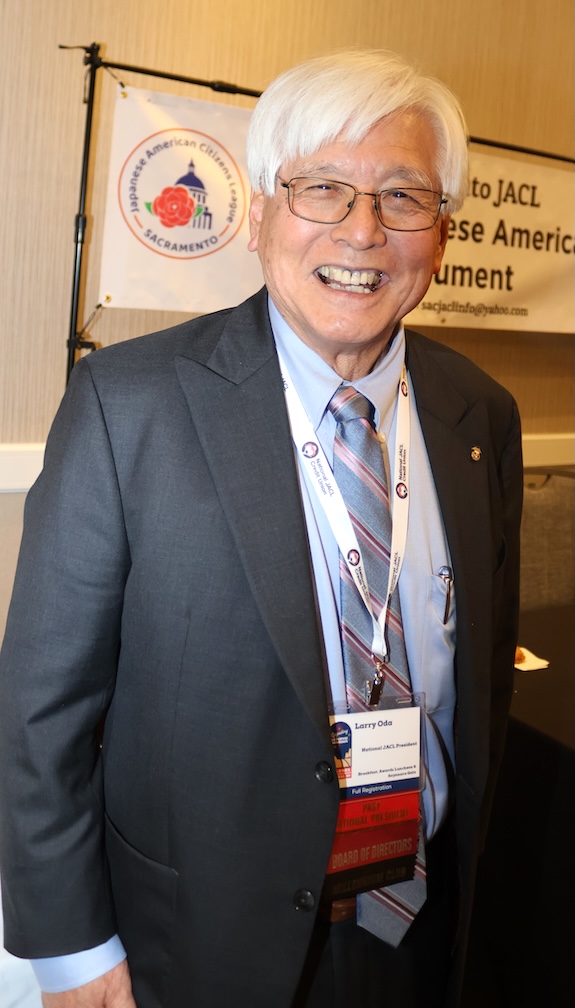
Larry Oda at the Welcome Reception during the 2026 JACL National Convention in Las Vegas
Undaunted, Oda ran from the floor unopposed, won and soon began appointing a cabinet to keep JACL viable. He would spend the next two years dealing with structural and financial problems that he had no inkling existed before his late-stage bid in the summer of 2022.
Despite challenges that included a still-shrinking membership base and declining revenue, Oda ran again for JACL’s national presidency — unopposed — at the 2024 at the national convention in Philadelphia and became the first JACL member to be elected to serve a total of eight years in the office. (see Aug. 9, 2024 Pacific Citizen, tinyurl.com/3h6w787c)
It would take much of the four-year period of 2022-26 for Oda to, as once he put it, to “get us back to zero.” One of those problems that would keep him, members of his cabinet and JACL staff occupied for much of his administration was the lack of attention to California’s Nonprofit Integrity Act of 2004, which requires nonprofit corporations with gross revenues exceeding $2 million to conduct annual independent audits.
Oda was knowledgeable about the Nonprofit Integrity Act, since it was in effect during his 2006-10 stint as JACL president. He was dismayed to learn that after the departures of former National JACL business managers Clyde Izumi and Matthew Walters, JACL had failed to perform its annual due diligence for several years.
HIs assessment at the end of this term in 2024: “We’re basically caught up now.” That would lead to JACL having to face some serious realities in Oda’s last second term — a further decline in membership to, for a time, fewer than 7,000 and a projected budget shortfall that had at one point been tagged at about $1 million.
During his 2024-26 term, to stave off running out of budgeted funds, some difficult actions occurred during his 2024-26 term: layoffs of two longtime staffers — one at JACL headquarters, one at the P.C., in spring 2025 — followed by the parting of the ways with JACL former executive director, whose shoes were filled initially on a temporary basis by NCWNP Regional Director Patty Wada and CFO Tom Fernandez until the hiring of Saki Mori as interim ED. (see “JACL, David Inoue Part Ways,” July 4, 2025, Pacific Citizen, tinyurl.com/2sn2reed and “JACL Selects Interim Executive Director,” Sept. 19, 2025 Pacific Citizen, tinyurl.com/3fxntzsa)
In early 2026, came the terminations of three more JACL staffers, one in its Washington, D.C., office and two — including Wada — at JACL headquarters in San Francisco. (see “JACL Staff Cuts, Latest Budget Woes Revealed,” March 6, 2026 Pacific Citizen, tinyurl.com/2atn5t86) That was followed by the resignation of CFO Fernandez at the end of May (See “JACL CFO Resigns,” June 4, 2026, Pacific Citizen, tinyurl.com/587pac7v), just as Lilly Simmering was hired as JACL’s executive director (see “JACL Hires Lilly Simmering as Exec Director,” June 5, 2026, Pacific Citizen, tinyurl.com/3pmx7yr4.)
Just before Oda’s term ended, JACL’s membership manager announced prior to the convention that she also had tendered her resignation. Add to that the end of Simmering’s training-wheel’s transition period as Mori’s stint as interim executive director wound down.
Despite the tumult that occurred in his final two years as national president, Oda nevertheless cleared the stage for JACL’s new leadership to attempt a comeback as JACL approaches a pair of milestones: the 40th anniversary in 2028 of the Civil Liberties Act of 1988, aka Redress, of which JACL was the primary engine of its improbable success, and, of course, JACL’s centennial in 2029.
Prior to JACL’s 2026 National Convention, the Pacific Citizen spoke with Oda get his take on his years as the organization’s national president and get his thoughts on JACL’s future. The following is the Q&A between Oda and Pacific Citizen.
◊◊◊
Pacific Citizen: What do you think you were able to accomplish, and what were you unable to accomplish that you wished you had been able to accomplish, maybe had the circumstances that you inherited not been there?
Larry Oda: My thinking was derailed because of this financial, um —
P.C: Disarray?
Oda: Yeah, that we ran into. We had no business manager. Price (Cobbs) came in, and he was actually able to get a couple of audits done, so that that stuff was back on track, but there were still anomalies that that still needed to be sorted out. When we got Tom in, [we] kind of got things on an even keel going forward.
P.C.: With your term wrapping up — and of course this is purely your opinion here — but what are the big issues that your successor may want to focus on from your perspective?
Oda: The main thing that I think that we should be focused on is membership. Membership is our largest unrestricted source of revenue. Corporate sponsorships carry some requirements that we do certain things, whereas membership dollars don’t. We can spend it on whatever we want. We can hire whomever we want, whereas if we get a sponsorship from somebody, there’s usually strings attached. They want us to do something or we get the money because we’re going to do something. So what’s the answer here? Well, the answer is increase membership, so we can do what we want and not be tied to a promise to do something else.
P.C.: Going back to your tenure, Larry, I know one of the things with Michael Kanazawa and his participation in the plenary at the 2023 JACL convention in Los Angeles was on visioning, some of which was very far-flung into the future, not so much how do we make it through the next several months, if not the next year. (see “One Small Step For JACL — And A Giant Leap For Its Future?, Aug. 11, 2023, tinyurl.com/4aryfxdh) Getting back to that, and that I would put that under one of your accomplishments, you kind of planted a flag, as it were, to the future, but of course you were dealing with these other real-world serious issues.
Oda: Yeah, we’re not going to remodel our house when it’s on fire. We are going to have this discussion at this convention about strategic planning. What I was talking about [with] this visioning project was strategic planning, looking into the future, not day-to-day stuff.
We had a Strategic Planning Committee that was disbanded in 2019. That committee used to be named Program for Action. They changed the name to Strategic Planning because it sounded better.
The purpose of that committee was to outline what our priorities would be for the next biennium. We would not get a report until convention. How would you plan for the next biennium or prioritize the next biennium when the budget’s already been set?
The Strategic Plan has always been for the next biennium, not for the next year or two. You know, five years, 10 years, 20 years, 50 years.
P.C.: With that, what, from your perspective, is the future of JACL?
Oda: It can go one of two ways. We can keep on the road we are — you know, declining members. We’re down to 7,000 members now. In 2010, our membership revenues were $1 million. Now we’re down to $500,000, $400,000, something like that. I’ll be frank. We let it die, or we kick some ass.
I mentioned membership revenue is our largest source of unrestricted revenue. We need unrestricted revenue. We need revenue, period. I was looking at, I think it was the 2000 convention minutes or, you know, transcripts, and the promise was we need to diversify our funding stream, meaning we need more sponsorships, grants, and so 25 years ago, we were talking about diversifying our funding stream. So I look at my graphs again. How’s that worked out for us? It hasn’t.
You know, I fall back on some of you know these quotes that I remember. One of them is, you know, (Albert) Einstein’s quote of doing the same thing over and over again and expecting different results as the definition of insanity. Well, let’s look in the mirror. We need to change. We need to think differently here, OK?
P.C.: You’ve just done two two-year terms, a total of eight years as national president. I think that qualifies as above and beyond the call of duty. You’re a person of a certain age, and you’re entitled to say, well, I’m done here with anything JACL-related. That said, what might your future involvement with the organization be?
Oda: I want to be helpful if there’s a need. I’m very willing to step in, just as I stepped in for this this current presidency. When the Kakehashi program was stumbling along, or when it first started, I volunteered to help and you know arrange for chaperones and oversee the applications. Even though I’m old, I can still contribute. If I can help, I’m here.
P.C.: What do you see as the role of Pacific Citizen in the future of JACL?
Oda: You know the Pacific Citizen, it’s at least as old as JACL. The P.C. is our — it should be — our crown jewel. We’re the only organization that has a newspaper, a bona fide newspaper, not a newsletter. I know that Floyd Mori wanted to do away with the P.C. because he thought he could use that money, you know, for whatever he wanted to do. It’s the wrong reason, and contrary to what the membership wanted. Maybe I’m old-fashioned or stuck in the past, but the P.C. is JACL.