Sebastian Carbajal
On Aug. 29, JACL PSW Youth teamed up with Nikkei Progressives and the Little Tokyo Historical Society for a collaborative evening social. Thirty of us moved through Little Tokyo together that day, tracing community history before closing the evening at Far Bar.
We met at 4 p.m. at the Nikkei Progressives office on First Street. It was in the high 90s that day, so they graciously offered us cold water and a chance to chat before we headed out under the sun.
Guided tours were led by Mike Okamura and David Nagano of the Little Tokyo Historical Society. We were split into two groups. I was in Mike’s group, and his tour focused on how Little Tokyo as a neighborhood was formed and how it evolved over time. At one point, I overheard David’s group talking about some of the neighborhood’s haunted spots, and I’ll admit I was a little jealous.
My favorite part of the tour is the sidewalk itself, as the ground is its own work of art. Facing west, the right sidewalk on First Street has engraved bands, each representing a decade of Little Tokyo’s history, with the name of the businesses that once stood at that spot. One band is painted black, marking two things at once: the forced removal of Japanese Americans to concentration camps and the era when this neighborhood was known as “Bronzeville,” home to a Black community who had come West for wartime jobs and settled in Little Tokyo, given it was one of the few communities in Los Angeles without racist housing covenants; that’s the same reason Japanese Americans, and later, Mexican Americans, settled in Boyle Heights.
It’s important to make it clear that these migrants didn’t displace Japanese Americans. They were also victims of that same segregation. Bronzeville disappeared in the postwar years for a mix of reasons: wartime jobs drying up, white landlords giving preferential leasing back to returning Japanese Americans. But the nail in the coffin was the city’s use of eminent domain to seize the blocks bounded by Main, Los Angeles, First and Temple streets, demolishing nearly a quarter of the neighborhood to build the Parker Center police headquarters and displacing Japanese Americans and African Americans alike.
That context isn’t part of the official tour, but it changes how you see a building like the one that now houses the Go for Broke National Education Center and the J. Morey office; that brick building was originally Nishi Hongwanji Temple. During the Bronzeville era, while Japanese Americans were incarcerated in concentration camps, the space was home to an African American Baptist congregation. The temple itself later relocated to what is now Nishi Hongwanji, and the old building found new life housing the stories of Japanese American veterans.
Back at Nikkei Progressives, our hosts offered us an introduction to their work and various committees. They also shared an overview of both the Asian American Movement’s roots in Little Tokyo and Japanese American activism more broadly. This talk was led by Miya Iwataki, Mark Masaoka, Kimi Maru, June Hibino, Jen Noji and Valerie Morishige. Miya joked it was “at least a six-hour presentation condensed into a half hour,” and she wasn’t wrong, but it landed anyway, tracing a throughline from the fight for redress and Ethnic Studies programs all the way to the Iraq War protests. I keep coming back to the image of Mark in his “Free Palestine, Sudan, Syria and Yemen” shirt. These are people who’ve been in the fight for decades, whose memories run long and whose commitment to justice hasn’t wavered.
Last year, around the first No Kings protest, I saw that Nikkei Progressives had constructed the flag of Palestine using origami paper cranes: strung up and hung together, various colors forming the shape of the flag, instead of cloth. I didn’t know it at the time, but that image was my first real encounter with Nikkei Progressives’ art committee.
At the social, I learned it was one piece of a much larger operation that includes ICE community watch patrols, visits to support detainees at Adelanto and a standing Palestine committee. For an organization of their size, the scope of their work is remarkable.
We closed out around 7 p.m. at Far Bar, hosted by JACL PSW, with light bites, koi-koi lessons and good conversation on the back patio.
None of this happened because JACL National asked for it. It happened because our youth board decided to build it, alongside Nikkei Progressives and the Little Tokyo Historical Society, on our own initiative. That matters because the relationship between JACL and Nikkei Progressives hasn’t always been an easy one.
Some of the people who now lead NP are there, in part, because they left JACL, disillusioned by moments where the organization didn’t live up to what it claimed to stand for; that history is real, and it isn’t something a single social event resolves. But it’s also exactly why a day like this means something.
When the next generation of JACL leadership chooses to show up, listen and build trust with the organization our elders sometimes walked away from, it’s a statement that we’re serious about being a civil rights organization.
This can’t be a one-off. Little Tokyo is dense with organizations doing serious work, and JACL has the national reach to back that work up in ways smaller orgs often can’t. If we’re ever too cautious to do what needs to be done ourselves, we owe it to the orgs that aren’t able to stand behind them, loudly and without hesitation. The only real question left is why it took us this long to start.
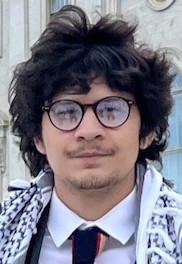
Sebastian Carbajal is the PSW youth representative of the NY/SC, born and raised in East L.A. and an active member of the Little Tokyo community.