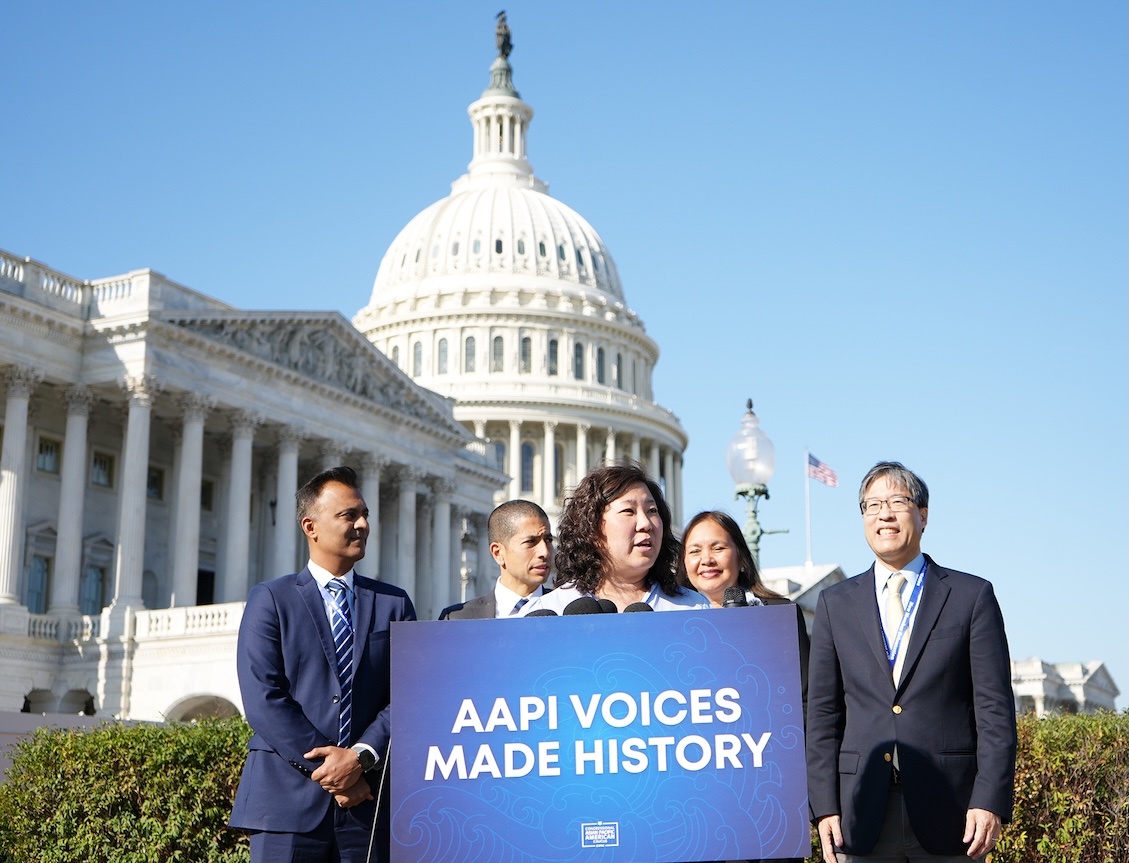
A significant shift toward Democratic candidates emerged in the 2026 midterm elections as Asian American, Native Hawaiian and Pacific Islander voters made their influence felt while advancing historic gains in political representation and expressing chief concerns regarding economic affordability, health care, civil rights and immigration reform in the U.S.
Related article here.
The results reflect a growing and increasingly engaged electorate that political organizations say can no longer be taken for granted by either the Democratic or Republican parties.
According to election figures released during a Nov. 4 AAPI Midterm Election Voter Poll hosted by AAPI Vote conducted by the 2026 Civic Health and Elections Project by NORC at the University of Chicago, 70 percent of Asian Americans voted for a Democrat for the U.S. House of Representatives, and 69 percent voted for a Democrat for Senate. In battleground states, 63 percent of Asians voted for a Democrat.
In addition, according to Karthick Ramakrisnan, executive director/founder of AAPI Data, “Those who voted for a Republican candidate in the last midterm election voted for a Democratic candidate today. But if you look across other voters of color, the crossover voting is much higher. So, what this tells you is that our community is indeed more persuadable. And it’s not just our community. Black communities and Latino communities as well. . . . The Democratic Party did much better than the Republican Party in winning the hearts and minds.”
Economic concerns and civil rights drive AAPI voter priorities
In a separate 2026 Midterm Election Voter Poll conducted by Asian Americans Advancing Justice and Asian and Pacific Islander American Vote (APIA Vote), in which more than 10,000 AAPI voters nationwide were surveyed, key findings identified affordability and civil rights protections as leading concerns.
Among AAPI voters, 53 percent ranked the cost of living and inflation among their top three issues for Congress and the president to address. Jobs and the economy followed at 37 percent, while 33 percent identified health care costs. Voters were also particularly supportive of policies protecting voting access and immigrant communities.
“While the cost of living remains a central concern, Asian American voters showed up this midterm election with clear priorities to protect the freedom to vote of every voter, reform our immigration system, demand accountability for ICE actions and addressing a rise in hate and discrimination against minority communities,” said John C. Yang, president and executive director of AAJC on Nov. 5. “Voters are rejecting abuses of power, demanding government accountability and calling for policies that protect their families, their rights and their communities.”
Said Christine Chen, executive director of AAPI Vote, “Asian American and Pacific Islander voters continue to shape elections and are growing stronger by the year. One in four became first-time voters in recent years. Many are young people and new citizens — the first in their families to vote in this country.
“While AAPIs are not a monolith of identity, we are voting because we are unified on our policy priorities: affordability, cost of living and civil rights under threat,” Chen continued. “Our message to elected leaders is clear: Don’t just court our votes; work with us and bring our community to the decision-making table.”
Historic gains in Congress
Election results saw Democrats take from Republicans control of both chambers of Congress. On the Senate side, Democratic candidates won 55 seats and take the majority. On the House side, Democrats took a commanding 256-seat majority to Republicans’ 169.
Democrats also took six governorships from Republicans: Alaska, Georgia, Iowa, Nevada, Ohio and Texas. Among governors, Democrats won 29 states.
In a statement released by JACL National, the Nov. 3 election “marks meaningful progress toward a government that reflects the full diversity of our nation.
“Representation matters,” the statement continued. “It broadens the experiences and perspectives that inform public policy and helps communities see themselves in the decisions that shape their lives. JACL looks forward to working with newly elected and returning leaders to protect civil rights, strengthen civic participation and advance the priorities of Japanese American, Asian American, Native Hawaiian and Pacific Islander communities.”
In a statement by the Congressional Asian Pacific American Caucus, “at least 22 AAPI members were poised to join the caucus in 2027,” its largest membership to date. In addition, at least 18 AAPI members are returning to Congress.
According to CAPAC, five newly elected AAPI members will join the House of Representatives in the 120th Congress: Alicia Garrido Limtiaco of Guam, Dan Koh of Massachusetts, Dr. Richard Pan of California, Dr. Amish Shah of Arizona and Pia Dandiya of Florida. Their victories mark historic firsts.
Limtiaco will become the first CHamoru woman to represent Guam in Congress; Koh will become the first Asian American and Arab American to represent Massachusetts in Congress; Pan will be the first Chinese American elected to represent California’s 6th Congressional District; Shah and Dandiya will become the first South Asian Americans to represent Arizona and Florida, respectively, in Congress.
Ted Lieu seeks historic position
U.S. Rep Ted Lieu (D-Calif.) won re-election to represent California’s 36th Congressional District and is seeking to make history as the first Asian American to chair the House Democratic Caucus.
Lieu currently serves as vice chair of the House Democratic Caucus. He announced his candidacy to run for chair in a Nov. 5 letter to Democrats following the party’s victories in the midterm elections.
The caucus will select its chair on Nov. 18. If elected, Lieu will become one of the highest-ranking Asian Americans in Congress.
The 120th Congress will convene in January 2027.
At the state level in California, Democrat Scott Sakakihara will take office Dec. 7 as a state senator representing District 10. He currently represents District 4 on the Union City City Council. A Harvard Law School graduate, Sakakihara in 2009 was a Mike M. Masaoka fellow who served in the Washington, D.C. office of Rep. Mazie Hirono (D–Hawaii). He earned a B.A. in political science from UC San Diego.
Midterms Result in Historic Firsts
Governors:
• The first Black female governor: Keisha Lance Bottoms, (Ga.)
• The first Native American female governor: Deb Haaland, (N.M.)
• The first Black Republican elected as governor in the U.S. and Florida’s first Black governor: Byron Donalds
• Wisconsin’s first Black governor: David Crowley
• Nevada’s first Black governor: Aaron Ford
• U.S. all-time record of five Black governors elected
• Texas’ first Latina governor: Gina Hinojosa
• California’s first elected Latino governor: Xavier Becerra
• Ohio’s first woman elected governor: Amy Acton
• Tennessee’s first female governor: Marsha Blackburn
• Minnesota’s first female governor: Amy Klobuchar
Congress:
• First openly gay man elected to the U.S. Senate: Chris Pappas (N.H.)
• First Muslim elected to the U.S. Senate: Abdul El-Sayed (Mich.)
• First Native American woman senator: Peggy Flanagan, (Minn.)
• First woman in South Carolina to be elected in the Senate: Annie Andrews
• Illinois is the first state to be represented by two female senators of color: Juliana Stratton and Tammy Duckworth
• First Gen Z woman elected: Melat Kiros, (Colo.) (Also Colorado’s first Black woman in Congress)
• First Asian American to represent Massachusetts in Congress: Dan Koh
State/Local:
• First Hmong American elected to statewide office in the United States: Yee Leng Xiong, Wisconsin Treasurer
• First openly nonbinary lawmaker and first Japanese American elected to the Georgia Assembly: Bentley Hudgins
• Los Angeles Mayor-elect Nithya Raman, City Attorney-elect Marissa Roy and re-elected City Controller Kenneth Mejia will now serve in all three of the city’s top elected positions.
— JACL Policy Team