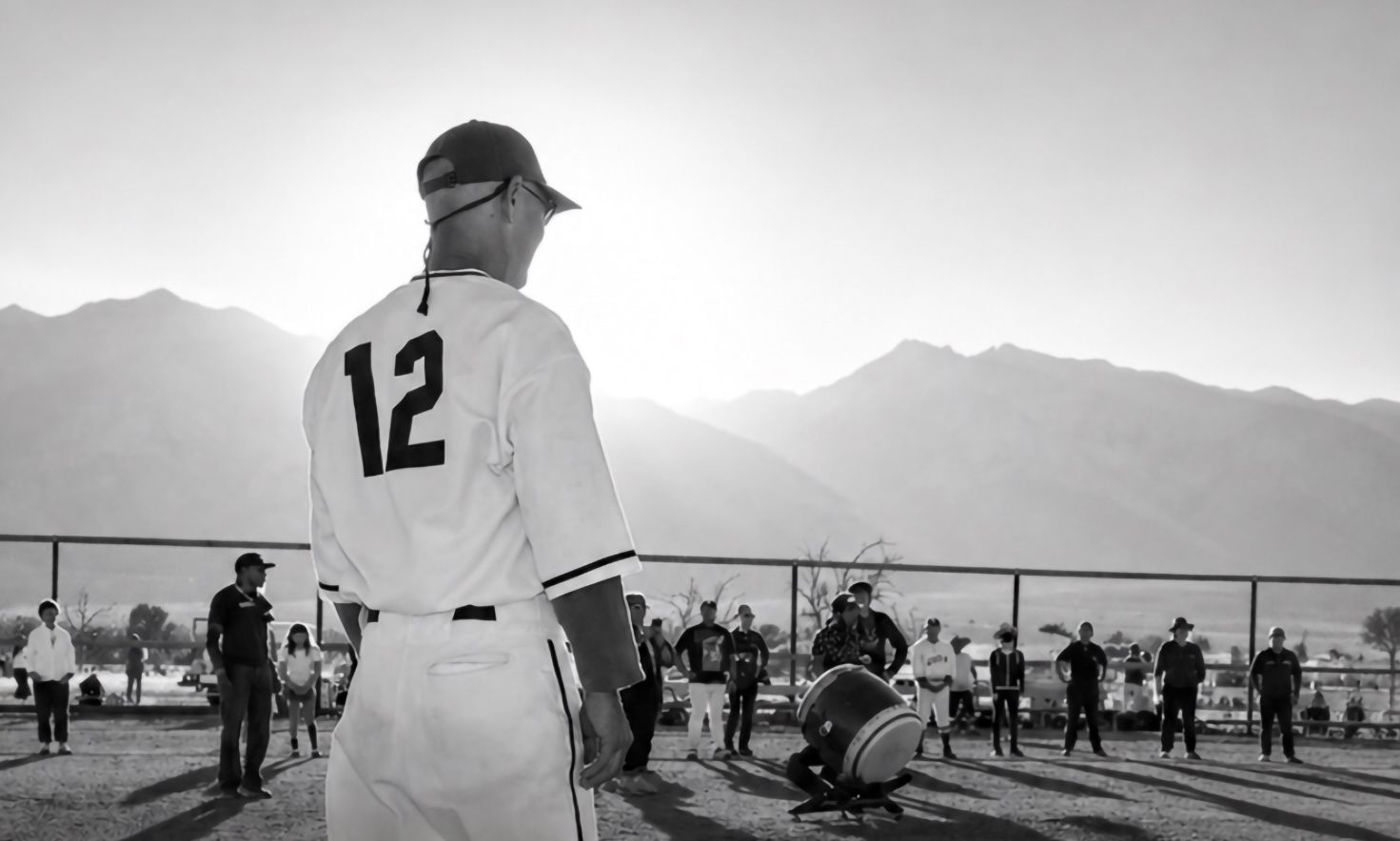
After 81 years, there was an official “Grand Opening Doubleheader” on Oct. 17 to celebrate the restoration of the baseball field at the Manzanar National Historic Site where, in 1942, more than 11,000 Japanese American citizens, along with others of Japanese ancestry, were unfairly and unlawfully incarcerated during World War II. The grand opening was originally scheduled last year, but because of the “2025 government shutdown,” it had to be canceled and a new date in 2026 selected.
This year’s successful event — which in addition to the two baseball games also featured a full day of performances and community spirit — was sponsored by the nonprofit Los Angeles-based multicultural performing arts organization Great Leap and the MNHS “Manzanar Baseball Project.”
It was well-attended by several hundred enthusiastic baseball fans, many of whom were family and friends of the Japanese American baseball players from both Northern and Southern California amateur baseball leagues.
Participating in the morning’s game were the Florin Athletic Club and the Li’l Tokio Giants, two of California’s oldest Japanese American baseball teams; the afternoon contest featured the North vs. South All-Stars.
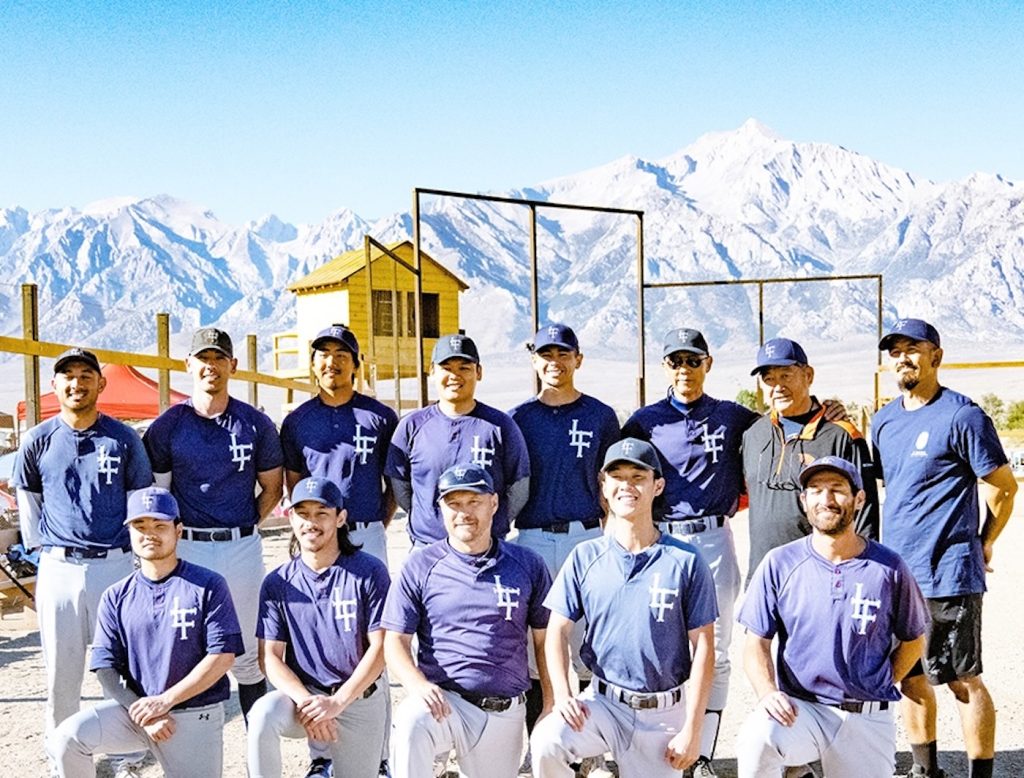
Representing the North All-Stars were players from the San Francisco Hawks, Monterey Maguro, Lodi JACL Templars and Florin Athletic Club, joined by members of SoCal’s LT-2 Ballbusters.
The South All-Stars included players from the Gardena Knights, Gardena Rebels, L.A. Pirates, Little Tokyo Beavers and the aforementioned Li’l Tokio Giants, which has been in existence since 1954.
Many of the players have historical ties to Manzanar through grandparents, aunts, uncles and other family members. Increasingly there are fewer living family members that were incarcerated during the war, which only adds to the importance of remembering and re-creating the history of the racism and fears that placed them there.
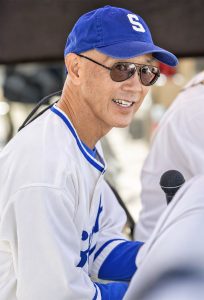
That baseball has finally returned to Manzanar is thanks largely due to the efforts by 71-year-old veteran performance artist Dan Kwong. He is also well-regarded as a master storyteller. His efforts over the past three years to reconstruct the baseball park was part of what he refers to as his “larger art project.”
Kwong spent three years traveling back and forth from his home at the 18th Street Arts Center in Santa Monica, where he is an artist-in-residence, to work on the baseball field. The 18th Street Arts Center’s stated mission is to “provoke dialogue through contemporary artmaking.”
Often working alone, Kwong endured extreme weather conditions to complete the work on the field. It is no secret that the temperatures in the Owens Valley where Manzanar is located can be blazingly hot in the summer, often more than 100 degrees. In the winter, it can also be bitterly cold. And almost at any time, very high winds sweep the area creating sandstorms. Kwong said that “high winds knocked the ball field’s wooden fences down twice.”
The success of the project is due to the support and cooperation of volunteers, both local and from outside of the area. It also had the cooperation of the MNHS NPS staff.
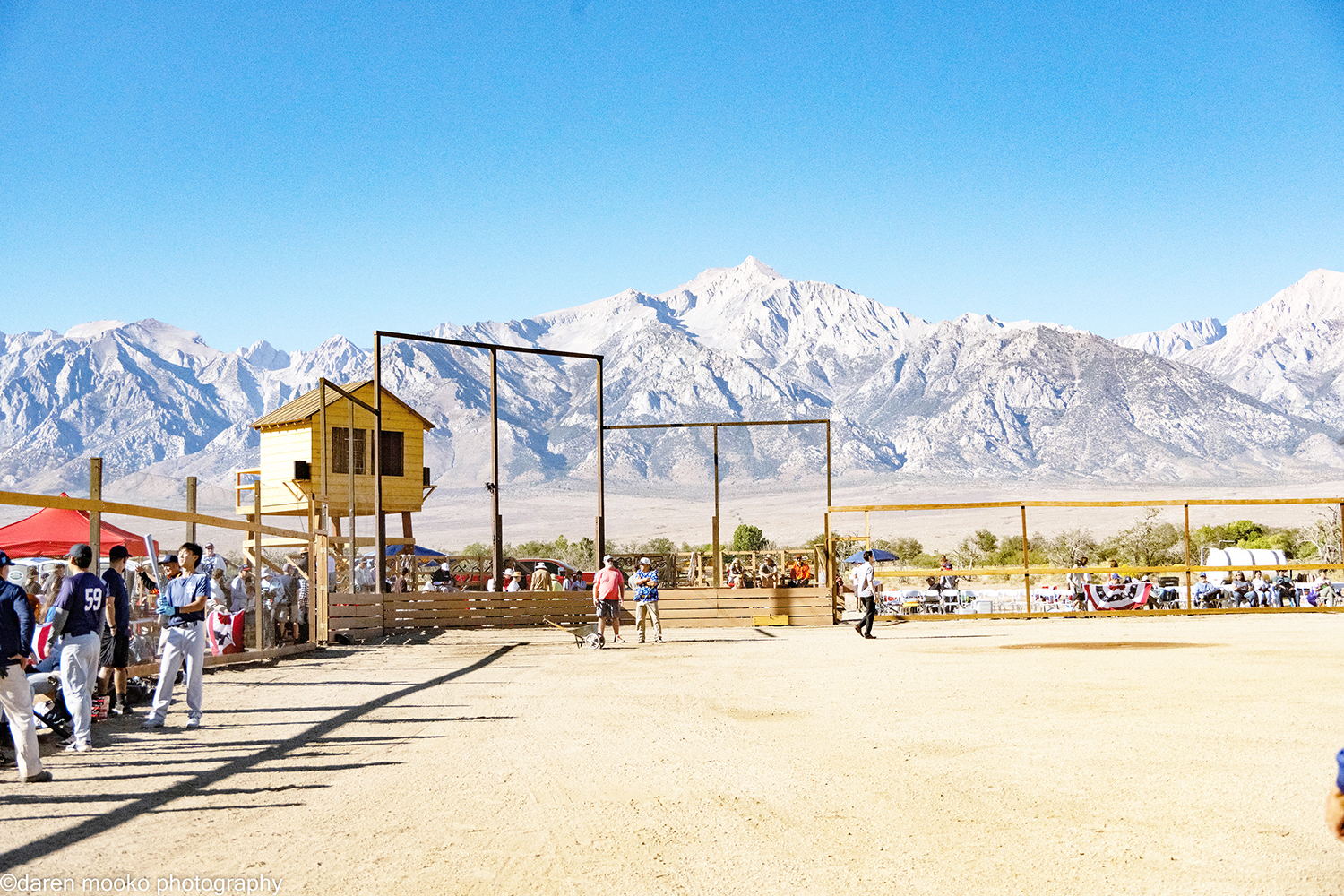
One critical local volunteer, Chris Siddens, from the nearby community of Independence, Calif., served as the construction supervisor for the project, greatly reducing its overall cost. According to Kwong, Siddens’ involvement was “huge.”
For authenticity, the baseball field was reconstructed from black-and-white photographs of the original field taken by renowned black-and-white American landscape photographer Ansel Adams, who visited the camp in 1943.
Kwong’s involvement began in 2023, partly in tribute to his mother, Momo Nagano, who, as a teenager, was incarcerated at Manzanar with her mother and two brothers. Although born 10 years after Manzanar’s closing, Kwong says, “My mother was a great storyteller, and she told me many stories about the camp and its people. We visited Manzanar many times during my childhood. I grew up knowing a lot about Manzanar. It’s what has inspired me to do this project.”
On the day of the “Grand Opening Doubleheader,” one could not have asked for better baseball weather. It was a clear sunny day with temperatures in the mid-70s — a perfect day for baseball.
Five members of Makoto Taiko performed before the start of the games during the “official opening” ceremonies held between the first and second games between the Florin Athletic Club vs. Li’l Tokio Giants in the morning and the North vs. South All-Star teams in the afternoon.
Kwong than offered a welcome on behalf of Great Leap as its co-artistic director. He then thanked Makoto Taiko and introduced the day’s first two teams: the Florin Athletic Club vs. Li’l Tokio Giants. These are two of the oldest Japanese American teams in the state. Dan Kwong has played with the Giants for the past 54 years. The final score was Li’l Tokio Giants over the Florin Athletic Club by a score of 12-2.
The official ceremonies began with an Indigenous blessing from Glenn Nelson of the Bishop Paiute Tribe. The Paiute tribes have lived in the Owens Valley for at least 1,500 years, well before the establishment of the Manzanar camp.
Following the blessing, in a thinly veiled reference to MAGA politics, Kwong spoke about how racism in the 1940s is being mirrored today based on the “premise of domination and supremacy” that stirs up racial hatred and exclusion. He spoke to the positivity and reliance of the people living behind the barbed-wire fences at Manzanar during the war “who not only found ways to survive; they found ways to thrive.”
Anne Piper, the state director for U.S. Sen. Adam Schiff (D-Calif.), then read a brief statement from the senator, highlighting the resilience of Japanese Americans and the significance that baseball had for those incarcerated at Manzanar. Schiff praised Kwong’s use of baseball to highlight their resilience and resistance to the injustices they suffered.
Keynote speaker Ann Burroughs, the chief executive of the Japanese American National Museum in Los Angeles, congratulated Kwong and all of the volunteers. She also thanked NPS Superintendent of Manzanar and the staff for their involvement. Burroughs noted that “the past has become not just the prelude to our present but has become our present … because we gather at a time when the lessons of Manzanar have never been more urgent. The racism, xenophobia, and cruelty that made what happened here possible are once again unfolding before our eyes.”
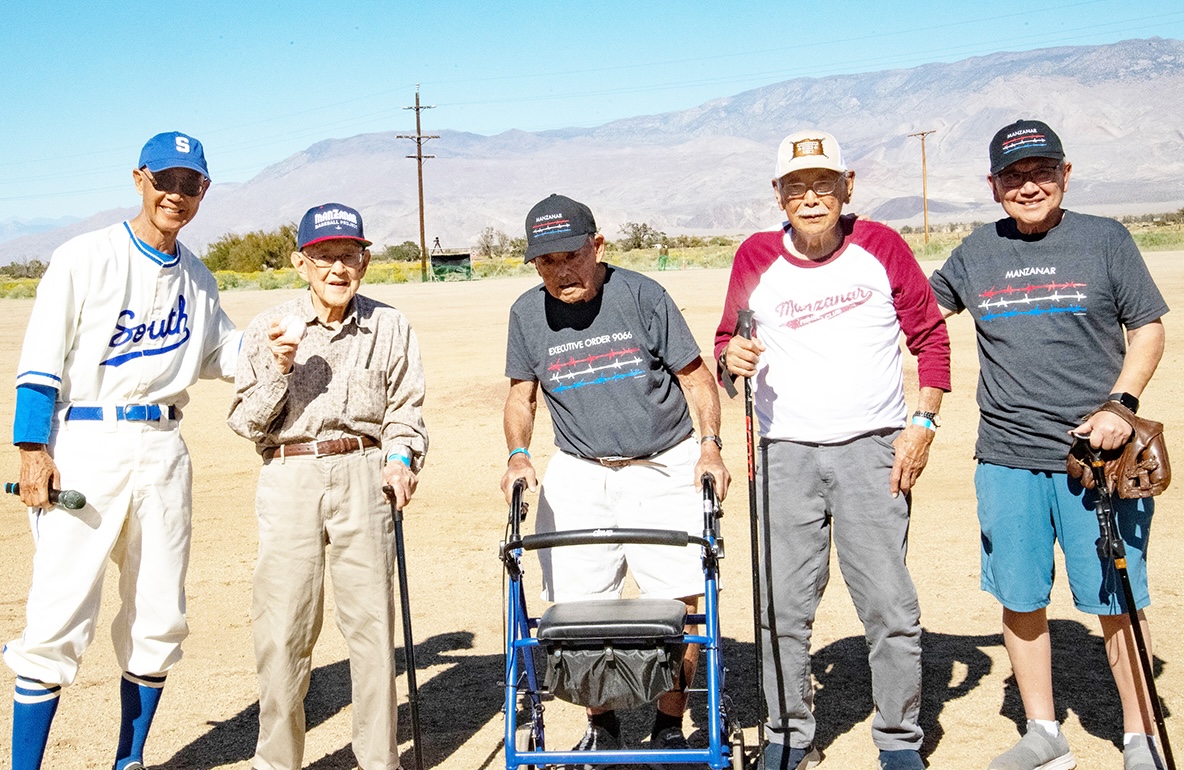
Following the conclusion of Burroughs’ remarks, Siddens, the volunteer construction supervisor for the project, and retired NPS Ranger Alisa Lynch threw out the first ball for the second North vs. South Game, followed by four Manzanar survivors: Special Guest of Honor Jim Marita, who was a 1943 Manzanar star player, and camp survivors Bob Matsumoto, Hiroshi Teshiba, and Mas Okui, all of whom were met with loud applause from the spectators.
After the All-Star teams were introduced, a performance of “Ghost Among Us,” created by Dan Kwong with Chie Saito, took place on the infield. A cast of characters — performers Emily Kaori Gruhn, Grace Jenkins, Kwong, Nobuko Miyamoto, Ryan Torii, Sho Yamada, Pauline Yasuda and Kuni Yoshida — were dressed in 1940s clothing and carried with them suitcases symbolizing the forced removal of Japanese Americans into incarceration centers during WWII.
Miyamoto also sings “Gaman” with lyrics asking the audience, “Why did you put me here?” and “Will we be here all our lives?”
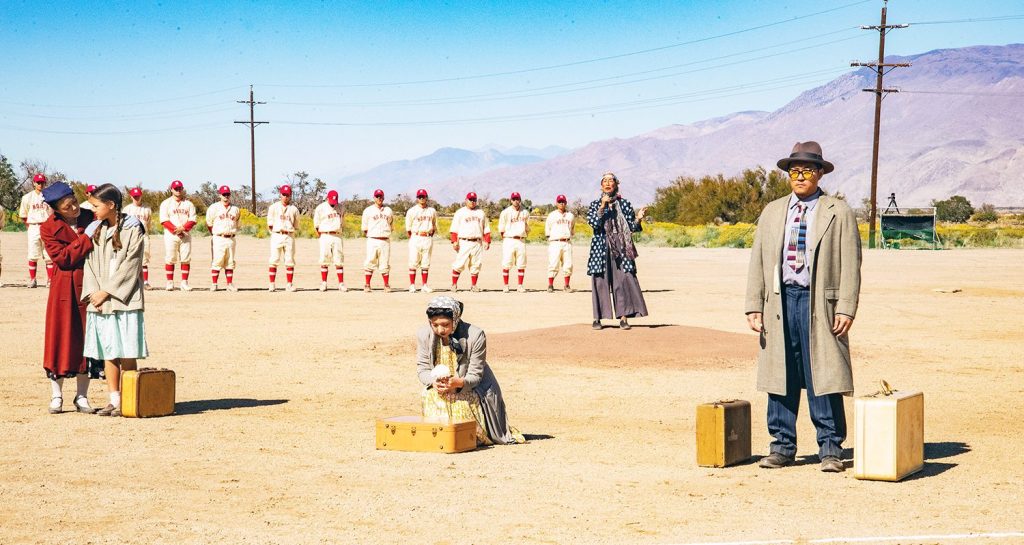
The performance expresses the strong emotions and uncertainty of Japanese Americans having to worry when or if they will ever be free again. That some Japanese Americans risked losing their lives fighting for the country was symbolized by a young woman carrying a folded American flag. A mother is with her young daughter who is wearing an identification tag on her coat, while a man is seen wearing a vintage baseball glove. The performance ends after a sign painted in Japanese calligraphy is displayed on a large white sheet symbolizing the “ghosts” of former incarcerees, followed by the National Anthem sung by Emily Kaori Gruhn.
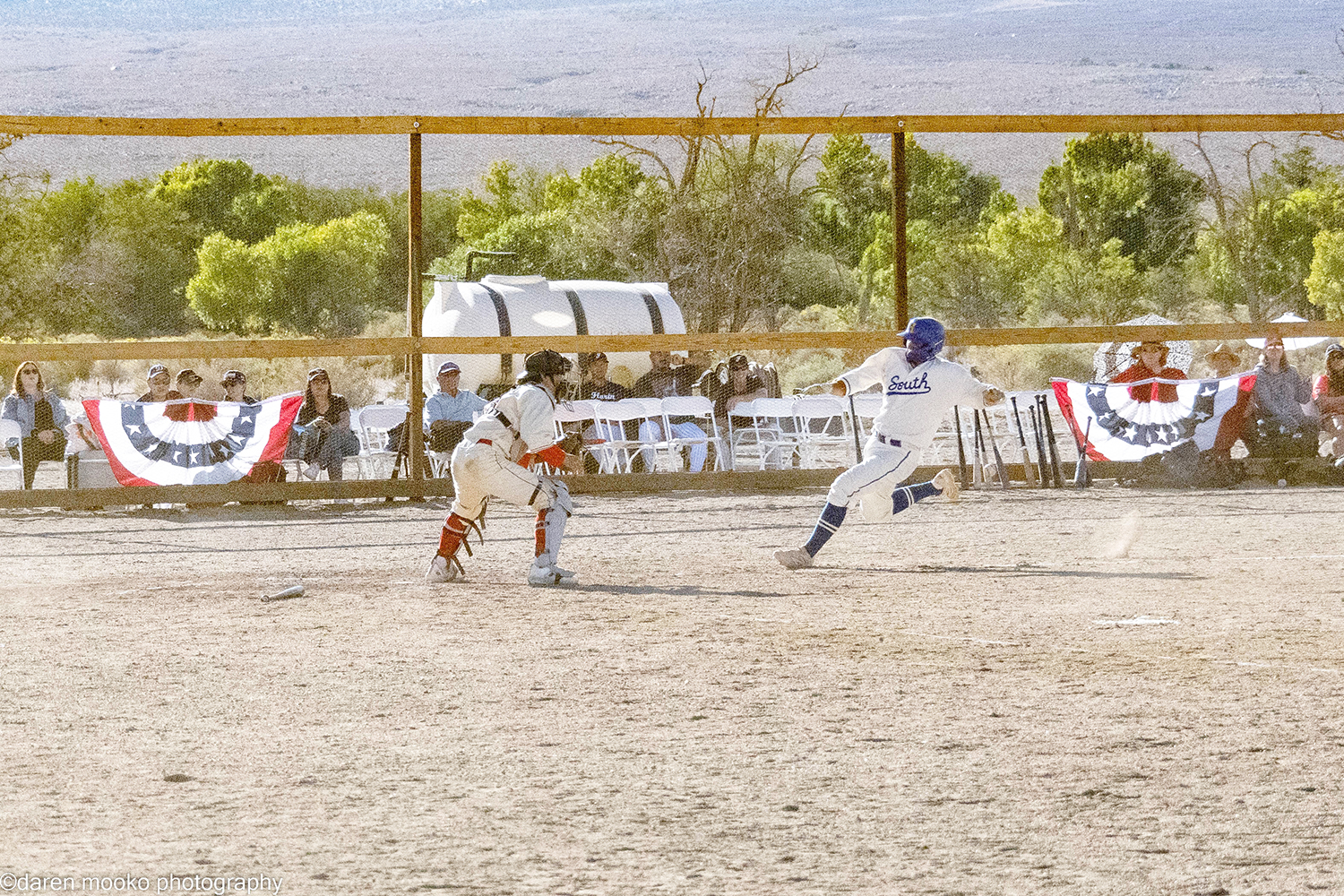
The North vs. South game ended with a score of 15-8 in favor of the South All-Stars. An interesting side note is that the uniforms designed from the WWII era cost $13,000 to have made. Kwong said that he hopes they get a lot of use from them in the future!
To close out the day, everyone was invited to join in an Obon Dance created and sung by Miyamoto titled “120,000 Stories.”
(If you would like to experience The Manzanar Baseball Project’s Grand Opening Doubleheader,” it is readily available for viewing on YouTube).