The Li’l Tokio Giants and the Lodi JACL Templars are facing off for the umpteenth time.
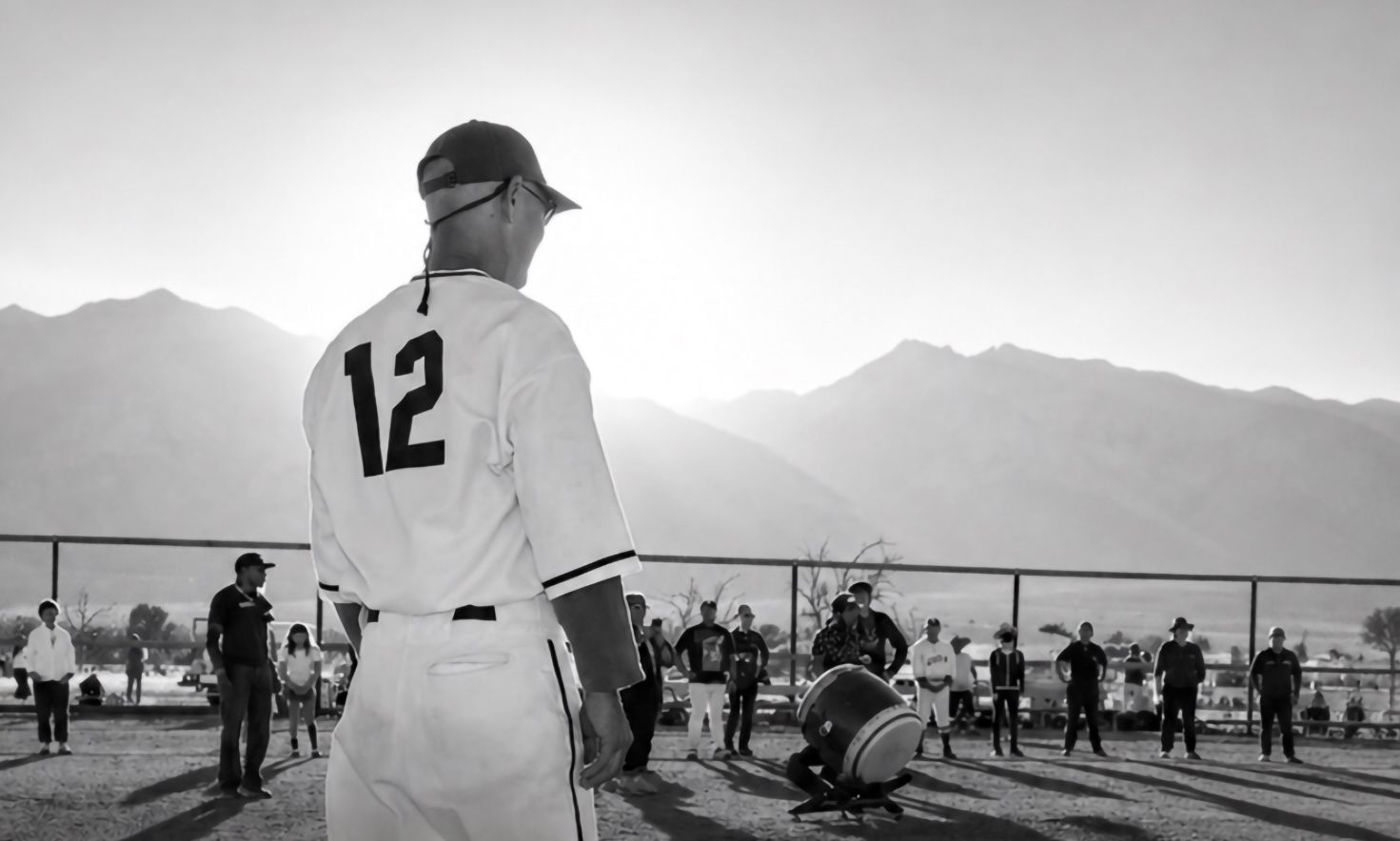
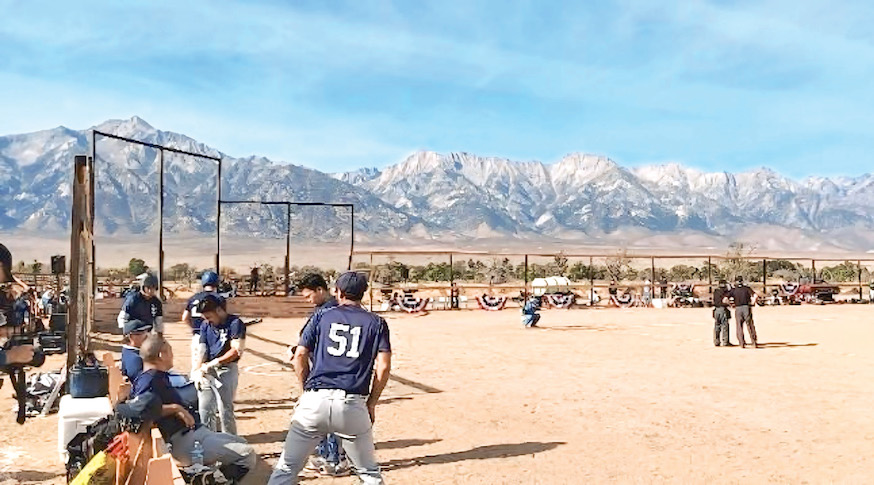
Having played against each other for so many times over the decades, these two Japanese American baseball teams are more than used to the ritual of the game. But Oct. 26, 2024, was no ordinary day at the Manzanar National Historic Site. For the first time since 1945, baseball was back at Manzanar.
The day marked the inaugural and unofficial opening of the Manzanar Baseball Project, an exhibition doubleheader with the Giants vs. Templars morning game, followed by the North vs. South California All-Stars.
Everyone in attendance was well aware of the immediate historical significance of actually playing in the first baseball game in more than 80 years at a place that incarcerated more than 10,000 Japanese Americans during World War II. From the batter’s position at home plate, a guard tower that still stands in the distance could be seen, a physical remnant of Manzanar’s past, which included a violent uprising in 1942 that led to camp guards shooting and killing two inmates.
The dichotomous nature of Manzanar’s painful history and this joyous event was clearly not lost on any of the players, especially Dan Kwong, who has been the spearhead of the Manzanar Baseball Project for the last year and a half.
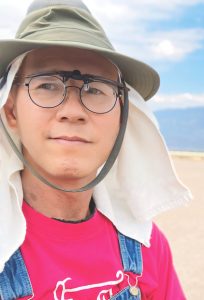
(Photo: Courtesy of Dan Kwong)
A native Los Angeleno who is half-Japanese American and half-Chinese American, Kwong is first and foremost an award-winning and critically acclaimed performance artist whose one-man shows have been presented nationally and internationally. He has also been a player on the Giants team for 52 years and counting, a first baseman. While standing at first base, Kwong could hardly believe that this momentous day was finally happening.
With the Sierra Nevada mountains a majestic backdrop, Kwong and the rest of the players became forever tied to one of America’s darkest times while creating a new story, one full of hope, healing and transformation. And as with most underdog stories that turn out to be epic and triumphant, the Manzanar Baseball Project’s humble beginning lay in tumbleweeds.
According to Kwong, an archeological study was done by Manzanar archeologist and Cultural Resources Program Manager Jeff Burton in 2002. “The study determined that there would be no adverse effects from restoring the field, and that greenlit the project for Manzanar,” Kwong noted. “The restoration was announced in May 2023, and the first call for volunteers was Memorial Day weekend to start clearing the field of tumbleweeds.”
The tumbleweeds problem proved to be monumental due to the heavy rain in the ensuing months between Memorial Day and Labor Day. Another call for volunteers on Veterans Day yielded 27 people doing the difficult job of clearing and digging out all of the tumbleweeds — the Russian thistle kind to be exact — which were covered with millions of tiny needle-sharp stickers.
To Kwong’s surprise, the misery of the removal of the tumbleweeds was offset by the volunteers’ positive attitude. “There were some baseball players from Li’l Tokio Giants, as well as a few from Lodi who made the long trek to volunteer. People were so happy to be there; it was so meaningful to them. Some players even brought their families. It was amazing,” he recalled.
For Kwong, the idea of the doubleheader came to him as he was on his hands and knees waging the seemingly one-sided battle against the tumbleweeds. Now, he had two projects to juggle — the restoration of the baseball field and putting the details and logistics together for the doubleheader.
Through a dear family friend who lives in Independence (a mere eight-minute drive from Manzanar), Kwong was introduced to Chris Siddens of Siddens Consulting. Siddens showed up at Manzanar on one of the tumbleweed-clearing days and told Kwong he could be of help. Siddens’ experience spans more than 35 years in the construction industry, and for the restoration of the baseball field, Siddens was a godsend.
Siddens’ initial involvement of just lending his welding skills expanded to overseeing and performing most of the arduous labor on the field. When Siddens surveyed the Manzanar field, he immediately noticed one of the challenges was working on a site that was not going to be graded to an even elevation. Another frustrating challenge was that some of the lumber that was purchased at Home Depot was defective. The brutal summer heat and unpredictable winds posed yet more challenges.
Still, Kwong and Siddens were undeterred. They were joined by Dave Goto, MNHS’ longtime arborist. Goto drove the dump truck, bulldozer and did most of the heavy lifting, while Siddens and Kwong focused on the project’s massive to-do list. Kwong is quick to credit Siddens with “building the whole damn thing.”
Under Siddens’ lead, the once tumbleweed-strewn plot of land slowly transformed into a visible semblance of a fully functional baseball field.
For Siddens, the Manzanar Baseball Project carried a deep significance. “I read about Manzanar in high school. As I learned more about WWII, I learned more about Manzanar through documentaries, and what I learned in high school was nowhere close to what actually took place here and at other internment camps,” Siddens said. “I had a neighbor in San Diego whose family was interned at Poston. She didn’t talk about it. I only learned this as I was watching a documentary on Manzanar, and I saw her sitting in the third row of the audience. I asked her if she was interned there, and she told me no, that they were moved to Poston. She became a good friend and neighbor before she was killed in an auto accident. I felt that I was giving back to her and all the other Japanese Americans that were wrongly forced out of their homes and businesses.”
In addition to Siddens and Goto, more than a handful of consultants, architects, engineers, construction companies and steel suppliers across the country came forward to contribute their expertise, time and equipment. Generous in-kind help was provided by History for Hire Prop House, Nous Engineering, Gwynne Pugh Urban Designs, graphic designer Mike Boula, Morey Insurance, Independence Fire Department (which provided stand-by ambulance and EMT), Owens Valley Unified School District and Alisa and Alan Lynch.
A crucial piece of the restoration puzzle was made complete by studying photographer Toyo Miyatake’s archival photos of Manzanar and its original baseball field from the mid-1940s.
Upon the completion of construction, the last remaining task was to get the baseball field ready for the doubleheader. This painstaking process would not have been possible without the labor that was put in by Gino McKiernan and his colleague, Alvin Yano. Both men work at the MLB Youth Academy in Compton, Calif., which provides baseball programs for kids. McKiernan and Yano did not represent the Youth Academy in their donation of time and skills but just as individuals who were more than happy to see the Manzanar Baseball Project come to fruition.
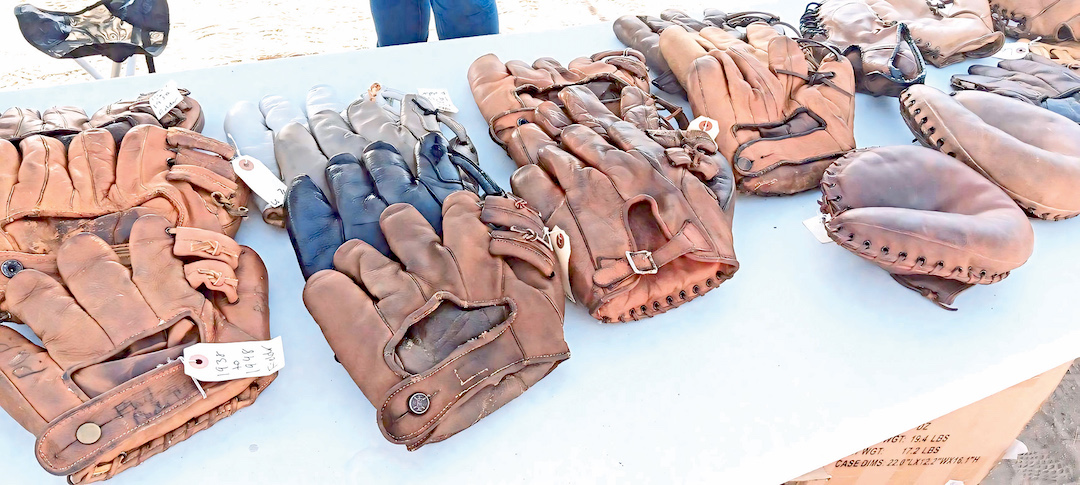
Various vintage baseball gloves (Photo: Alex Luu)
McKiernan knew Gail Materials, the company that supplies infield dirt for the Major Leagues. Through McKiernan’s connection, 50 bags of infield dirt were donated.
Kwong was also amazed by Yano’s focus on the most-minute details that came with evening and smoothening out the field. “We had this infield drag mat, one of those steel mats, and Alvin was out there with a little minitractor dragging that entire field,” Kwong remembered. “Usually, you only use the steel mat on the infield area, but Alvin was working on the entire 3-acre field just going in circles. We’d be working on other things, and he would be out there dragging that steel mat for hours at least three, four days.”
It truly took a village.
The cloudless October sky on game day remained the same as the games were played. In the fourth inning, 20-year-old Kainoa Tsuye, one of the youngest players for the Giants, hit the game’s first RBI. Feeling the adrenaline rush of the RBI, Tsuye grinned as he crossed home plate. “It feels amazing to be out here playing and to run on that dirt,” Tsuye said. “This is such a significant moment for me. My great-grandfather was interned here in Manzanar, and I have a few great-uncles who were at other camps. It’s surreal to see how far this game has traveled and to be doing similar as the camp baseball players did so long ago. I will remember this for the rest of my life.”
For Sho Yamada, who also spent hours volunteering on the field clearing tumbleweeds as well as being a player on the Giants team for the last 20 years, the focus of the day was just to play good baseball. “This is my way of honoring the interned players as a whole and for any spirits in attendance to give them a good show,” Yamada stated. “Play in a way they would be proud of and with all the media here, a chance to showcase what Japanese American players can do.” Even though Yamada has family members that were incarcerated in Arkansas, he admits that until recently, their experience had not weighed heavily on his mind. “However, with all the scapegoating of immigrants happening today and after the results of the last presidential election, I’ve experienced a new fear and awareness of the injustice of the internment camps.”
Manager of both the North All-Stars and the Monterey Amberjacks team, Mike Furutani is in awe of standing on “hallowed ground.” “Eighty-plus years ago, guys who lost everything played on the same field we’re standing on — they played to forget about their situation for a while and gave the community an opportunity to forget as well. When I was on the mound and looked around the diamond, I saw the guard tower in the distance, and that hit me pretty hard — they were prisoners for just being Japanese. They had committed no crime,” Furutani reflected. “The other thought I had, after I processed the anger and frustration of the racism of the past, was how lucky we were that those who came before us persevered through the hardships and gave us, 80 years later, the opportunity to honor them and remind the next generation — some of who were on the field and at Manzanar for the first time — to never let this kind of injustice happen again.”
For Marty Sakada, manager of the Lodi JACL Templars, the oldest team in California, being at this inaugural doubleheader had multiple meanings. “You couldn’t help but get emotional during the introductions while lined up on the freshly chalked foul lines. It was like 10,000 camp internees were watching our every move,” he recalled.
Sakada’s family farmed in the Sacramento Delta pre-WWII but were interned at Tule Lake. “My father was 16 years old at the time and drove the camp’s ambulance. My mother was also interned at Tule Lake, along with my grandmother and aunties,” Sakada said. “My oldest aunt was a nurse at Tule Lake but passed away in camp with appendicitis complications. I was told that she was not able to receive the proper antibiotics that were reserved for the camp military personnel only. I am fortunate that both of my parents persevered after being in camp. They raised my sister and myself and provided us with so many wonderful opportunities that they were not given in their lifetime.”
In the first game of the doubleheader, the Giants beat the Lodi Templars handily. However, the final score is not what matters. More important is what transpired on that field — the rebuilding of community and a reverent homage to honor ancestors at a middle-of-nowhere locale whose landscape features searing summer heat, biting winter frost, treacherous winds and tumbleweeds.
As Kwong walked off the field, he took it all in — the Sierra Nevada mountains, the cheers and hollers from the crowd, his teammates jumping up and down and high-fiving one another.
“That was amazing! At a certain point, you’re just playing baseball, right? You’re just playing baseball …” Kwong said as tears welled up in his eyes. “It’s almost surreal when you’ve anticipated something for so long. To see how the other players reacted and how meaningful it was for them, the looks on their faces, to feel their excitement. I got you here! I made this field for you!”
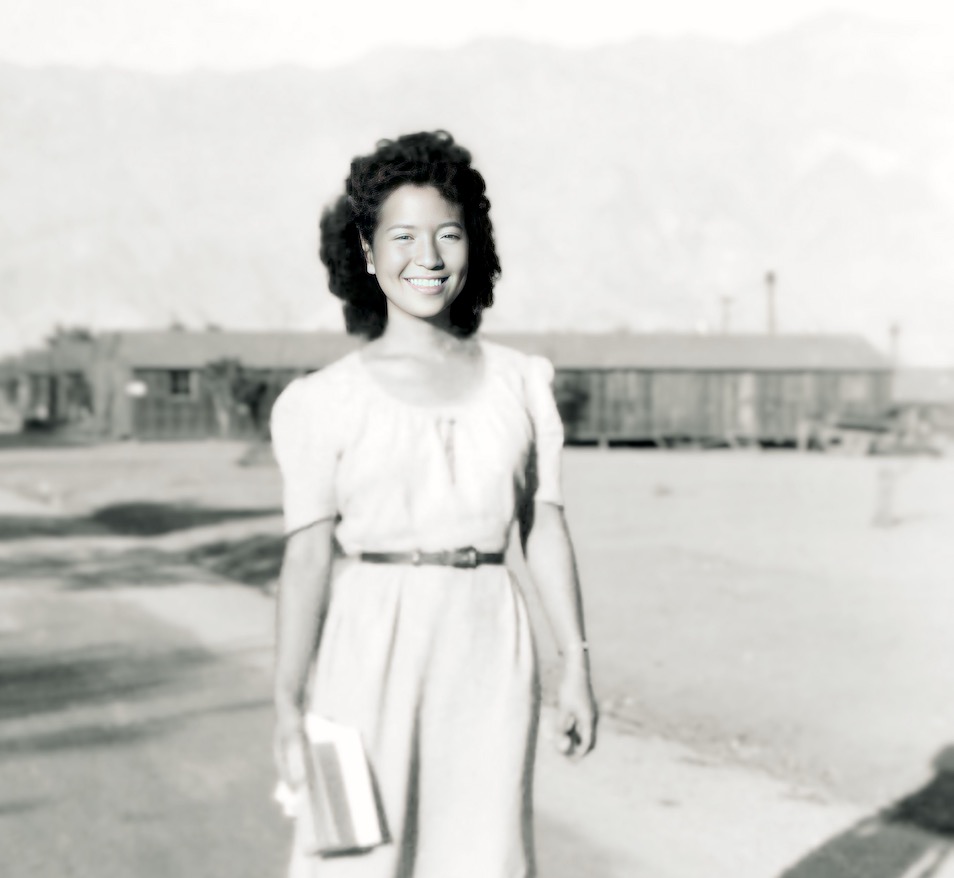
Momo Nagano was Incarcerated at the Manzanar War Relocation Authority Center (Photo: Kwong Family Collection)
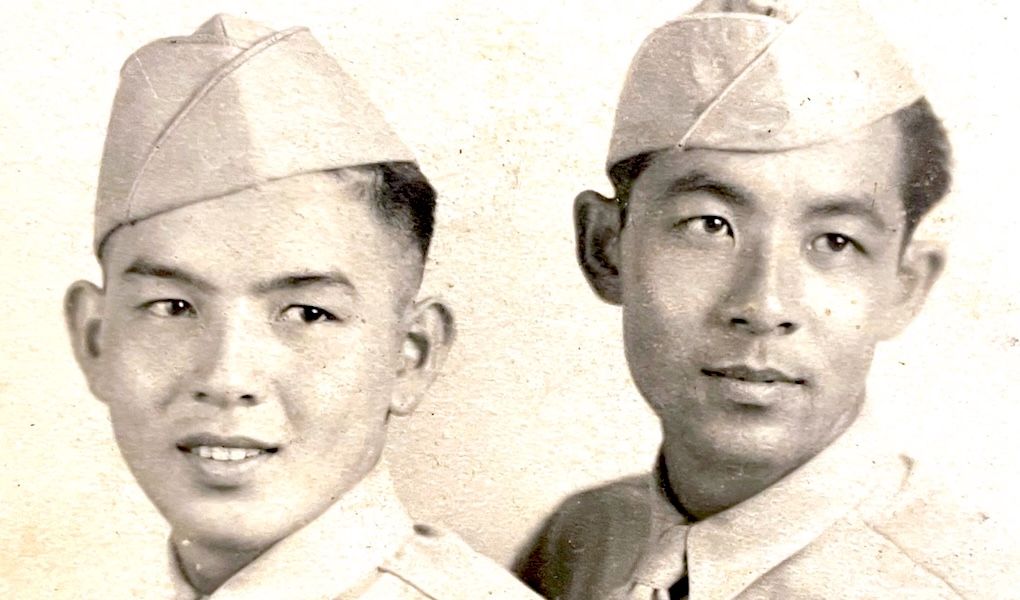
Kwong also has a deep personal connection to Manzanar. His mother, Momo Nagano, and her extended family were incarcerated here. On the same day that Pearl Harbor was bombed, her father, Kiro, was picked up by the FBI. Nagano entered Manzanar when she was 16 and left two years later when the war ended. While in camp, she even played softball with the Gremlins girls club and, according to Kwong, “Had her nose broken when playing catcher when the batter threw the bat.”
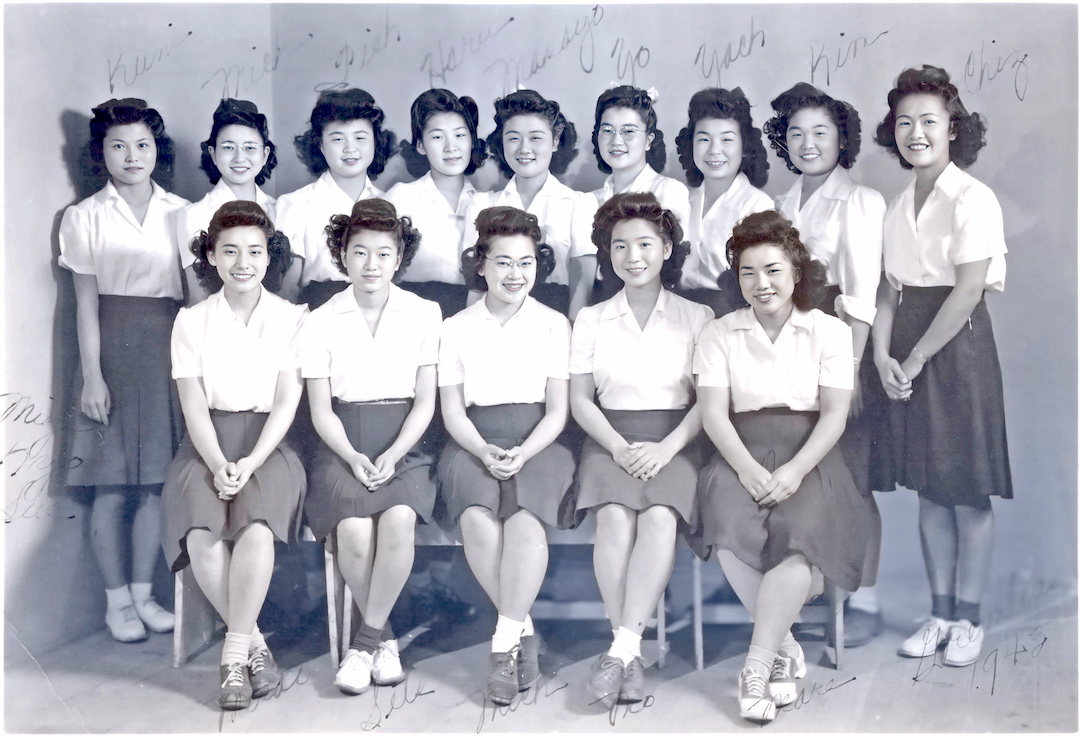
A team photo of Manzanar’s Gremlins softball team Photo: Kwong Family Collection)
It is fitting that Kwong has dedicated the Manzanar Baseball Project to his mother, who died in 2010. “To me, the baseball field is acknowledgement of the spirit of the JA community and that even under harsh and heartbreaking conditions, Japanese American people were determined to hold on to their sense of community and dignity as fully as possible,” Kwong said. “Stuck out in the middle of the desert, rejected by their own country, having lost everything, they were going to make art, create beautiful gardens, play music, dance — and play baseball. They were going to live.”
The Oct. 26, 2024, doubleheader will certainly not be the last baseball game to be played at Manzanar. Kwong envisions regular games to be played once the Manzanar Baseball Project has its official opening sometime in fall 2025.
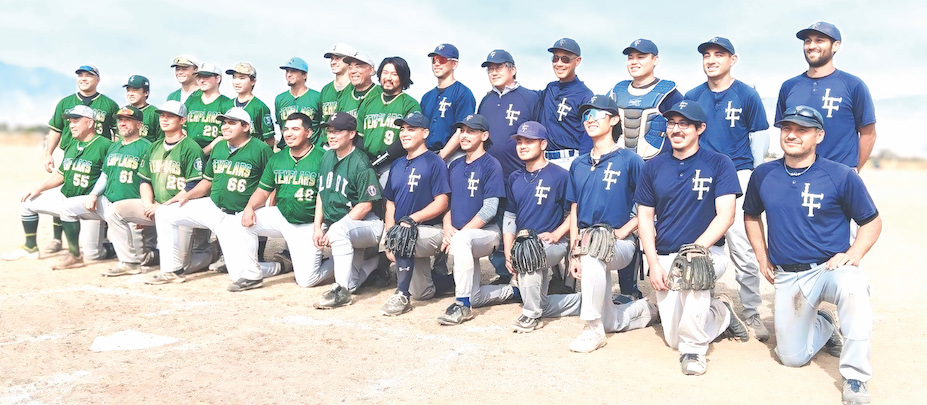
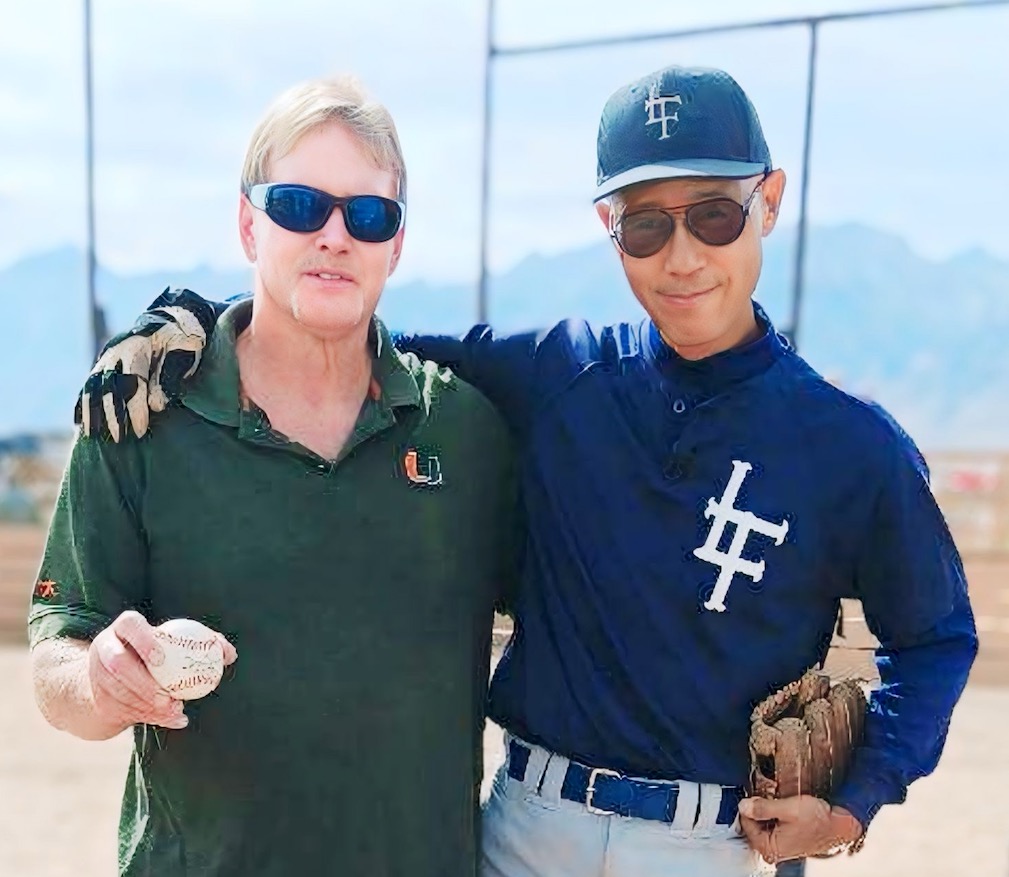
Members of the Lodi JACL Templars team (in green) and the Li’l Tokio Giants team (Photo: Alex Luu)
“I hope the baseball field draws wider attention to this piece of American history — the legal atrocity that was committed against Japanese Americans on the West Coast during WWII and how that resonates with our current political climate, in which there is talk about putting other people into ‘camps’ and how wrong and inhumane an idea that is,” Kwong stressed. “If we receive a grant, we will be doing educational work with high school students about this piece of history. Hopefully, the doubleheader becomes an annual tradition.”
If we are to believe Giants player Yamada, the “spirits in attendance” will no doubt greet Kwong upon his return to Manzanar. That and a fresh new batch of tumbleweeds.