
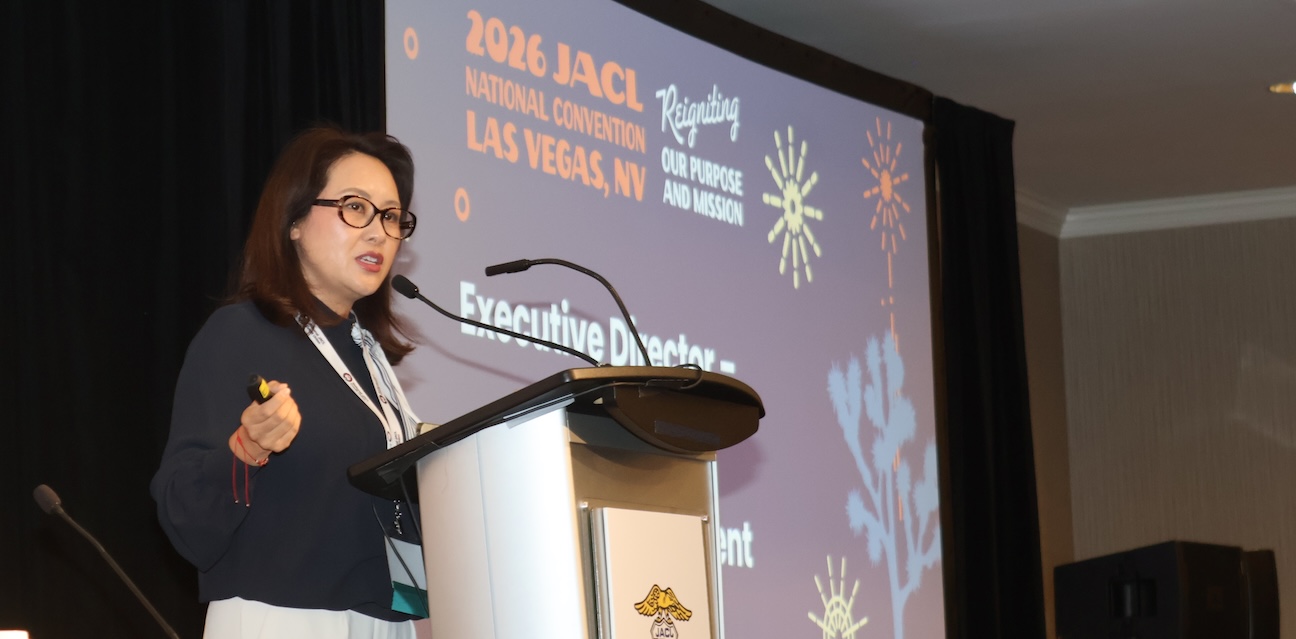
JACL Executive Director Lilly Simmering (Photos: George Toshio Johnston)
JACL’s ED lays out a lofty game plan during
a breakfast meeting at the National Convention.
By George Toshio Johnston, P.C. Senior Editor
Although it was promoted as “Breakfast With JACL’s Lilly Simmering,” the JACL’s new executive director had to go hungry until after her 7 a.m. address on July 31 was completed.
Unlike those in the audience, for Simmering, breakfast had to temporarily stay on the back burner until she first addressed from her perspective all the problems, challenges and issues facing the Japanese American Citizens League that she had been studying over her 66 days on the job.
(See related story here.)
Simmering began by establishing her bona fides prior to taking on JACL’s ED role, noting that she had “spent most of my career in government,” which included working in Washington, D.C., at the U.S. Department of Agriculture, where she learned among other things about negotiating contracts, which was followed by a move to Washington state, where she worked first for Boeing Capital Corp., then for King County and next, for about nine years, the County of Orange (deputy county executive officer) after relocating to Southern California.
Simmering segued into her assessment of the challenges facing JACL, first noting, “I have always been that person that fixes things,” followed by her observation that the “programming side of the house rarely understands the administrative side of the house,” perhaps an allusion to the constant clash between trying to put a return on investment on spending for programs that don’t necessarily translate to easily quantifiable results. “Trying to bridge that gap has always been my specialty,” she said.
Before addressing what was in her slide deck (see tinyurl.com/zkrkrehf), Simmering foreshadowed the latter part of the morning’s presentation by announcing what Katie Masano Hill (JACL Norman Y. Mineta fellow) and Matthew Marumoto (JACL Daniel K. Inouye fellow) would be focusing on over the next several months.
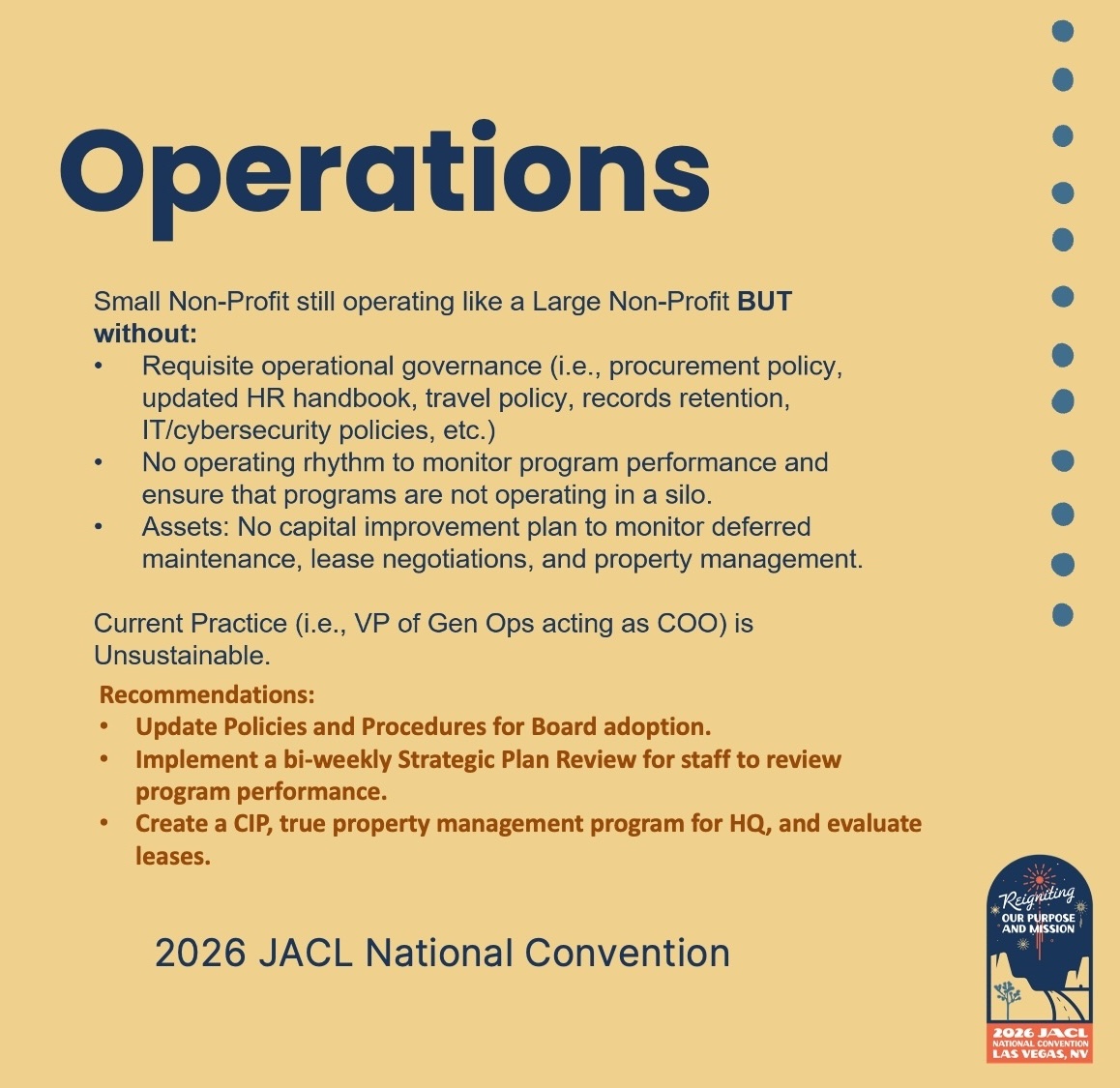
Click image to view the entire slide deck.
Although Simmering prefaced her statement by saying that it was no surprise or secret “that the two fellowship programs will be sunsetting in December,” it may have been the first public acknowledgement to JACLers that the Inouye and Mineta fellowships would be paused.
Accompanied by a PowerPoint slide deck, Simmering addressed her first slide and observed, “We are a small nonprofit that is still behaving like they are a large nonprofit from back in our ’80s. And what does that mean? That means that we are spending money on exorbitant services that we no longer need. Right? We are making decisions like we have an endless pot of money.”
She noted that going forward, for example, travel spending would need to be “essential.” She also cited JACL’s lack of a capital improvement plan, in reference to its San Francisco headquarters building. Also related to her first slide, she said, “I need to update the policies and procedures. That’s going to be the role of the vp of gen ops. I need to implement a biweekly strategic plan review. That is my responsibility, and that is the responsibility of the vp of planning and development because those programs are what we’re going to go out and fundraise for.”
In the next slide, which addressed JACL staff, Simmering acknowledged low staff morale, lack of staff training or investment in staff development (“There’s been no investment in my staff for development.”), key positions that are vacant (“Back in the old days, you guys had a Washington rep. … I don’t have that now.”), exempt vs. nonexempt employee classification issues and a “fundamental misunderstanding of the relationship between staff, National Board and members that causes tension between staff and National Board.” The slide also expressed the need to redefine staff and board roles and responsibilities.
Simmering’s recommendations were to implement a formal staff development program for training, hire staff to fill vacant key positions and reinforce the idea that the “board represents the members. As staff, we’re the bottom of the totem pole.”
Simmering’s other slides addressed JACL programs, including membership, education, policy, Pacific Citizen, scholarships and Kakehashi. Other priorities included having staff undergo sexual harassment and cybersecurity training, as well as a change in philosophy regarding customer service, saying: “We’re changing our values. We’re going to change our customer hospitality approach.”
Regarding the future JACL staff hire whose area is managing membership, which was officially vacated Aug. 12, Simmering said that person will be supervised by the director of business development when that hire is made. She also stated a goal of increasing JACL membership by 5 percent-7 percent year-over-year growth.
“You have chapters that are declining in membership so severely. Where’s National? I should be there with you right now, asking, ‘Well, what do you need?’” Relatedly and rhetorically, Simmering also asked, “Do you guys know what the No. 1 question I get when I go out and talk to people about JACL is? My No. 1 question is: ‘How is JACL still relevant?’”
Answering her own question, she said, “There are so many people that become so curious about Asian American culture, Japanese culture, Japanese American culture. Why are we not capitalizing on these opportunities?” and “My recommendations are: You guys created an education curriculum. We need to dust that sucker off, update it.”
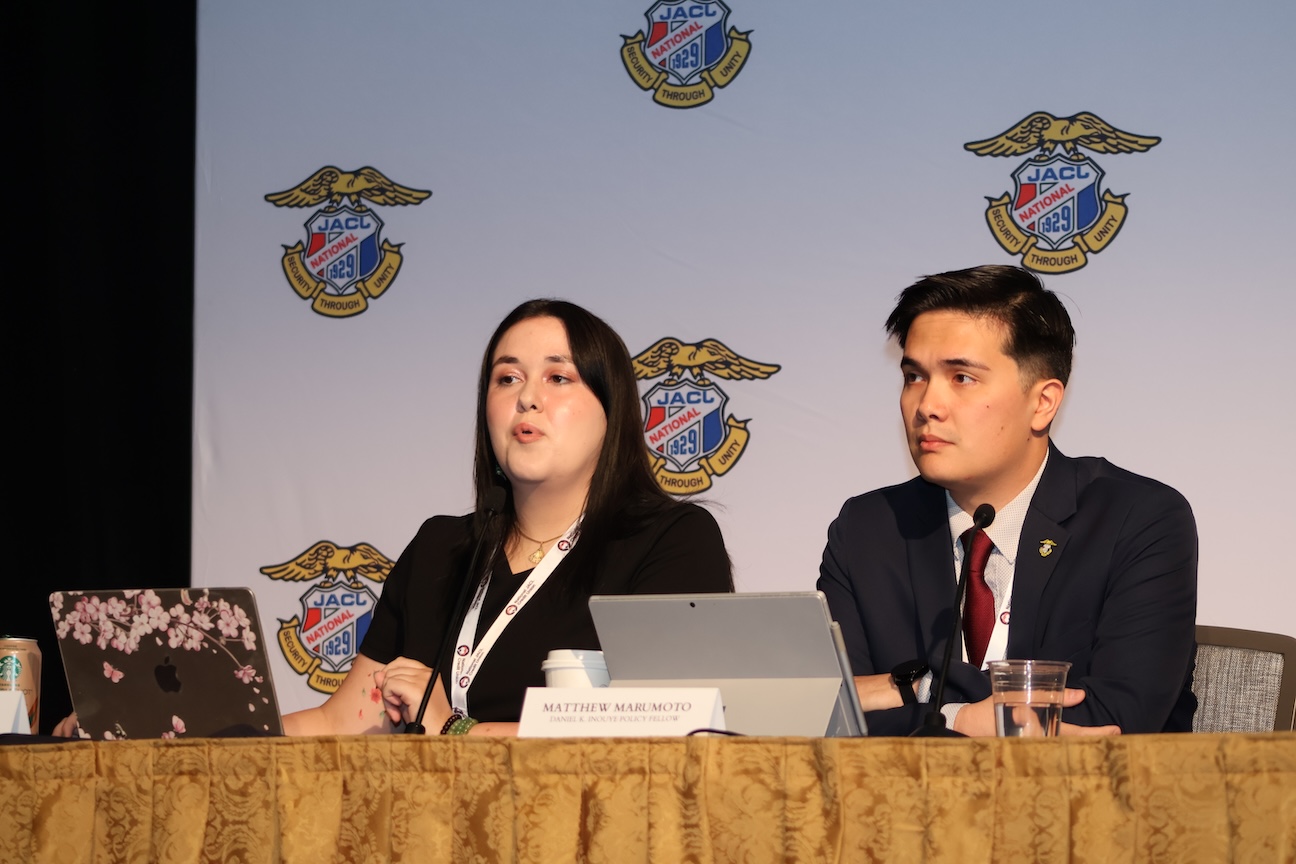
JACL Norman Y. Mineta Fellow Katie Masano-Hill and JACL Daniel K. Inouye Fellow Matthew Marumoto
Before passing the baton to the policy team — Hill and Marumoto — Simmering asked, with regard to overcoming the challenges JACL is facing, “Why can’t we do it again? . . . We shouldn’t be able to sit here and struggle and say we don’t know how to do this. We absolutely know how to do this.”
Simmering then explained the portfolios each fellow focused on, noting that the area of civil rights was “everybody, whatever it takes.” She said Hill’s portfolio focus was historic preservation, public history and community development, and Marumoto’s portfolio focus was immigration and refugee affairs, as well as voting rights.
Hill began by reading the portfolio the duo shared: civil rights preservation and advancement. “The children’s issues include civil rights enforcement, constitutional rights and civil liberties protections,” she said. “Equal protection and equal opportunity, protecting the right to free speech, protecting birthright citizenship, which I am very proud to say that we are protected now.”
(Editor’s note: To read the entire list of items in Hill and Marumoto’s respective portfolios, visit: tinyurl.com/42aw8hd2.)