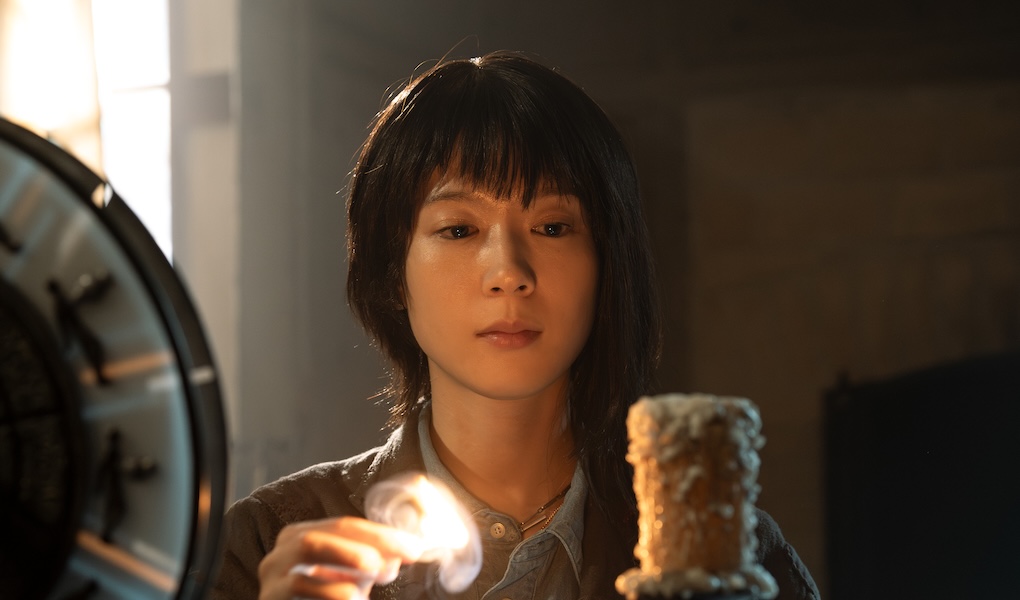
Moeka Hoshi stars in “Never After Dark,” now playing in U.S. theaters. (Photos: Courtesy of Magnolia Pictures)
By Gil Asakawa, P.C. Contributor
For American filmmaker Dave Boyle, the journey from streaming hits like Netflix’s “House of Ninjas” to the atmospheric world of Japanese horror has been a labor of love. Love of Japan. His latest feature, “Never After Dark” — released domestically in the U.S. on Sept. 25 — dives headfirst into the eerie traditions of J-horror while bringing a fresh, gothic sensibility to the screen.
“Never After Dark” is about a Japanese medium-for-hire who travels wherever a client has problems with supernatural presences. Her ability to travel into the in-between dimension to help any spirit that’s stuck in order to help them move into the afterlife is facilitated by setting up artifacts like a spinning wheel and a candle that lets her stay in the other dimension while it’s lit.
But when she is asked to come to a huge empty hotel that is haunted by a malevolent spirit, she faces a different kind of ghoul than she has ever dealt with before. The movie is a creepy, dark, atmospheric dive into the J-horror genre.
The film is now in select theaters nationwide — just in time for the spooky Halloween season. It was released in Japan in June by its Japanese studio, Toho.
A Lifelong Love for J-Horror
Boyle’s fascination with Japanese horror runs deep, rooted in the genre’s golden era of the late 1990s and early 2000s.
 “I graduated from high school right around the time all the great J-horror classics like ‘Ringu’ and ‘Ju-on’ came out,” Boyle, 44, reflected. “So, those loom so large in my memory. … This one is more on the gothic horror side of it, but we definitely were conscious of the legacy of J-horror and also, you know, story wise we tried to kind of tweak and play with the J-horror traditions.”
Unlike the relentless jump scares often favored by Hollywood horror offerings, “Never After Dark” leans heavily into tone, atmosphere and psychological unease. Boyle wanted to capture a very specific kind of scary.
“I think part of it is just a sense of awe and dread at the uncanny, the unknowable,” Boyle explained. “I sort of like to just offer clues and try to make the audience lean in and try to make the viewer invested in the characters and finding the answer to the riddle. That to me is more interesting than just purely making them scared.”
Finding the Ultimate Haunted House
The film’s palpable atmosphere is anchored by a stunning, eerie haunted hotel setting that feels straight out of a classic Western ghost story like “The Shining,” despite being nestled deep in the Japanese countryside. Finding the right location was no small feat in a country where film permissions can be notoriously difficult to secure.
“One of the things that I learned after a few years working in Japanese film and TV is there’s just one sort of structural barrier that filmmaking faces there: the availability of location,” Boyle noted. “Very few places are willing to inconvenience all of their customers by letting you film there. So, you end up seeing the same locations reused over and over.”
For “Never After Dark,” Boyle’s production team went above and beyond, unearthing a remarkable building in a small town called Kiyosato, right on the border of Yamanashi and Nagano prefectures. Built in the 1930s as a getaway for the imperial inner circle and aristocratic elite, the building is a yokan — a Western mansion-style hotel rather than a traditional Japanese ryokan, the better-known small traditional inns.
Although the production team had to creatively mask its surrounding neighbors and bed-and-breakfasts with a bit of “movie magic,” the location’s isolated charm and rich history set an immediate, chilling tone for the cast and crew.
Bridging Cultures and Languages
Boyle’s fluency and deep immersion in the Japanese film industry allowed him to work seamlessly with local crews and talent. While he is modest about his language skills — describing himself as “bilingual with a lowercase b” — he conducted writer’s rooms entirely in Japanese for “House of Ninjas” and directed “Never After Dark” with minimal reliance on translation.
Boyle was born and raised in Utah. He was then sent to Australia to live in a Japanese community on a Mormon mission, where he fell in love with the language and culture. Much of his movie career has told Japanese or Japanese American stories.
That cross-pollination extended directly into the cast, which features stellar performances by breakout star Moeka Hoshi (“Shogun”) and Kento Kaku (who starred in “House of Ninjas” and is Boyle’s producing partner).
“She’s fantastic,” said Boyle of Hoshi. “She’s superprepared but also superspontaneous and just a really, really lovely, conscientious [person] who really pays a lot of attention to the crew and how they’re feeling. … The whole group — it almost never happens, but on this movie, I got my first choice for every single role.”
Looking Ahead
With “Never After Dark” now finding its audience through word of mouth and specialized theatrical runs, Boyle is balancing a slate of upcoming projects on both sides of the Pacific.
He is currently developing a sci-fi thriller for producer Walter Hamada at Paramount and an American film for Screen Gems at Sony, alongside ongoing projects in Japan.
Ultimately, Boyle hopes to continue bridging the gap between Hollywood and Japanese cinema, creating more opportunities for creative teams to collaborate across borders. But for now, he invites audiences to step into the dark, lean into the mystery and experience a chilling new chapter in J-horror on the big screen.