
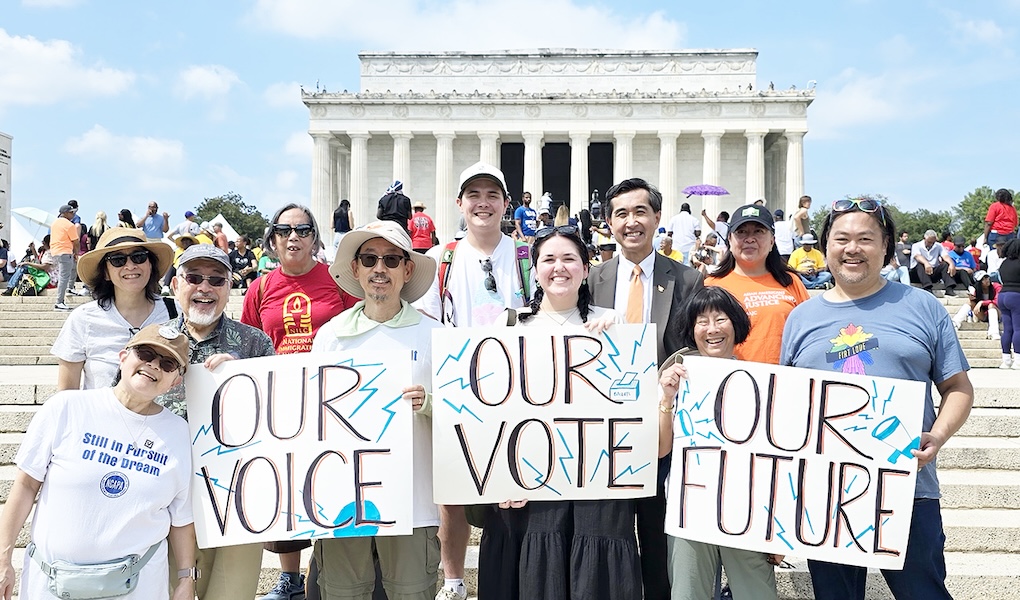
Members of various AAPI organizations hold signs in front of the Lincoln Memorial. Pictured (front row, from left) are Lou Igasaki, Paul Igasaki, Paul Uyehara, Katie Masano Hill, Martha Watanabe and Ben de Guzman and (back row, from left) Nancy Choy, Deeana Jang, Matt Marumoto, John Yang and Marita Etcubanez. Photod: Courtesy of Matt Marumoto)
JACL joins thousands at the Lincoln Memorial as part of
National Action Network’s March on Washington, themed ‘Defend the Vote.’
By Matthew Marumoto, JACL Daniel K. Inouye Fellow
On Aug. 28, I stood with fellow JACL members and friends from Asian Americans Advancing Justice and APIAVote in front of the Lincoln Memorial, carrying signs that read “Our Voice, Our Vote, Our Future.”
Sixty-three years ago, JACL members stood on the same ground carrying signs demanding civil rights, a higher minimum wage and first-class citizenship for all.
Thousands gathered on the National Mall for the 2026 March on Washington, and the crowd kept growing through the heat into the afternoon. At the original march in 1963, JACL was the only Asian American organization to formally join, standing in solidarity with the African American community to fight discrimination and segregation. In 2026, we came back to defend the right to vote and stand in solidarity.
The “March on Washington 2026: Defend the Vote” was convened by the National Action Network, led by Rev. Al Sharpton, and the Drum Major Institute, led by Martin Luther King III and Arndrea Waters King.
The morning program that preceded the march offered an opportunity to hear from speakers representing faith groups, advocacy organizations, trade unions and several members of Congress, including Congressman Mark Takano of California, Congresswoman Alexandria Ocasio-Cortez of New York and Sen. Bernie Sanders of Vermont.
A common theme among the speakers was that the march continued what originally started in 1963, carrying the work forward rather than just commemorating the occasion.
Nearly every speaker discussed the decision in Louisiana v. Callais that was handed down in late April. The decision severely weakened Section 2 of the Voting Rights Act of 1965 (VRA), making it much harder to challenge district maps that may discriminate on the basis of race.
Janai Nelson, president and director-counsel of the NAACP Legal Defense Fund, who argued the case for Black voters in Louisiana before the Supreme Court, told the crowd that the high court “adopted a vision that silences Black voices and suppresses Black votes.”
Breaking with the norm of redistricting only after the census, 10 states have drawn new voting maps through legislation or litigation in the lead-up to the 2026 midterm election.
Following the decision in Callais, both Louisiana and Alabama eliminated one of two majority-Black districts, while Tennessee eliminated its only majority-Black district.
The gutting of Section 2 of the VRA was one of the sharpest rollbacks of voting protections in decades and was one of the primary reasons people were called back to the Lincoln Memorial to march.
Takano, representing California’s 39th district, reminded the crowd that the late Congressman John Lewis stood on the steps of the Lincoln Memorial 63 years ago when he was 23 years old to demand that America live up to its promise. Just two years later in 1965, Lewis was badly beaten on the Edmund Pettus Bridge while making the same demand.
“He knew what awaited him on the other side of that bridge. Yet, he crossed it anyway because America was worth fighting for,” Takano said.
Two years after the original march, a member of JACL also went to Selma. Todd Endo, born less than a month after the attack on Pearl Harbor, spent his first three years of life in the Rohwer Incarceration Camp. In March of 1965, following the beating and death of Rev. James Reeb, with whom Endo had worked in Washington, Endo joined the civil rights demonstrations in Selma, Ala.
The next month, Endo wrote in the Pacific Citizen, “Both as Americans, who sought to work to bring the American ideal and the American reality closer together, and as Japanese, who have a stake in this minority struggle, we should be lining up actively alongside the Negro against the ‘keep America white’ bigots” (see April 16, 1965, Pacific Citizen, https://tinyurl.com/2xnx7uur).
Solidarity between the Japanese American and African American communities during the civil rights movement ran in both directions. Months after the brutality in Selma, and under the same Congress that passed the Voting Rights Act, the Immigration and Nationality Act of 1965 ended the national origin quota system that excluded Asian immigrants from coming to America for decades.
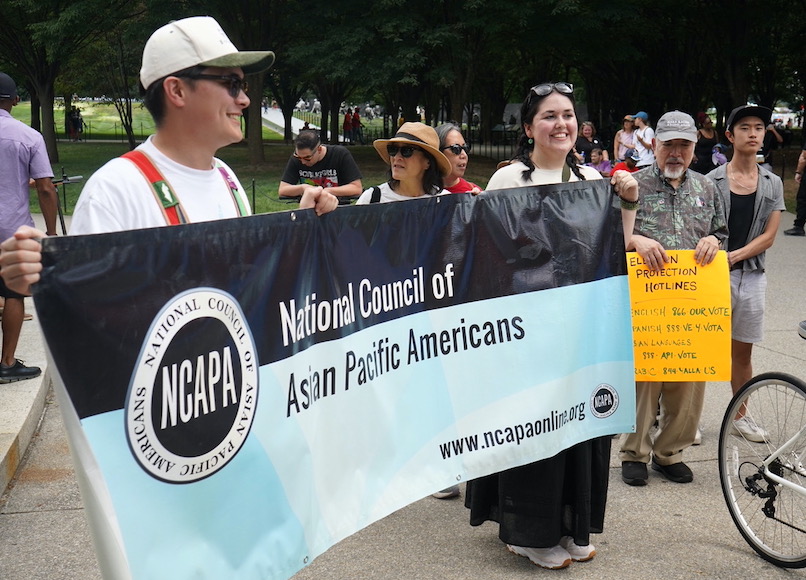
JACL DC fellows Matt Marumoto and Katie Masano Hill hold a banner for the National Council of Asian Pacific Americans.
In 1967, JACL submitted an amicus brief in support of Mildred and Richard Loving, a couple challenging Virginia’s ban on interracial marriage. JACL’s counsel, William Marutani, was given leave to argue before the Supreme Court in support of the Lovings.
The decision in Loving v. Virginia ended anti-miscegenation laws that had also prohibited Asian Americans from marrying white people. And in 1988, with significant support from the Congressional Black Caucus, the Japanese American community secured a formal apology for the wartime incarceration and redress under the Civil Liberties Act. These memories and a continued commitment to solidarity are what brought JACL back to march shoulder to shoulder 63 years later.
In 2026, we find ourselves in a consequential political moment. Threats to the right to participate in our democracy are being aimed right at our community and the communities with which we stand in solidarity.
Proof-of-citizenship requirements like those in the yet-to-be-passed SAVE Act create burdens that fall hardest on naturalized citizens. According to Pew Research data, 58 percent of eligible Asian American voters (https://tinyurl.com/3m8rz8y6) are naturalized citizens. Restrictions on mail-in voting threaten ballot access for millions of Americans. And voter intimidation, including the prospect of immigration enforcement being present at polling locations, further discourages people from engaging in elections.
The stakes for the upcoming midterm elections could not be higher. In 1965, Endo wrote, “So, the question is not, ‘What is there for us to do?’ Rather, the question is, ‘Do we care enough to rise from our complacency and comfort?’”
Today, the question is the same. Answering the question starts with checking your voter registration, confirming your polling place and district, making a plan for when and how you will vote in the upcoming election and ensuring your friends, family and community do the same.
To become more involved, sign up to be a poll worker or poll monitor in your community. JACL will continue to share resources to help get the AAPI community to the polls. Sixty-three years later, JACL still marches. This November, we vote.