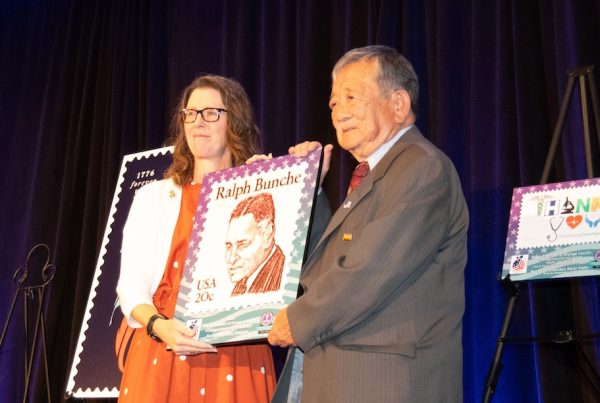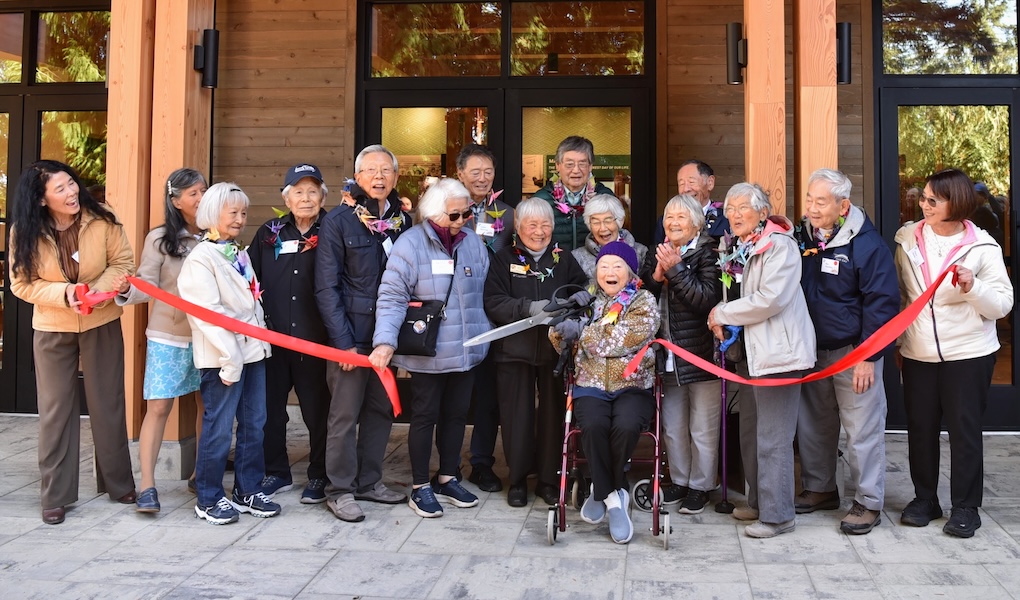
Twelve survivors of America’s concentration camps during World War II and their descendants cut the official ribbon signaling the grand opening of the Bainbridge Island Japanese American Exclusion Memorial Visitor Center on Oct. 11. (Photo: Nancy Treder/BIJAEMA)
Grand opening of Visitor Center culminates a 25-year-long vision.
By Sheldon Arakaki, JACL National President
On a crisp fall Oct. 11 morning on Washington’s Bainbridge Island, 12 survivors of America’s concentration camps cut the ribbon to the Bainbridge Island Japanese American Exclusion Memorial Visitor Center exactly one year after construction commenced on the $6.5-million, 1,545-square-foot space.
The new building’s grand opening welcomed more than 200 attendees, including Sen. Maria Cantwell (D-Wash.), Bainbridge Island Mayor Clarence Moriwaki, 23rd Legislative District Rep. Greg Nance and Bainbridge Island Memorial Executive Director Ellen Sato Faust.
The ceremony completes the final phase of the memorial project and stands as a permanent space for education and reflection to remember the 227 Japanese Americans who on March 30, 1942, were the nation’s first to be forcibly removed from their homes on the West Coast following the issuance of Executive Order 9066.
The Bainbridge Island Japanese American Exclusion Memorial Assn., the Bainbridge Island Japanese American Community, the Bainbridge Island History Museum, the Bainbridge Island School District and the National Park Service all contributed to the interpretive work for this permanent indoor space. The visitor center with its paved plaza and amphitheater will hold film screenings, educational activities, seminars, interpretative exhibits and historic artifacts to further the memorial’s purpose to share the story of the Bainbridge Island Japanese American community.
“It’s an honor to join you in commemorating the opening of the new Bainbridge Island Japanese American Memorial Visitor Center, a new addition to our National Historic Sites, which is part of our National Park Service, to tell a story Americans should never forget,” said Cantwell. “We’re here today to acknowledge the significance of the very ground that we stand on and the role it plays in American history. A difficult and shameful chapter, but that is exactly why this site is so important. It serves to acknowledge and memorialize the wrongs committed here in the name of national security and to help educate future generations. … It will stand as an enduring symbol of what should never happen again.”
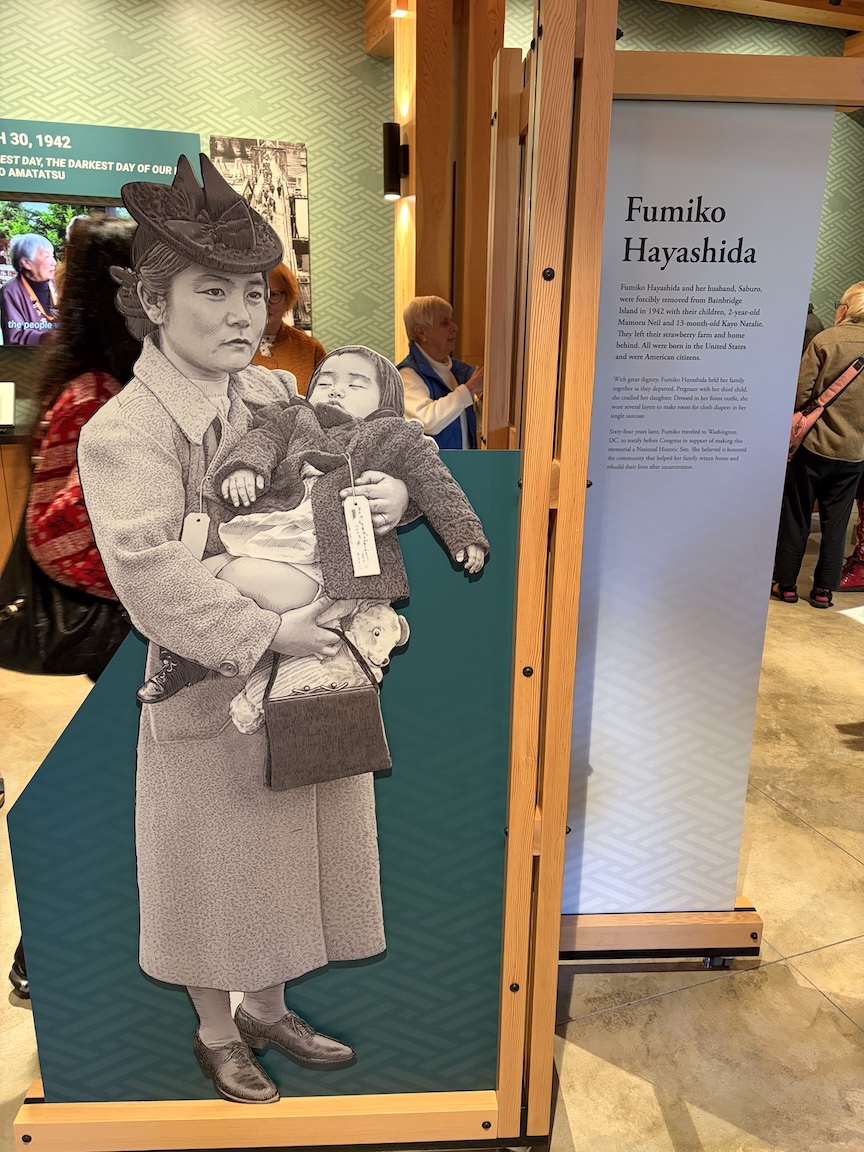
The visitor center exhibit depicts the life story of Fumiko Hayashida, who, along with her husband, Saburo, and their two children, were forcibly removed from Bainbridge Island in 1942 following the issuance of Executive Order 9066. (Photo: Liz Dunbar/Puyallup Valley JACL)
The visitor center’s exhibit floor space tells the story of Dr. Frank Kitamoto, the visionary; Fumiko Hayashida, who iconic image represents the more than 125,000 Japanese Americans incarcerated; and Bainbridge Review newspaper publishers Walt and Milly Woodard, who editorialized against the mass incarceration. The Woodards were also the Edison Uno Civil Rights Award recipients at the 1986 JACL National Convention held in Chicago.
In the postredress 1990s, Kitamoto told the story of Japanese American incarceration at schools, churches and conferences with a focus on the Bainbridge Islanders. His educational outreach eventually led to an interfaith group suggesting a memorial to tell the story with its important messages of strength, healing and forgiveness.
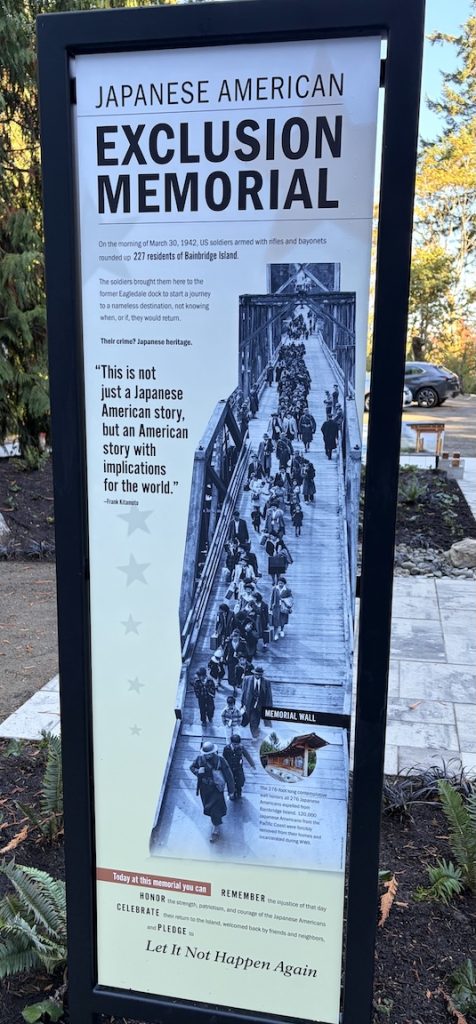
BIJAEMA signage (Photo: Liz Dunbar/Puyallup Valley JACL)
What started as an EPA Superfund Site then became a proposed public park with a parallel BIJAC and the North Kitsap/Bainbridge Interfaith Council memorial site plan for the western edge of the park in 2001.
Several months later on March 30, 2002, a plaque commemorating the 60th anniversary of the forced removal was placed near the departure site. A total of $8 million was then raised to acquire land for the memorial. And every year as more funds were raised, elements of the vision were turned into reality — a pavilion, a memorial wall, the rebuilt departure ferry dock and more up to the visitor center’s October dedication.
One important milestone in the history of the memorial site was the testimony of then-95-year-old Hayashida before the U.S. Congress in 2006 supporting a bill that would eventually lead to the inclusion of the memorial as part of the Minidoka National Historic Site in 2008. BIJAEMA was also formed that year to better solicit funds for the project.
BIJAEMA’s Faust stated that this memorial project was a result of imagination, cooperation and good luck. She also cited the outcome as an example of true partnerships between institutions and the community. BIJAEMA worked with all levels of government, from the federal government to the state legislature to the city council to the school district and the parks department.
Faust also cited the support received from other nonprofits such as the Bainbridge Community Foundation and museums. The $6.5 million was raised from government grants, foundations and private donors with the Legacy Families creating a matching fund to secure the final financing of the visitor center.
She also thanked longtime project champion Cantwell, who secured $767,000 in federal funds and personally took the meetings in her D.C. office.
The memorial is located by the Eagledale Ferry Dock, where the 227 members of the Japanese American community began their forcible removal starting with what is now a 35-minute ferry ride to downtown Seattle and then a five-day train ride to Manzanar in California. About a year later, most were transferred to Minidoka in Idaho. Those who were away at school or work were not allowed to return after Executive Order 9066 and are part of the total 276 forcibly removed Bainbridge Island individuals.