
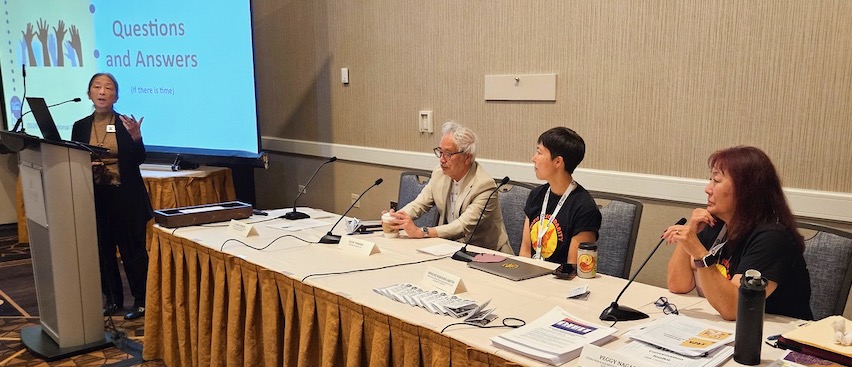
Participating in the panel were (from left) Carol Kawase, Don Tamaki, Masumi Hayashi-Smith and Peggy Nagae. (Photo: Gil Asakawa)
The National Convention panel focused on Black reparations.
By Gil Asakawa, P.C. Contributor
One crowded panel during the recent JACL National Convention at the Paris Hotel & Casino in Las Vegas covered the issue of reparations for African Americans through the historical lens of the Japanese American community.
Moderated by newly elected VP for Public Affairs Carole Kawase, who was still NCWNP vice governor during the panel on July 31, the lively discussion invited interaction from the audience and responses from panelists attorney Donald Tamaki of Minami Tamaki and Peggy Nagae and Masumi Hayashi-Smith, co-chairs of Tsuru for Solidarity Black Reparations and Solidarity Campaign.
The session wasn’t a “sermon from the mount” about reparations, but rather a primer for where the effort currently stands, with printed information for attendees to take with them, including ’zines to explain the topic for younger readers.
Tamaki, whose “almost retired” law partner Dale Minami was the lead attorney that overturned the incarceration case of Fred Korematsu and who was on the Korematsu v. United States team, is still very much active in the civil rights field.
In 2021, he was appointed by California Gov. Gavin Newsom to serve on the nine-member California Reparations Task Force that produced the groundbreaking Final Report comprehensively documenting the cumulative impact of slavery, Jim Crow oppression and decades of segregation.
In response to a question from the audience about how the African American community saw the Japanese American support, Tamaki noted, “First of all, as far as advocates for Black reparations, they welcome the support of Japanese Americans.
“When I was asked by the governor to participate in the task force, my first reaction is, ‘Who, me?’ You know, I mean, far be it for me to tell Black Americans what’s good for them, and so I was very reluctant,” Tamaki recounted. “Ultimately, you know, I agreed to be on this, and you’d be surprised how much it is appreciated that this group, JACL, was in support of reparations. When you look at the numbers, Black Californians constitute 6 percent of the population, 14 percent nationwide. It ain’t going to happen without us and without coalitions of non-Black people who recognize that this involves everybody, and once you deal with Black reparations, it’s a rising tide that lifts all boats. So, it’s for the country. It preserves democracy.”
This movement, Tamaki added, isn’t just a reaction to the current national political climate. “I think historically, of course, the most outrageous disparities now are rooted in not something that happened, you know, with the Trump administration, or 20 years ago, or Jim Crow. This is 1619 stuff. It’s just never been reconciled, and so it keeps on repeating,” he said. “It keeps on getting recycled. How otherwise can the president tell the nation that Haitian immigrants are eating your dogs and cats or basically take an image of, you know, cartoon apes and transpose the faces of the Obamas. I mean, this is Jim Crow antebellum stuff, and it’s a racial pathology that keeps getting recycled.”
Tamaki noted that one thing that helped Japanese American redress was the bipartisan support for the effort. “If you look at and compare the conditions that gave rise to redress and the possibility of getting reparations, one thing that happened during redress, and it seemed improbable at the time, was that you had some Republican conservatives joining in seeking redress. The question is, how do you broaden the coalition in support of reparations to include more than folks like us and our usual or customary norms?”
Kawase agreed on the need for broad support.
“Yeah, great question,” she said. “I do know that when Tsuru for Solidarity went into the offices of senators and asked for them to support HR 40, we did go into the offices of Republican senators as well. So, we’re not counting these people out just you know by party lines.”
Nagae, a former trial attorney herself as well as assistant dean of the University of Oregon Law School and a consultant, has served on JACL’s National Redress Committee, the Civil Liberties Public Education Fund Board and was president of NAPABA. She was lead counsel for Minoru Yasui when his WWII Supreme Court case was reopened in 1983 and his conviction subsequently overturned. She also spearheaded Yasui’s nomination for a Presidential Medal of Freedom, awarded posthumously in 2015. Because of Nagae’s efforts as co-chair honoring Mitsuye Endo’s successful WWII challenge of Executive Order 9066, Endo was posthumously awarded a Presidential Citizens Medal in 2025.
Tsuru for Solidarity was laser-focused on its educational mission.
Nagae spoke on the rise of ’zines in the media culture and how they can carry a message to different (younger) audiences than traditional communication platforms. She pointed to ’zines in front of her and told the audience to take copies with them. “’Zines historically were created by dissident, underrepresented and marginalized groups, and especially during the 1920s and ’30s Harlem Renaissance, they were little packaged, easily published or like a roadmap. You can go on our website and make a copy, print out a copy, fold it, come to our table, learn how to fold it and cut it and put it together. So, that’s what we’re doing at our table. We have the larger toolkit conversations. We have the ’zines, all for your use and edification as you go forward.”
Masumi Hayashi-Smith, a queer biracial facilitator, writer and musician originally from Coast Salish land in Tacoma, Wash., added additional information about Tsuru’s campaign, showing a QR code for people to learn more about Tsuru’s Reparations program. She also urged everyone to look close to home as well as at national campaigns.
“Find out about your own local reparations efforts. There are things happening on the ground, and it’s inspiring,” Hayashi-Smith said. “Like I think that sometimes national reparations is an overwhelming idea, but on the micro level, things are happening everywhere, so you know that’s a great source of hope to see what’s happening hyperlocally. Ask your congressman representative to co-sponsor HR 40. I have my computer at our table. I have a website set up. You can actually come to our table and look up your representatives on the spot and see if they have signed on, and actually, on a similar note, you can also, if you’re Californian, see if your representative has supported AB 2599, which is the Truth and Disclosure Act.”
Kawase promised that JACL will review any lawsuit or legislation about reparations that comes before her. “I will review a lawsuit. I will see what the connections are for between the AAPI community and whatever is happening on the Hill because it’s so confusing and so fast and furious that we really need instantaneous response or reviews.”
Nagae noted that Kawase and JACL have been important promoters of Black reparations. “I thank you from the bottom of my heart what you contribute to JACL. I want to put a plug in for Carol because she is the person that does this monthly report. She is the person that put the resolution through so that our committee could be in action.”
Kawase closed the session by nothing that the word “reparation” carries an important meaning within it. “I always like to talk about the word ‘repair,’ which is where reparation comes from,” she said. “If we think about it, we’re talking about the work of repair, and the UN has a very really useful way of talking about reparations, where it isn’t just about money; it’s about so many other things.”