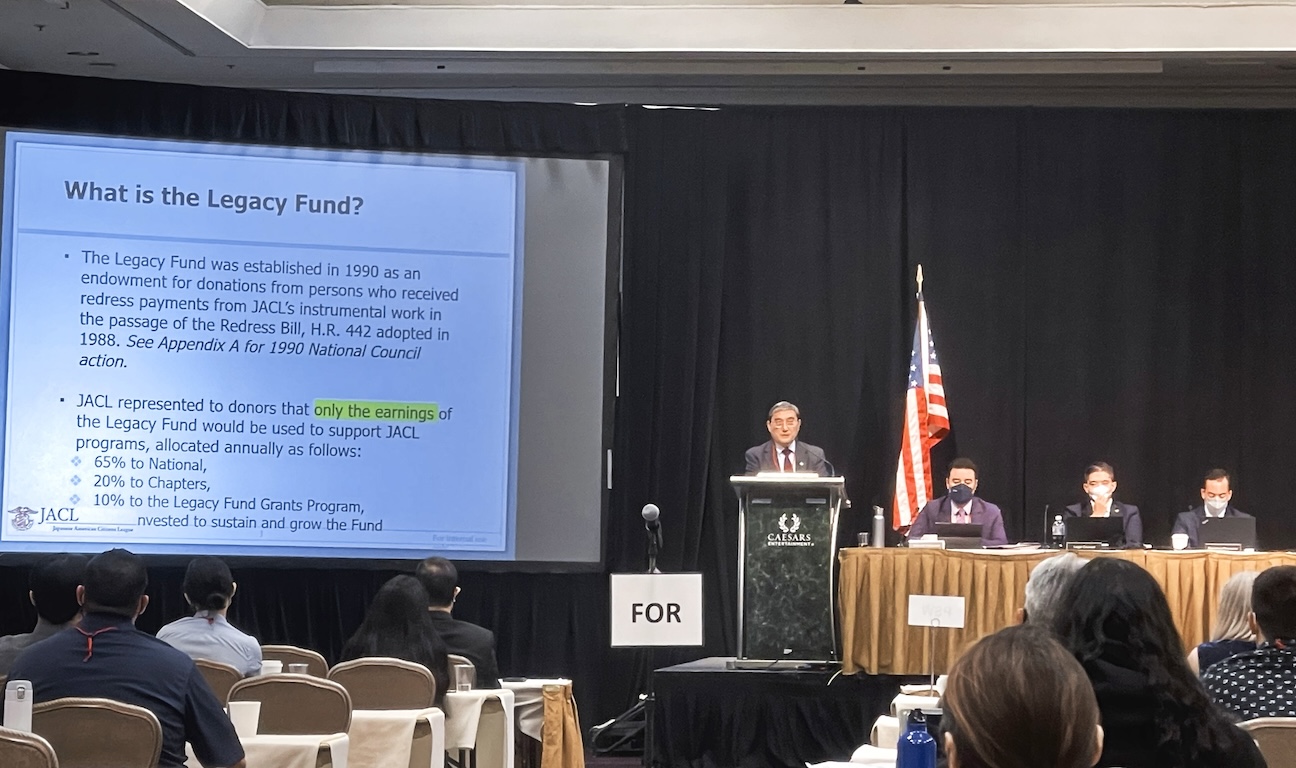
Legacy Fund Review Committee Chair Dale Ikeda addresses the JACL National Council on a proposed amendment, effective immediately, to the Legacy Fund Management Policy during the organization’s National Convention. (Photo: Allison Haramoto)
The unanimous decision successfully maintains the viability and sustainability of JACL.
By Dale Ikeda, Legacy Fund Review Committee Chair
I am pleased to report that the JACL National Council adopted a new Legacy Fund Management Policy (“Policy”) during its morning session on Aug. 6 during the recent JACL National Convention in Las Vegas.
The Policy was developed by the Legacy Fund Review Committee (“Committee”), which began its work in February 2021. Many thanks to the Committee’s voting members, including David Lin (vice chair), Matthew Farrells (treasurer), Floyd Mori, Paul Uyehara, Ken Inouye and Kendal Takeshita, as well as ex-officio members Jeffrey Moy (national president), David Inoue (national director) and Brandon Mita (national legal counsel).
The last time the National Council adopted a formal Legacy Fund Policy was in 2000. That policy expired two years later without the National Council adopting a new policy. The Policy conforms to and incorporates provisions of the 2009 Uniform Prudent Management of Institutional Funds Act (UPMIFA).
The impetus for UPMIFA arose out of the financial crisis of 2008-09 when many nonprofits could not access endowment funds during the stock market slump due to implied restrictions on invading the corpus based on their solicitation materials.
The new law permits “prudent” spending even in years when the endowment portfolio loses money or involves spending a portion of the corpus considered restricted funds under the prior law. For JACL, the corpus has included donations, including return of the chapter rebates from chapters with separate corporate status, and 5 percent of earnings reinvested for growth as represented in its solicitation materials. In some years, the reinvestment rate was increased to 10 percent.
The Policy has a spending rate between 0 percent-7 percent of the Legacy Fund’s value averaged over the 36-months trailing Fund values. The 36-month look back will help level out the swings in the Fund’s value, which consists mainly of stocks and bonds and mutual funds composed of the same.
The normal or “default” spending rate is set at 4 percent. (This is more conservative than the 5 percent proposed by the Committee and past practice since 2017.) The spending rate can be adjusted based on seven factors specified in UPMIFA, including general economic conditions, the effects of inflation or deflation and other resources available to JACL.
This year’s JACL budget, which originally proposed a distribution of 5 percent of the Fund’s 24-months trailing average, was approved under the new Policy using 4 percent of the 36-month trailing Fund value of $334,770 out of a total budget of approximately $2.4 million.
The Policy has two safeguards or guardrails to protect, preserve and grow the Fund. The first is an aspirational threshold called the “Inflation Adjusted Corpus” (IAC). This is defined as the “value of the Corpus taking into account the impact of inflation and deflation on its purchasing power” as adjusted by the Consumer Price Index as reported by the U. S. Bureau of Labor statistics. The Policy endeavors to avoid spending that reduces the Legacy Fund balance below the IAC and follow spending below the IAC with “steps to restore the Legacy Fund value to the level of the IAC.”
The second safeguard is to protect the corpus by requiring a two-thirds vote of the National Council to budget any withdrawal that would reduce the Legacy Fund value below the corpus and “take vigorous steps to restore the Corpus thereafter when conditions permit.”
The overall effect of these two policies is to provide a more predictable and steady income stream while protecting the original and inflation-adjusted value of the corpus, including funds reinvested in the corpus.
In the Committee’s draft report, the inflation adjustment figure was based on the IAC. However, the recommendation was revised when it became apparent that the data to calculate the IAC would not be available in time for the 2022 National Convention and might never be ascertainable given the state of JACL’s records.
A majority of the Committee voted to change the recommendation to an Inflation Adjusted Principal (IAP) using the amount of the donations made to the Legacy Fund of $4,758,081 as the base and applying the Bureau of Labor Statistics’ CPI calculator from June 1997, a year after the conclusion of the Legacy Fund Campaign, to the current date.
Since the IAP would be less than the IAC, it would also provide the National Council with greater flexibility in determining an appropriate spending rate. Paul Uyehara submitted a minority report urging the adoption of the original IAC followed by a Supplement Memorandum, which was joined by Ken Inouye.
At the National Council session on Aug. 6, I recommended the adoption of the IAP with the possible consideration at a future convention of converting to the IAC if and when the data points could be determined to make the calculations.
Applying the Policy to the current budget would suggest a spending rate of less than the approved 4 percent of the Legacy Fund value, which was $8,747,066 as of Aug. 3. Mr. Uyehara’s estimate of the IAC as of Dec. 31, 2021, was in excess of $9.3 million. Due to the high rate of inflation through July, the IAC grew to over $9.9 million, over $1.1 million more than the IAP for the same time period.
The National Council approved the amendment to substitute the IAC for the IAP. The amended Policy was then adopted unanimously. Congratulations to the delegates for updating the Legacy Fund Policy. The Committee has successfully fulfilled its mission to propose reforms to maintain the viability and sustainability of JACL and conform to current law.
Thank you to all the members of the Committee, both voting and ex-officio members, and advisers David Kawamoto, Cressey Nakagawa and Floyd Shimomura.