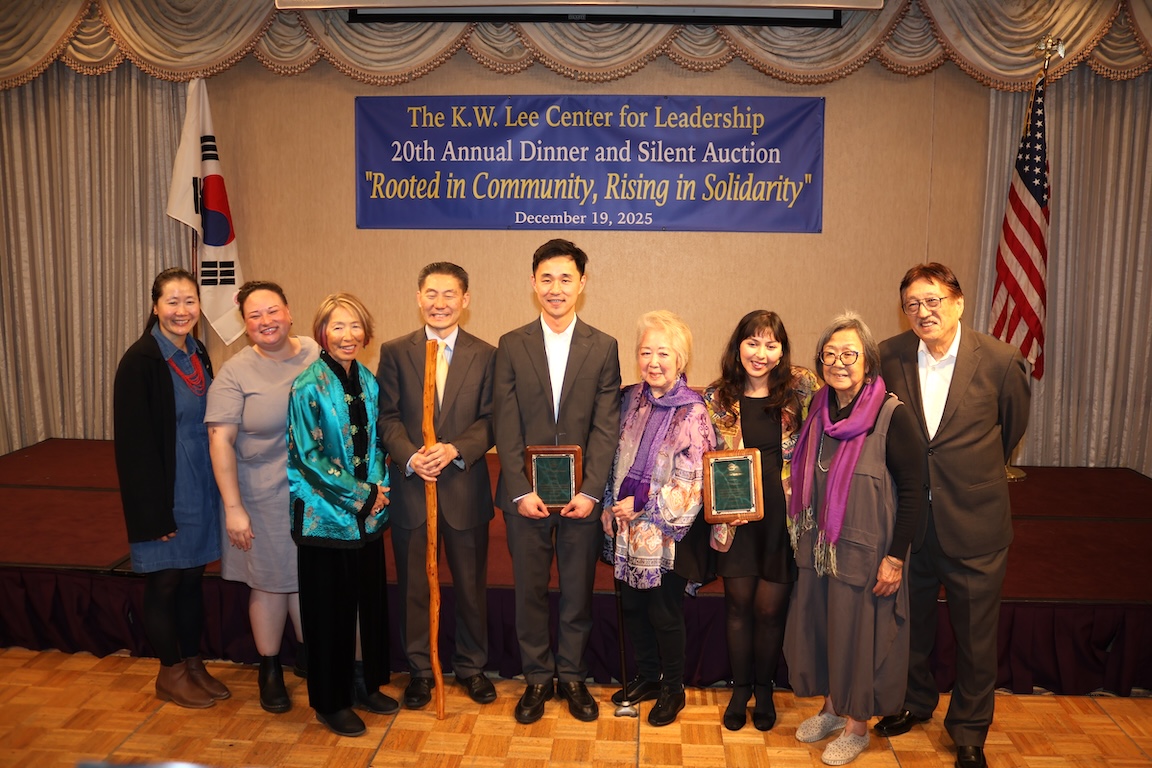
From left: Ayaka Nakaji, Kristin Fukushima, Arlene Inouye, Do Hyung Kim, Ju Hong, Miya Iwataki, Nina Nakao, Kathy Masaoka and Mike Murase (Photos: George Toshio Johnston)
K.W. Lee Center for Leadership holds annual awards dinner, marks 20th anniversary.
By P.C. Staff
The evening of Dec. 19, 2025 was an inflection point for the K.W. Lee Center for Leadership. On one hand, the organization continued its yearslong tradition of holding its annual awards dinner and silent auction at the Oxford Palace Hotel in L.A.’s Koreatown.
But on the other hand, the occasion was noteworthy not just because it was the organization’s 20th such annual event, but it also was the first with its titular figure and North Star, investigative journalist K.W. Lee, no longer among the living.
The Center nevertheless marked the end of its second decade by honoring a group and an individual, namely Nikkei Progressives and Ju Hong, an advocate for undocumented immigrants and families.
Related stories:
• ‘Free Chol Soo Lee’ Reframes an Infamous Injustice, March 18, 2022, tinyurl.com/2vykm2uh
• 13 a Good Omen for K.W. Lee Center for Leadership, June 15, 2018 tinyurl.com/2ut3e2ws
Repeating his past role as master of ceremonies was K.W. Lee Center for Leadership board member Eugene Kim, who recalled how Do Hyung Kim, who became and still is the nonprofit’s board president, invited him over to discuss launching the organization. “I remember walking out of that meeting to my car, and I was like, ‘What did I get myself into?’ Because it’s been 20 years, and we’re still here … I’m actually very proud of this in my life.”
Kim noted K.W. Lee’s passing. “This year is especially meaningful, as we also had to say goodbye to our mentor, our friend and truly our inspiration, K.W.”
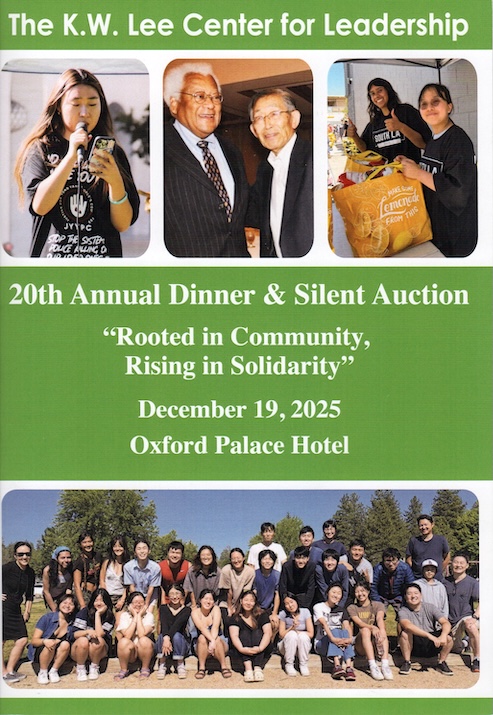
Program for K.W. Lee Center for Leadership’s 20th anniversary dinner
Introduced by Kim was KWLCFL board member Albert Oh. “The K.W. Lee Center is a special place for me. It has done much for the community, and I personally became part of this organization as a 2010 college intern,” he recalled, adding, “Tonight’s theme, ‘Rooted in Community and Rising in Solidarity,’ is a message that is more important than ever. As our community is rocked by attacks on our immigrant brothers and sisters, we are reminded more than ever of the need for solidarity in the face of such adversity.”
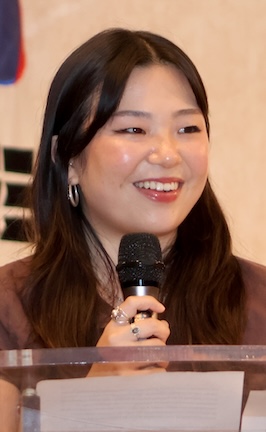
Kayla Mar
The evening’s youth speaker was Scripps College junior Kayla Mar, who reflected on serving last summer as a college intern the Center’s program, Korean American Youth Leaders in Training (KAYLT) and how the experience enriched her “life and personal growth.” She returned to the stage later in the program with three of her KAYLT cohort to give Nikkei Progressives its award.
The evening had two in memoriam recognitions: one for K.W. Lee, who died at 96 on March 8 (March 21, 2025 Pacific Citizen, tinyurl.com/9u9b6szd), the other for Kent Wong, who died at 69 on Oct. 8 (tinyurl.com/upxbs8az).
Arlene Inouye (tinyurl.com/ywppa82e), of Asian Pacific American Labor Alliance (APALA) and outreach co-coordinator of Foundations and Futures, a project of the UCLA Asian American Studies Center, provided the tribute to Wong, the former director of the UCLA Labor Center from 1991–2023 and professor of labor studies and Asian American studies.
Describing him as a “champion of worker justice and immigrant rights” and a “master strategist and visionary who saw the local, national and global context,” Inouye said, “He has been one of the most influential people in my life, who’s not only changed me personally, but he has changed the whole trajectory of my life.”
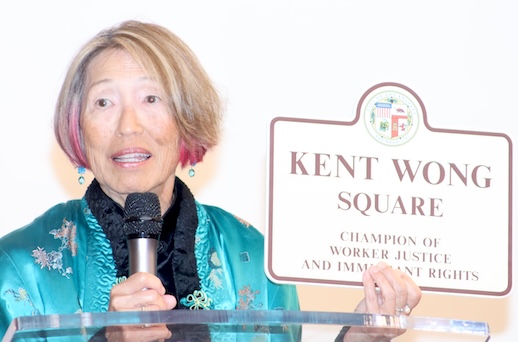
Arlene Inouye displays a copy of the sign designating Park View Street and Sixth Street in Los Angeles as Kent Wong Square.
Inouye also noted that where the UCLA James Lawson Jr. Worker Justice Center is located has been “appropriately renamed the Kent Wong Square, located at Park View Street and Sixth Street in Los Angeles.”
Next was a tribute to the center’s namesake, K.W. Lee, which began with a slideshow by Emmy-award winning “Free Chol Soo Lee” co-director Julie Ha, and personal tributes by Steve Chanecka, who co-founded Koreatown Weekly with Lee in the mid-1970s, and Sophia Kim, who Lee hired as a reporter for that newspaper as well as at the Korea Times English Edition.
Chanecka reflected fondly on his professional relationship and personal friendship with K.W. Lee, with whom he first met at the Sacramento Union and later worked with at Koreatown Weekly, along with the late Randy Hagihara. The newspaper was the first English language newspaper for the Korean American community before folding after about five years, was a few years ahead of its time. “There were no Koreans speaking English back when we started this paper,” noted Chanecka.
As for Lee’s overall impact, Chanecka said, “He was a teacher. That’s what he really enjoyed the most. He loved his time with the Korea Times English Edition, when he was able to gather up young, mostly Korean journalists, and he was able to teach them.”
Later, from the audience, Chanecka commented on how fitting it was that the Korean American K.W. Center for Leadership was honoring a Japanese American community organization, with a nod to Pacific Citizen. “The Koreatown Weekly was born at Pacific Citizen,” he said, noting that the first two, possibly three issues were produced in Los Angeles using the P.C.’s equipment, thanks to former P.C. editor Harry Honda, who had been friends with Lee. “That was an early example of the Japanese helping Koreans.”
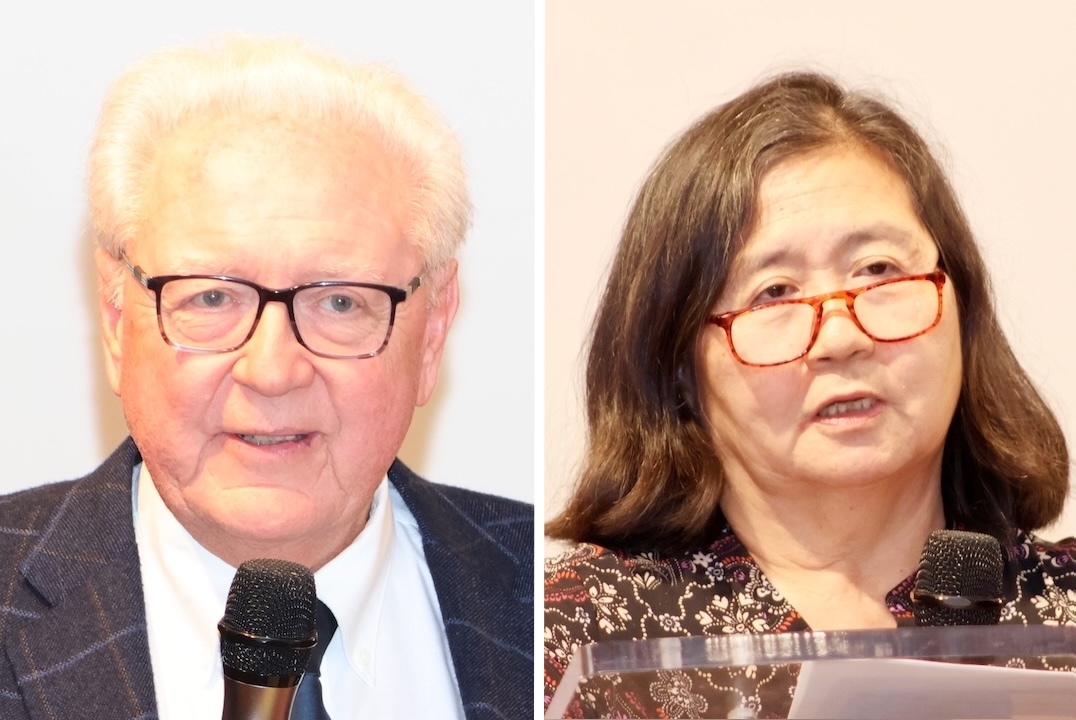
Steve Chanecka and Sophia Kim
Kim, whose relationship with Lee spanned both newspapers, said, “This legendary journalist that so many of us had the privilege to call our surrogate father and mentor has fulfilled his life’s mission, in his words, to comfort the afflicted and to afflict the comfortable. In other words, sniff out racism and kick the ass of those who trample people’s right to social justice.”
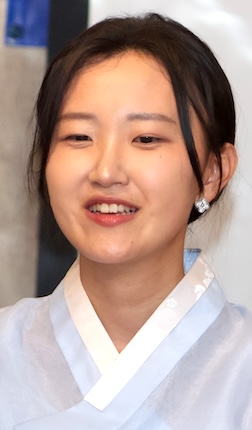
Chase Karng
Following a vocal performance by Chase Karng was the presentation of the two K.W. Lee Spirit Awards. Speaking on behalf of Nikkei Progressives and its mission were Nina Nakao and Miya Iwataki. Nakao in her remarks said, “I really liked learning about K.W. Lee’s legacy has really shown how much that aligns.” She received huge, inadvertent laughs when she recalled how she first got involved with Nikkei Progressives during Trump’s first term, when she misspoke, saying “pregnancy” instead of “presidency.” During her turn, Iwataki praised the Center. “Your mission to train young Korean Americans to become leaders in K.W. Lee’s legacy is so crucial right now.”
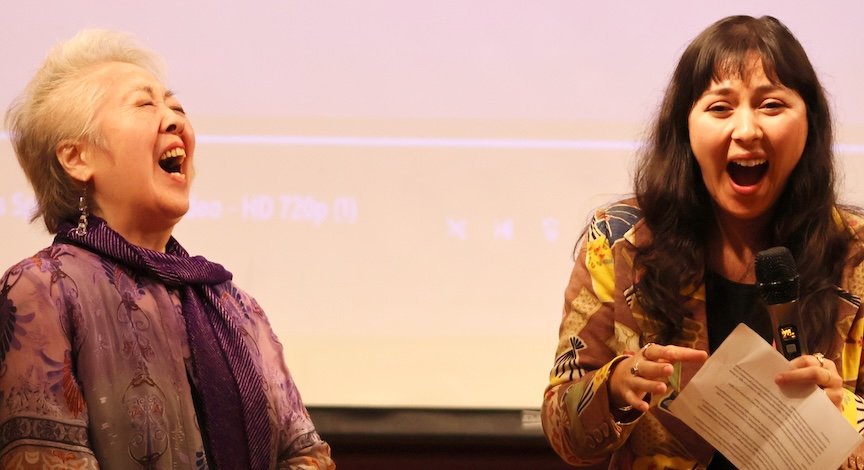
Miya Iwataki and Nina Nakao share a laugh after Nakao’s malaprop.
Ju Hong’s award was presented by K.W. Lee Center for Leadership President Do Hyung Kim. Hong, an advocate for undocumented families who famously — or infamously, depending on your viewpoint — as a 24-year-old undocumented student challenged President Obama during a 2013 speech to use his executive order power to halt deportations that separate families. (tinyurl.com/5n66xj4k)
“He was the only one that spoke up, but once he spoke up, others started chanting. So we always need someone to start that movement, and I really see Ju Hong as one of those leaders that helped to start this movement,” Kim said.
Upon receiving his award, Hong said, “K.W. Lee taught me that change doesn’t happen alone. It begins by standing with the community. It rises when it builds bridges across race and difference. He believed our responsibility is not only speak truth to power, but to empower others to lead their own voices.”