Gil Asakawa
I really love the new movie “Rental Family,” which stars Brendan Fraser as a fading expat American actor who gets a gig in Tokyo working for a “rental family” agency. Most Americans aren’t familiar with the burgeoning Japanese industry, which provides actors who take on roles for clients, usually as family members but also as friends or, say, journalists pretending to be on assignment.
“Rental Family” is, as advertised in many reviews, “heartwarming.” It’s a perfect holiday season feel-good movie, and Fraser is nothing if not amazing at selling the role of the “token white guy,” as the owner of the rental family agency, Shinji, played by Takehiro Hira, tells him when he is hired for his first gig: playing a “sad American” attending a funeral.
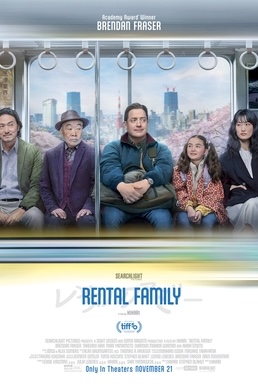 Fraser has the perfect doleful eyes to be a gaijin (foreigner) standing head-and-shoulders taller yet lost amidst the dense population of Tokyoites as he dons demeaning mascot costumes or runs to auditions for roles that he doesn’t get.
So, he is confused when Shinji explains after the hilarious funeral scene – Fraser’s character, Phillip Vanderploeg, is part of a group of mourners all hired by the client, who is in his open casket and wanted to know how it would feel like to attend his own funeral – that the agency doesn’t just provide people for clients, it provides emotions.
Though Phillip is hesitant at first, he takes on assignments: being a friend who visits a young man who is a hikkikomori — a person who self-isolates, a common mental illness in Japanese society that afflicts all ages — and an elderly famous actor suffering from dementia, who Phillip visits, pretending to be a journalist who is on assignment to interview the star.
And at the heart of the film, Phillip takes on the role of a father to a young mixed-race girl named Mia, played by Shannon Mahina Gorman, whose single mother now needs a father figure present for the girl so that she can apply to attend an exclusive private school.
Yes, Japanese society has cultural hangups about many things, including single-parent families.
For Japanese Americans (and Asian Americans) such cultural values that require the help of a rental family agency probably makes sense even though such businesses don’t really exist here in the U.S. We don’t discuss difficult issues such as mental health and loneliness. Dementia is common, yet we wait until we have to deal with the illness because the symptoms can’t be ignored or hidden away any longer.
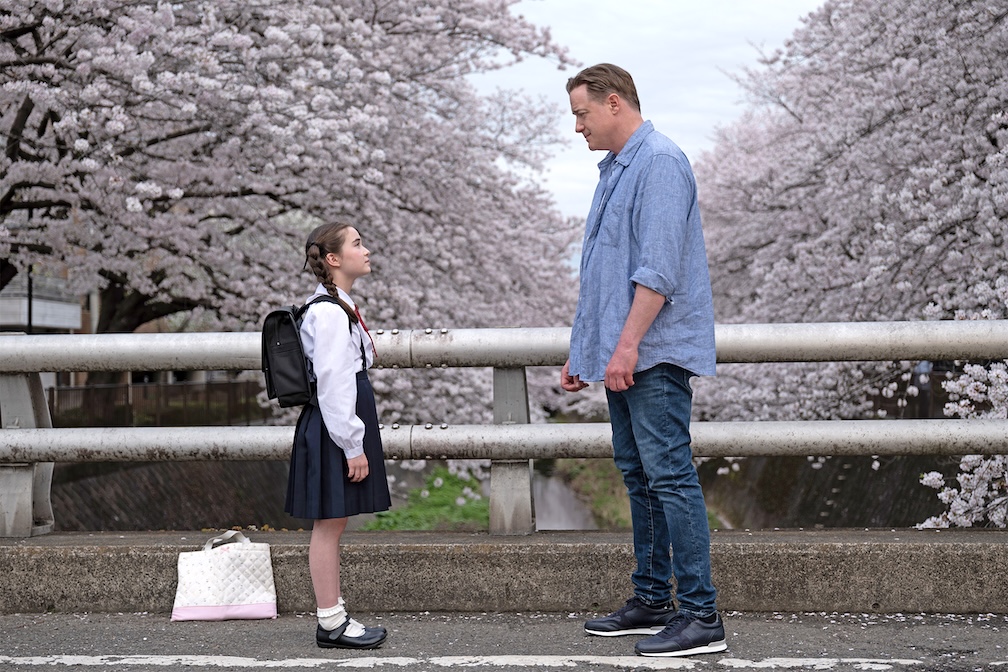
Shannon Mahina Gorman and Brendan Fraser star in “Rental Family.” (Photo: Courtesy of Searchlight Pictures)
There are many touching scenes in the movie (and lots of funny ones, too), so viewers should have tissues on hand. The interplay between Fraser and Akira Emoto as Kikuo Hasegawa, the aging movie star, are poignant, and Gorman as Mia is especially powerful as their relationship develops. She’s angry at him at first because she thinks he’s the father who abandoned her, but then she learns to trust and accept him, to the dismay of her mom. Gorman deserves special commendation for her performance, since this was the first time she has ever acted.
All of the emotional and social threads that run through and weave this movie together will be familiar to JAs because of our family values. Hikari, the director and co-writer of the film, understands Japanese and American values: She was born and raised in Japan but came to Utah as a high school exchange student and stayed in the U.S. to study and work in the film industry. She directed three episodes of Netflix’s powerful AANHPI series “Beef,” about unexpressed Asian values of anger and regret.
We’ve all struggled with the emotional constipation, family pressures and social rules and norms that our community’s conscribed by. So, in a very real sense, “Rental Family” expresses very much the theme of “Voices of the People” — our voices as Japanese Americans — as well as our roots as Japanese.
See this movie, and let me know if you agree. Happy Holidays to all and be proud to share your voices with the world!
Gil Asakawa is the author of “Tabemasho! Let’s Eat! The Tasty History of Japanese Food in America.” He is currently the interim board chair of the Pacific Citizen Editorial Board.