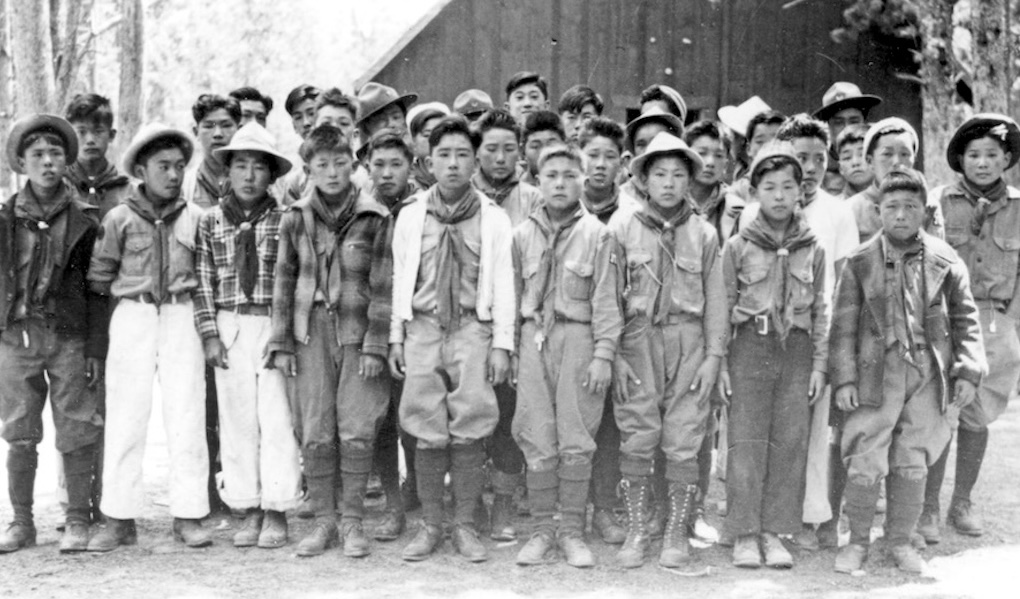
Bacon Sakatani (front row, center, dressed in a white jacket) is pictured here as a member of the Heart Mountain Boy Scouts. (Photo: Courtesy of Bacon Sakatani)
Founded in response to injustice and sustained by shared memory,
the organization must decide who it wants to be — and who it hopes will carry it forward.
By Lynda Lin Grigsby, P.C. Contributor
Once, JACL was united by injustices done to its people. The organization’s founding in 1929 focused on many problems facing the Japanese American community, for which Saburo Kido entrusted to the stewardship of the Nisei.
“This could only be done by co-operation,” said Kido, then a JACL leader, in a published report of the organization’s first National Convention.
Back then, the message was clear: Amid a tenuous existence in this country, the JACL provided a sense of shoes-off safety and a space that allowed the Nisei to assume leadership of their own community.
Amid the barren landscape of the World War II camps, this identity continued to crystallize. The victims of mass incarceration gradually became the guardians of civil rights, shaped by a terrible life event that continues to ripple through generations — the WWII incarceration.
But as this unifying identity continues to fray, the question presses harder: Who is the JACL now?
The organization, which is inching closer to celebrating its centennial, bills itself as the oldest and largest Asian American civil rights organization in the U.S. Yet, the membership numbers tell a quieter, more troubling story. For years, membership has been falling precipitously.
Today, membership hovers just under 7,000 — likely a lower number than the organization experienced in its early years. The problem of dwindling membership has long been whispered about and spoken aloud in broad strokes, but whispers are no longer enough. JACL is facing an inflection point.
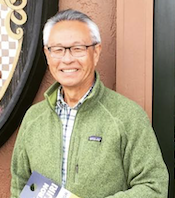
Ron Ikejiri formerly served as JACL’s Washington, D.C., representative from 1978-84.
“The single most important position is membership,” said Ron Ikejiri, a former JACL Washington, D.C., representative. “If you can’t make membership sales, you have no organization.”
Now, more than ever, JACL must reckon with itself. What does it want to be? And how can it reignite more cooperation in younger generations, who, despite seeing echoes of history in today’s news headlines, do not feel compelled to buy into the organization’s mission statement?
This call for change comes from inside the house. In my early days as the Pacific Citizen assistant editor, I committed to memory the names and faces of JACL members who, for every national board meeting in San Francisco, greeted us in hotel lobbies before making the short walk to headquarters. At national conventions, members gathered in what was affectionately called the “peanut gallery” to witness the tedious but earnest process of adopting resolutions and bylaws.
To these members, JACL represented something larger — a moral anchor and a unique sense of comfort, wrote one reader in a letter to the P.C. during my tenure, urging for the return of the JACL logo to the front page of the publication because it brought her so much ease during the war years.
These ardent members form the heartbeat of the organization. But to boost membership, JACL needs to cast a wider net and ask itself a difficult question: Why hasn’t it captured the hearts and minds of these devoted members’ children and grandchildren?
Elusive Hearts
Peter Shigeki Frandsen, 44, grew up adjacent to all things JACL. His family history in the organization runs deep. Since 2004, a student has won a JACL national scholarship named after his grandfather, Shigeki “Shake” Ushio, who helped establish the National JACL Credit Union in Salt Lake City, Utah. Frandsen’s uncle, David Ushio, served as JACL national director.
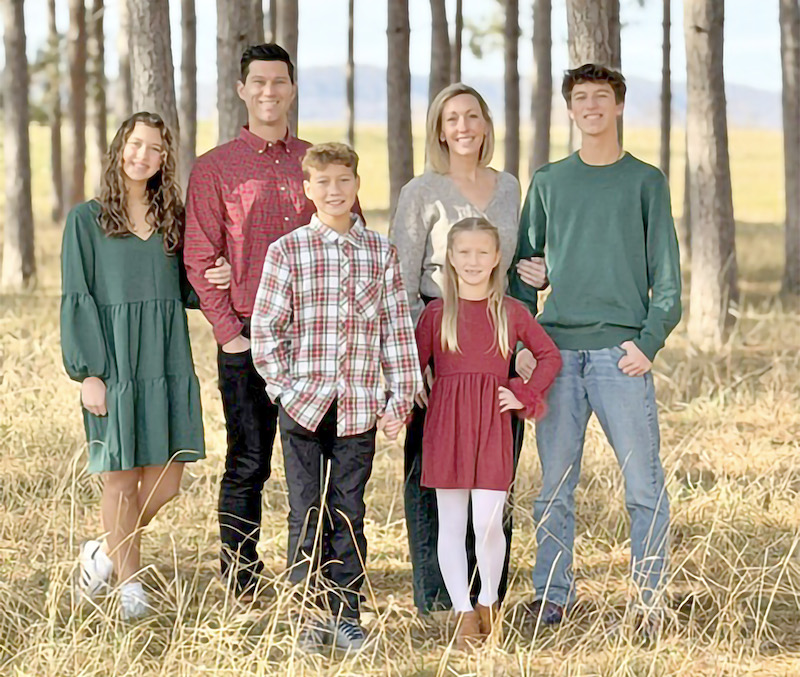
Peter Frandsen and his family. Pictured (from left) are Clara, Peter, Bennett, Emily, Daisy Ray and William. (Photo: Courtesy of Peter Frandsen)
Frandsen grew up attending JACL events with his family. He participated in programs such as the Washington, D.C., Leadership Summit and, for a time, became a member of the Salt Lake City and New York chapters.
“But it wasn’t enough to set me on a path,” said Frandsen, a pediatric dentist in La Crosse, Wis., about his participation in the JACL.
Life, family and career pulled him in a direction away from the organization. The closest chapter, Wisconsin JACL, is based hundreds of miles away in Milwaukee. To bring Frandsen, a Yonsei, back into the folds of the organization, the barriers of re-entry need to be low. Frandsen reflects on the guard-down relationship he has with his Mormon faith, which allows him space to be himself. No matter where he is, he finds people who, like him, are united in faith.
“It’s just easy, you know?” said Frandsen.
Peter Frandsen visits the Vietnam War Memorial during the Washington, D.C., Leadership Summit in 2005. (Photo: Courtesy of Peter Frandsen)
From that lens, he wonders if JACL can offer social connection where a person can exhale at the door and enter a safe space. Can it fulfill a communal need that people are not getting in their regular work and community lives?
“If we’re in a place where the walls come down easily,” said Frandsen. “What is it collectively that we want to do?”
During historic times of crisis and reconciliation, JACL provided its members with tangible services and mutual aid. After the Second World War, the organization helped its members resettle in towns and cities without barbed-wire fences. During the 1980s, pages of this publication became a repository of updates on every step of the Redress Bill.
Once, the Japanese American community was unified by a singular event — a wrong that was done to it. The further away the community gets from the last big injustice, what bonds it together?
For Frandsen, stories of the WWII incarceration, the heroics of the 442nd Regimental Combat Team and redress land differently for his children, who don’t have the support of a vibrant Japanese American community like he did growing up in Salt Lake City.
The fraying sense of community identity is a problem, according to Ikejiri, who served as the JACL Washington, D.C., representative from 1978-84.
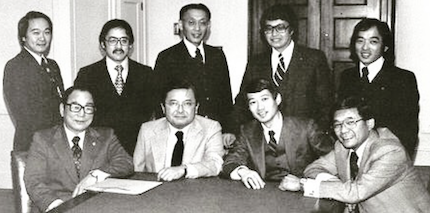
Ron Ikejiri during redress. Pictured (back row, from left) are Karl Nobuyuki, Ron Mamiya, Clifford Uyeda, Ron Ikejiri and John Tateishi; seated (from left) are Senators Spark Matsunaga and Daniel Inouye and Congressmen Robert Matsui and Norman Mineta. (Photo: Pacific Citizen Digital Archives)
“You have to be rooted in your history,” said Ikejiri, 77, a lawyer and former Gardena City Council member. “What are we good at? I think the bottom line is: JACL really has a story to tell about Japanese American history.” But stories only matter if people see themselves inside them.
Today, it’s difficult to imagine newer JACL members consistently traveling to national conventions simply to observe bylaw debates. Is this apathy or misalignment? Maybe this is because the organization hasn’t won the hearts and minds of its people.
“What’s really out of whack is the relevancy of the JACL,” said Ikejiri, a Sansei. “Our job is to instill upon the younger generations that it’s really cool to go out and protect American Constitutional rights.”
After a hiatus from JACL, Ikejiri has sent in his 2026 membership dues.
Make It Cool Again
When I covered JACL events for the P.C. as a staff member, I marveled at the grab-bag crowd spanning professions, belief systems and geography — all united by a shared faith of a more perfect union. At national conventions, former Secretary of Transportation Norman Mineta would wend through hotel hallways alongside conventiongoers wearing their JACL neck badges.
For those occasions when I met new members, I relied on a well-worn question to break the ice: Why is JACL important to you?
Most responses centered on “never again” or a moral sense of obligation to carry on the work of the Issei and Nisei, who endured unspeakable adversities to ensure a better world for the next generations. Idealism dripped from their mouths as they described this inheritance.
But over time, gradual shifts in attitudes led to seismic changes. At national conventions, youth members’ presence was often paid. Chapter delegates sheepishly admitted that they served because no one else would.
This changing attitude mirrors larger cultural changes. Now, echoes of the past are seeping into the present. News of mass incarceration and legal challenges to birthright citizenship sometimes makes it feel like WWII again.
This is part of JACL’s reckoning: What principles will galvanize people into action now? Will there be meaning in becoming a card-carrying member again?
This reckoning has been waiting at the organization’s door. Now is the time to let it in.
“History doesn’t repeat itself, but it often rhymes,” Mark Twain once said.
When the Nisei created the JACL, they likely faced skepticism, too. The Japanese American community is complex and hardly monolithic, but as Kido suggested in 1929, cooperation was enough to begin.
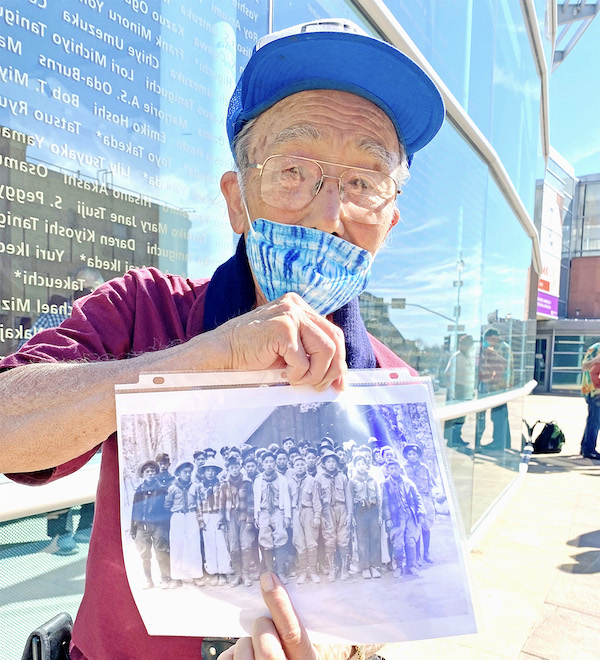
Bacon Sakatani, a longtime San Gabriel Valley JACLer, was a member of the Heart Mountain Boy Scouts.
Photo: Courtesy of Bacon Sakatani
Bacon Sakatani, 96, joined the JACL during the Redress Era. As a child incarcerated at Heart Mountain, he was moved to join when he learned about the illegalities of the WWII incarceration. He called his local JACL chapter and was put to work fundraising. The purpose-driven mission hooked him. He’s been a longtime member of the San Gabriel Valley JACL.
“I have a lot of history to talk about,” said Sakatani. “It’s too bad that we do not have an audience anymore.”His children and grandchildren are not members. He speaks plainly about the future, citing high rates of out-marriage and shifting identities.
What does it mean to be Japanese American now?
“You have to face reality. You have to face today and the future. We’re thinking too much of the past,” said Sakatani. “I’m part of the past.”
JACL cannot be everything to everyone. But it has to mean something to enough people to survive. The reckoning at its door raises a lot of questions for which there are no easy answers.
I am also a lapsed member.
Since leaving the organization as a staff member, I have also taken my own path away. And yet, when I think about the young Nisei who stood on the precipice of upheaval and built an organization that has endured for almost 100 years, my heart still roots for the JACL.
The question remains — and it is an urgent one:
Who does the JACL want to be?