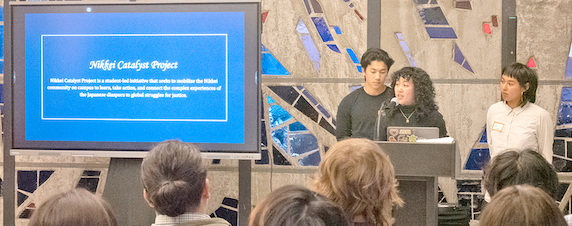
Berkeley NSU student speakers (from left) Jayden Tanaka, Zora Uyeda-Hale and Kiyomi Niara James. (Photos: Enzo Chen)
UC Berkeley NSU holds a Day of Remembrance program
that focuses on the importance of building community.
By Reese Haramoto
‘Japanese Americans were incarcerated merely because they looked like the enemy,” said Yuuto Izumi, co-emcee of the University of California, Berkeley, Nikkei Student Union’s 2026 Day of Remembrance event on Feb. 20.
This year’s theme, “Solidarity Across Borders: Remembering Japanese Incarceration,” explored the resilience of those who were forcibly incarcerated during World War II and the meaningful impact their stories still have on the Japanese American community today.
“DOR is always an important time to reflect on community remembrance and resilience, and I’m glad NSU gets to host one annually,” said Halie Matsui, NSU’s community service and issues board member.
The program began with a land acknowledgement by co-emcee Clarisse Nikaido, who recognized that UC Berkeley sits on the ancestral and unceded land of the Ohlone people, successors of the sovereign Verona Band of Alameda County.
Nikaido then gave a brief history of the university’s NSU, which was founded in 2002 and serves to foster social and community service engagement for students of Japanese descent and others who are interested in Japanese American culture. The organization’s DOR program — which recognizes the wrongful incarceration of more than 120,000 individuals of Japanese ancestry following the issuance of Executive Order 9066 on Feb. 19, 1942 — is one of its biggest events of the year.
Serving as the program’s keynote speaker was UC Berkeley Associate Professor Hidetaka Hirota from the History Department Center for Japanese Studies. Hirota specializes in U.S. immigration law and policy and is a social and legal historian.
Hirota began his speech by talking about the challenges of birthright citizenship in the 19th century for racial minorities and the widespread belief that Asian Americans didn’t qualify under the 14th Amendment, an ideal expressed by white Americans who wanted Asians excluded from the U.S.
“Naturalization was then a privilege only for white people, and Black people and Asians were not considered either,” he said.
In the 20th century with the onset of WWII, according to Hirota, the U.S. government deemed the incarceration of Japanese Americans a necessary measure for “protecting national security.” He specifically mentioned the testimony of former California Attorney General and Gov. Earl Warren, who became a driving force behind the internment of Japanese Americans without any charges or due process.
Hirota went on to dispute Warren’s claims, saying, “Warren manufactured a crisis with little foundation, blaming domestic racial minorities for this crisis and then persecuting them on that basis.”
Fear and misinformation have resurfaced again today in the form of racial profiling and the wrongful deportation of U.S. citizens, according to Hirota. “You know these things are already happening under the current administration within the similar framework of national security discourse as in the past. But at the same time, I believe history gives us important inspirations and strengthens our sense of justice.”
He went on to remind the audience of the impactful feats accomplished by JA civil rights pioneers Mitsuye Endo, Gordon Hirabayashi, Fred Korematsu and Minoru Yasui as sources of inspiration in the pursuit of justice in the U.S. for all communities.
“The fact that we’re here gathering to commemorate their fights shows that we are inheriting their spirits, and that fact gives us hope,” concluded Hirota.
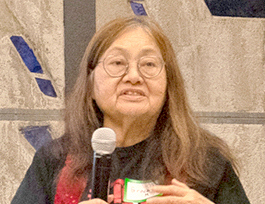
Grace Morizawa
The program also featured a candle-lighting ceremony acknowledging the 10 War Relocation Authority concentration camps and Department of Justice camps and citizen isolation centers. They were represented by Nancy Arata-Fong (Gila River), Scott Kagawa (Rohwer), Eloy Maoki (Crystal City/DOJ), Kaz Mori (Jerome), Grace Morizawa (Heart Mountain), Joyce Nakamura (Poston), Maren Sawamura (Minidoka), Grace Shimizu (Tule Lake), Alicia Tan (Manzanar), Leslie Tsukamoto (Topaz) and Kay Yatabe (Amache/Granada).
Each of the representatives then spoke about their personal connections to the Japanese American WWII incarceration experience.
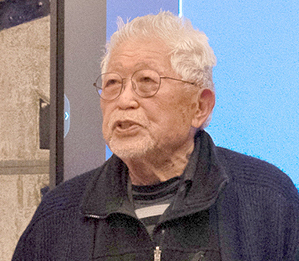
Kaz Mori
Morizawa recalled how her grandmother wanted to take one final family photo before departing for Heart Mountain. “My grandmother said, ‘We have to get a picture because we don’t know we’ll all be together.”
Mori spoke about his family and how they were incarcerated at several camps, including Tule Lake, Jerome and Amache. Mori’s brother was a student at UC Berkeley but “had to be yanked out of Cal Berkeley to go into camps.” Mori’s brother had to convince their father to leave Tule Lake, saying, “Dad, sign the loyalty oath because this is going to be turned into a security camp. It’s going to get rough.”
UC Berkeley NSU President Alicia Tan represented Manzanar and spoke about Ralph Lazo, a Mexican and Irish American from Los Angeles who was the only known non-Japanese American to self-incarcerate during WWII as a show of solidarity for his Japanese American friends and neighbors.
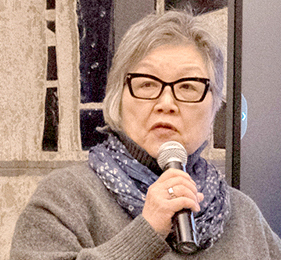
Joyce Nakamura
Having experienced racism himself, Lazo was “really angry about what was happening to his community,” said Tan.
Lazo, who passed away in 1992, “uprooted his life to voluntarily show solidarity for the Japanese American community” and later helped raise funds “in support of the class-action lawsuit that led to the Civil Liberties Act of 1988,” said Tan. “. . . His story really shows that solidarity is ongoing. It’s a lot more than just one social media post or one donation, it’s really a commitment to helping our community members who helped us in our time of need.”
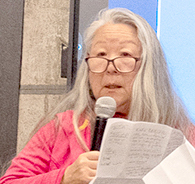
Grace Shimizu
In addition, the DOR program included the introduction of UC Berkeley NSU’s Nikkei Catalyst Project, which is a “student-led initiative that seeks to mobilize the Nikkei community on campus to learn, take action and connect the complex experiences of the Japanese diaspora to global struggles for justice,” and featured entertainment by Cal Raijin Taiko, who performed two selections, “Matsuri” and “Sazanami.” The event ended with a group discussion/reflection circle.
During his closing remarks, Izumi thanked the evening’s participants and acknowledged the support of Beckie Masaki and the Japanese American Women Alumnae of UC Berkeley for their sponsorship and assistance. He also reminded the audience about the importance of reflecting on the past while simultaneously looking toward the present and future to ensure that the same mistakes will never happen again.
“It is vital that we protect our neighbors and friends and keep fighting for the constitutional rights of all,” said Izumi. “Even when the struggle for equity and decent human rights feels futile, when the most powerful people and politicians in the country continue to take a step backwards, we must build community and take action toward a better future.”