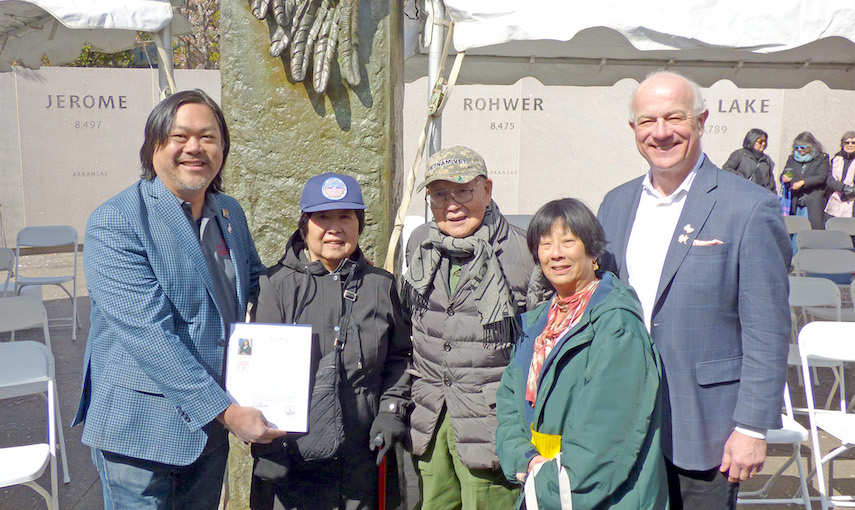
Tak and Carol Furumoto (center) with (from left) Ben De Guzman, D.C. Mayor’s Office on Asian and Pacific Islander Affairs; Martha Watanabe, Freedom Walk Committee; and David Moran, chair of the National Cherry Blossom Festival (Photos: Courtesy of Matthew Marumoto)
Freedom Walk Returns to the Japanese American Memorial to Patriotism During World War II
By Matthew Marumoto, JACL National Daniel K. Inouye Fellow
The 28th Annual Freedom Walk was held at the Japanese American Memorial to Patriotism during World War II, a short walk from the United States capitol in Washington, D.C., on March 28.
The Freedom Walk, organized by the National Japanese American Memorial Foundation, the Japanese American Veterans Assn., the D.C. chapter of the JACL and Ekoji Buddhist Temple, is held each year to raise awareness of the incarceration and displacement of Japanese Americans during the Second World War. This year’s ceremony held additional special meaning, as it also marked the 25th anniversary of the memorial’s opening in 2001.
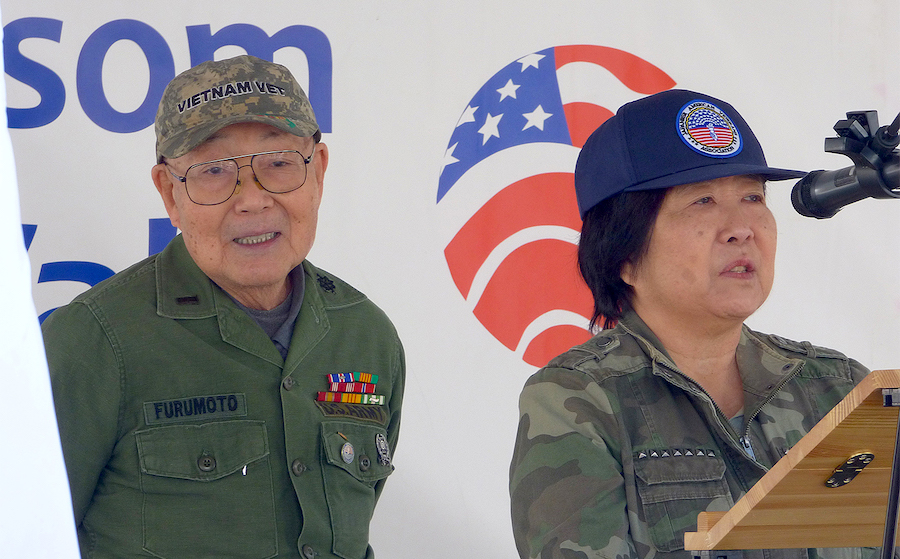
Carol Furumoto briefly speaks to the audience next to her husband, Tak.
Beneath the blossoming cherry trees, the crowd filled the grounds of the memorial as Nen Daiko’s taiko drums thundered through the crisp spring air. The ceremony then welcomed a keynote address by Takeshi “Tak” Furumoto, who was born in the Tule Lake Segregation Center and went on to become a decorated Vietnam War veteran and an activist preserving the history of the atomic bombings of Hiroshima and Nagasaki. Furumoto, donning the same jungle fatigues he wore in Vietnam, was joined onstage by his wife, Carol Furumoto.
Following President Franklin D. Roosevelt’s signing of Executive Order 9066 on Feb. 19, 1942, Furumoto’s family spent six months in the Santa Anita relocation center before being moved to the Rohwer Incarceration Camp in Arkansas.
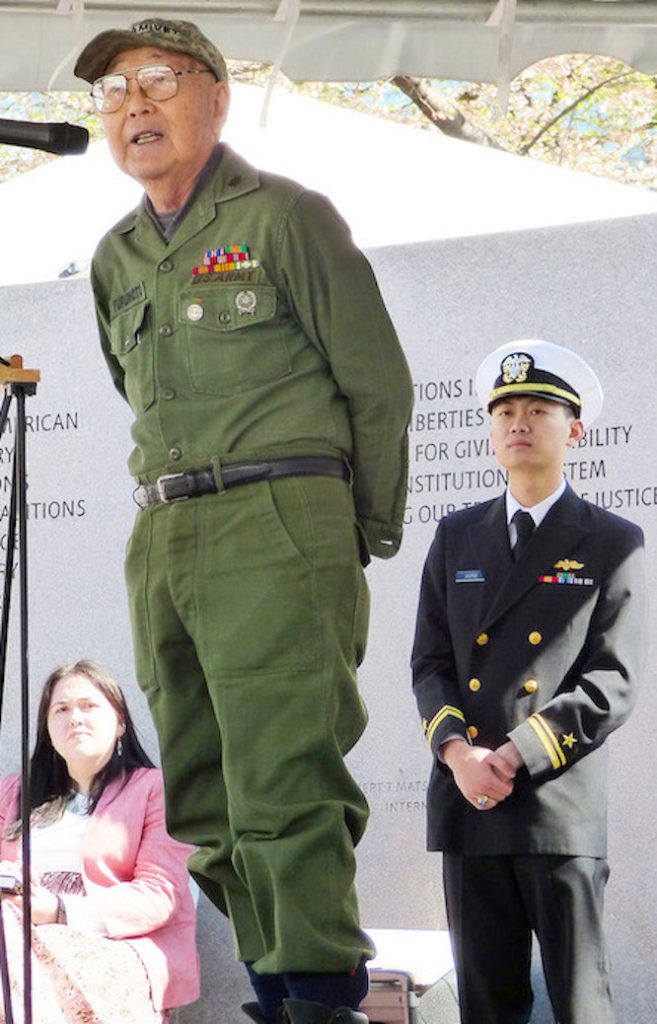
Tak Furumoto delivers a keynote address at the 28th Annual Freedom Walk at the Japanese American Memorial on March 28. Also pictured are JACL Norman Y. Mineta Fellow Katie Masano Hill and Navy Lt. Daniel Wong.
While in Rohwer, his parents answered “no-no” to the Loyalty Questionnaire in 1943. Furumoto said that his parents answered “no-no” because the government had taken their business from them and left them with only $4.
Additionally, his parents still had family in Japan whom they feared they would never see again if they disavowed the emperor. The War Relocation Authority moved Furumoto’s parents to the Tule Lake Segregation Center, which held others who similarly answered “no-no” on the questionnaire.
In 1944, Furumoto was born incarcerated behind the guarded barbed-wire fences of Tule Lake. After the Second World War, he and his family were deported to Japan. Furumoto grew up in Hiroshima, where his family lived with his grandparents, who were survivors of the atomic bombing.
In 1956, the Furumoto family returned to the United States. He recalled that despite being incarcerated and later deported, his father still saw opportunity in America.
“He had street smarts, and he really made it in 1938. But, all of his effort was taken away when President Roosevelt signed Executive Order 9066, and with the flick of a pen, incarcerated 120,000 people like us. But my father never forgot; America does give an opportunity, even though he only had an eighth-grade education,” Furumoto told the audience.
Although he had been born behind barbed wire, Furumoto volunteered to serve in the U.S. Army, where he would serve as an intelligence officer. He recounted guarding Highway 1 near Parrot’s Beak during the United States incursion into Cambodia in 1970.
For his service in Vietnam, Furumoto was awarded the Bronze Star Medal. He returned home bearing the invisible wounds of war, including what he called a “serious case” of post-traumatic stress disorder and the lasting effects of Agent Orange.
While he healed, Furumoto relied heavily on his wife to support their family and run their real estate business. In 1993, he received a letter of apology from President Bill Clinton, which he read aloud to the audience.
This letter followed the enactment of the Civil Liberties Act of 1988, which provided a formal apology and redress payments to survivors of the incarceration.
Furumoto recognized that for many, redress was too little, too late.
“It took about six years to pay us the $20,000 reparations in this apology letter,” he said. “But you know what? The 60 percent who really needed to read this letter had passed away. They were not able to read this letter. And the $20,000? How in the world can you replace four years of your lives?”
More than 80 years after the signing of EO 9066, Furumoto sees the lessons of incarceration as not merely historical. They are a warning.
“After 84 years, it is happening again in the United States,” he said. “I have to give the people in Minnesota a lot of credit for standing up and safeguarding our Constitution. The ICE agents disappeared. You know who did that? It’s us. It is us who protect our country, and we must continue to be proactive.”