MS Now’s Rachel Maddow joins a JA community event in Denver to discuss her new audio series.
By Gil Asakawa, P.C. Contributor
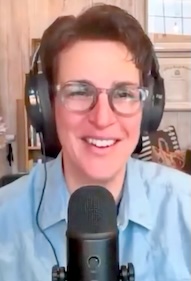
MSNow’s Rachel Maddow talks about her “Burn Order” podcast via Zoom during the Feb. 21 Denver discussion event. (Photos: Courtesy of Gil Asakawa)
MS Now anchor and journalist Rachel Maddow’s “Burn Order” podcast, a six-episode audio series digging into the Japanese American incarceration from its roots in racism and EO 9066 to the journey that resulted in the Civil Liberties Act of 1988, should be required listening for everyone. Especially Japanese Americans.
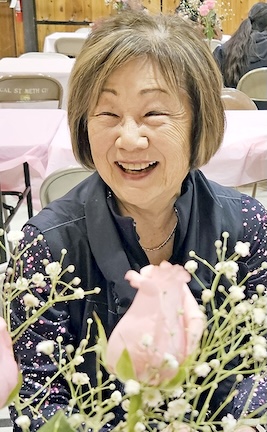
Event co-organizer Millie King of the Japanese American Resource Center of Colorado
Read related story here.
So, when Millie King of the Japanese American Resource Center of Colorado, and Brian Lee, pastor of Simpson United Methodist Church in the Denver suburb of Arvada, decided to organize a community potluck dinner and discussion session for “Burn Order,” they invited members of their organizations and Tri-State Denver Buddhist Temple and Mile High JACL to first listen to the podcast and then come ready to talk about each episode in small groups.
The idea came out of a Jan. 10 memorial service for JA community leader Calvin Hada, where some attendees had listened to “Burn Order,” but others hadn’t. So, the group got the word out to ask people to listen to the series and then planned the potluck.
Once it was on the books for Feb. 21, the organizations invited people to attend if they had listened to the podcast episodes, which are all available on Maddow’s MS Now page, complete with transcripts and archival supplementary materials.
And then they got word of an uninvited — but very welcome — guest.
Maddow’s staff, which is nothing if not fastidious with researching the topics for her reports, MS Now shows, documentaries and the podcasts, came across an announcement for the community gathering to discuss the episodes — and they contacted King. The chance to join a discussion with an audience, which Maddow rarely does, appealed to her.
Maybe it’s the Colorado setting — one of the podcast’s executive producers is Michael Yarvitz, whose wife is Japanese American, and her family “self-evacuated” to the state to escape incarceration at the start of World War II. Maddow has done public panels and presentations, including a kickoff MS Now event at the Orpheum Theater in Los Angeles last December, but no one in Denver was prepared to hear from her live over Zoom.
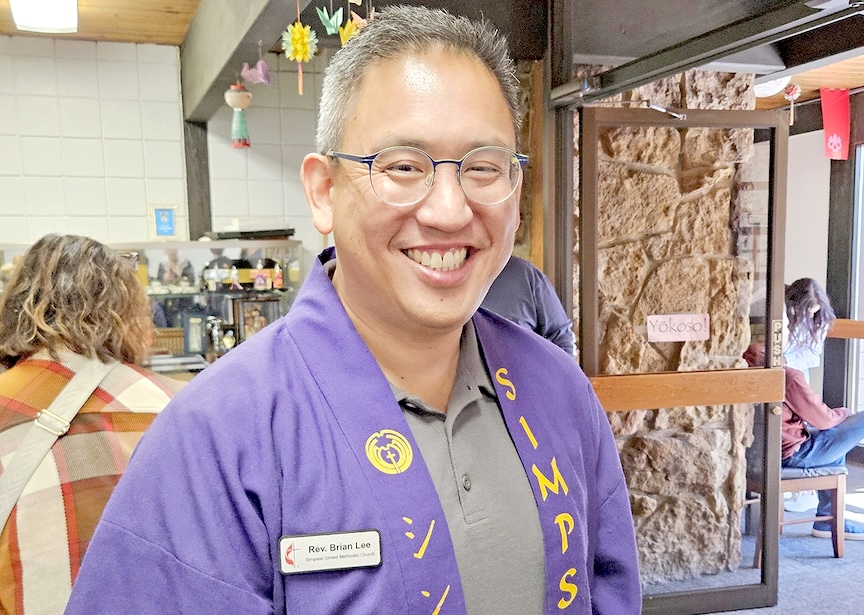
Co-organizer Brian Lee, pastor of the Simpson United Methodist Church in Arvada, Colo.
But Maddow arranged to dial in and greet the group after their separate table discussions. King and Lee figured it would be a brief selfie moment with a celeb. Instead, Maddow stayed online and on camera for 45 minutes, engaging with the Denver audience and even getting emotional about the history that she had uncovered — a history that, as King said to the journalist, many in the audience knew personally as descendants of survivors or, in King’s own case, as survivors themselves.
Even though she is an activist in the community, King acknowledged as she introduced Maddow to the audience and thanked her for the podcast series, “It is a story that many of us, even as survivors and descendants, do not know the details. And for our younger generations, it’s even worse because they are not getting this kind of information.”
Maddow broke in and gushed her appreciation in return. “Allow me just for a second. Let me just say how moving, how moving it is to me that you guys listened together, that you listened at all, but that you listened together and put all of this deliberate thought and effort into talking about it amongst yourselves and seeing what it evoked for you, and the study guide and everything is just incredibly moving to me,” she said.
“I don’t always know how the things that I do resonate out there in the world,” Maddow continued. “And for you guys to be coming together and listening to this and talking about it and letting me crash your party today and talking about it a little bit — it’s just unbelievably rewarding and moving to me.”
When the audience started asking questions like the history of Japanese Latin Americans, Maddow admitted that there were so many directions she and her cowriters could have taken and that they had to leave many stories on the cutting room floor. That, of course, left the audience wondering if she would follow up with another series revisiting the wartime JA experience.
“Whenever you’re producing something, it’s always a funnel, you know. You start with X amount of stuff, and then you have to get it down to 0.1x maybe, before you actually come up with the story that you can tell, so that it has a plot and propulsion and can hold people’s attention on that stuff,” Maddow said. “But with this, in particular, compared to everything else that we’ve done, we just felt like we could have done 10 series, you know, not like if this was a six-episode series. We could have done 10 more of these with that many episodes, I mean, and even stuff that we did touch on, there’s so much more to say.”
Another thread Maddow could have followed was the largely unknown stories of the 5,000 JAs who voluntarily self-evacuated during a period from the West Coast to states such as Colorado and Utah to avoid the concentration camps.
Maddow greeted Mike Ishii, co-founder of Tsuru for Solidarity, who was in Denver for a Day of Remembrance event. Maddow has done events with Satsuki Ina, the other founder of Tsuru. She lauded the work that Tsuru does in educating people about JA history and equating the past with the division and trauma of the current American political landscape.
After a lineup of local community leaders asked their questions, 17-year-old Sophie asked a final question about the emotions that the research about incarceration brought up in Maddow. Her parting words: “You know, the government does things wrong. The world does terrible things, and some people prove themselves willing and able and up to the task of fighting for what’s right in those difficult circumstances. And you know, may that be you, may that be all of us. I think it’s a model of a worthy life.”
The conversation was sincere, and Maddow was generous to share so much of herself with a room full of Japanese American strangers.
Pastor Lee, when asked how this happened, simply explained it as “dumb luck.” The church and community groups hadn’t planned on hosting an event for Maddow, but her participation catapulted the event’s success into another level completely. He also credits folks in the community who had listened to the podcast who thought having an event to bring groups together and discuss it would be powerful.
Once Maddow’s office contacted them, King stayed in touch and worked out the details. “She was so honest,” said King of Maddow. “And I love that it was so open-ended that I bet she does do more. I hope so.”
The archived recording of Rachel Maddow’s talk with the audience in Denver is available online at https://www.ms.now/rachel-maddow-presents-burn-order.