Keynote speaker Dale Minami, co-founder of the law firm Minami Tamaki LLP (Photo: Matt Weisbly)
The 2026 pilgrimage focuses on the importance of
vigilance and its essential role in preserving freedom.
By Matthew Weisbly, JACL Education Programs Manager
Under overcast skies and surrounded by the snowcapped Sierra Nevadas, around 1,000 people gathered for the 57th Annual Manzanar Pilgrimage on April 25 at the Manzanar National historic Site near Lone Pine, Calif.
(Related story: 56th Manzanar Pilgrimage)
This year’s gathering, which centered on the theme “Lessons From Manzanar: Vigilance Is the Price of Democracy, 1942-Today,” felt especially poignant given continued attempts by the current administration to change policies and laws, stripping the civil and human rights of millions of Americans.
As Manzanar Committee Co-Chair Bruce Embrey said in the announcement for this year’s pilgrimage, “The significance of our annual Manzanar Pilgrimage has never been greater than it is today. As the assault on our democracy, the militarization of our cities and the building of massive concentration camps unfolds, we need to come together like we did during the Redress Movement and fight for our democracy. My mother, the late Sue Kunitomi Embrey, always reminded us that democracy was fragile, so we must make every effort to protect it when we recognize injustice.”
The pilgrimage event kicked off in the late morning with musical performances by Ken Koshio of Phoenix, Ariz., and the University of California Los Angeles’ Kyodo Taiko. Event emcees, the father-daughter duo of Tony Osumi and Maiya Kuida-Osumi (a former JACL intern), welcomed attendees to Manzanar and reminisced about their first pilgrimages — Tony’s in the 1970s and, years later, Maiya’s as a baby playing in the dirt.
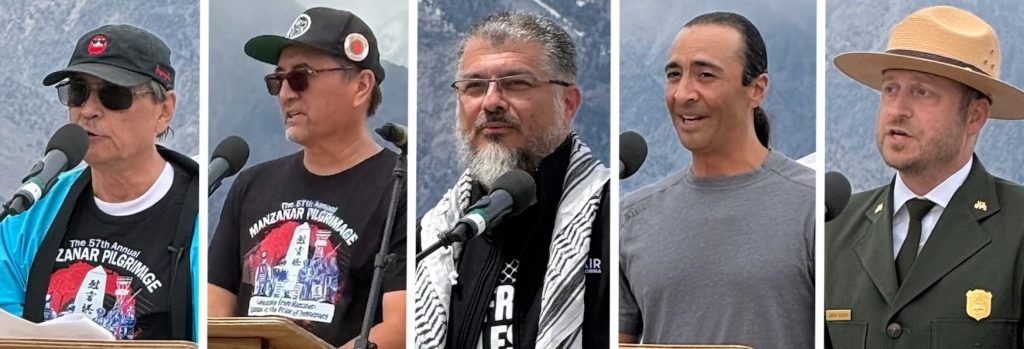
From left: Manzanar Committee Co-Chair Bruce Embrey; co-emcee Tony Osumi; CAIR-LA’s Hussam Ayloush; Paiute-Shoshone tribe’s Jeremiah Joseph; and MNHS Superintendent Jeremy Schrier.
This year’s program was dedicated to Kathy Jefferson Bancroft, a member of the local Paiute-Shoshone tribe whose work and friendship with the committee over the years has been invaluable not only to the pilgrimage but also to the expanding programs and events at Manzanar.

Cover of the 2026 Manzanar program
It was also dedicated to Professor Arthur “Art” Hansen, who spent nearly his entire academic career researching and publishing the history of Japanese American incarceration, including working with the Japanese American National Museum in Los Angeles and Densho in Seattle.
The first welcome was given by Jeremiah Joseph, Cultural Resources Protection representative for the Paiute-Shoshone Tribe. He discussed the ongoing relationship between the Japanese American community and the Paiute-Shoshone tribe, as well as their shared history at Manzanar.
He also spoke about the continued patterns of incarceration and abduction that have long marked the nation’s history and persist today, citing the actions of ICE and other immigration agencies.
On a hopeful note, Joseph concluded his address by expressing his belief that activities like baseball can bring people together and shared his hope that players like the Los Angeles Dodgers’ Shohei Ohtani might one day visit Manzanar’s baseball field.
Next was Jeremy Schrier, superintendent of the MNHS, who emphasized the importance of the site and its path to historic designation. He thanked the Manzanar Committee for sustaining the pilgrimage year after year and noted that those who come to Manzanar are “adding to the legacy of those who came before.” In closing, he shared that 93,000 people had visited the site in the past year, underscoring its continued significance.
In the final welcome, Embrey thanked attendees for their vigilance, describing it as an essential part of preserving democracy. Embrey, the son of Sue Kunitomi Embrey, one of the co-founders of the Manzanar Committee and a key figure in launching the pilgrimage nearly 60 years ago, reflected on the event’s legacy.
He began by noting that “for 57 years, we have said our history is a cautionary tale,” adding that “sadly, it appears some in our country have failed to learn the lessons of Manzanar.”
Embrey then focused on the use of national security as a justification for targeting marginalized communities in the United States, as well as the deployment of American-made weapons abroad, all parallels, he suggested, to the forces behind the mass incarceration of Japanese Americans over 80 years ago.
His message was clear: “We cannot stand by and allow this administration to spread lies and persecute immigrants, Muslims, the LGBTQIA+ community and any other community.
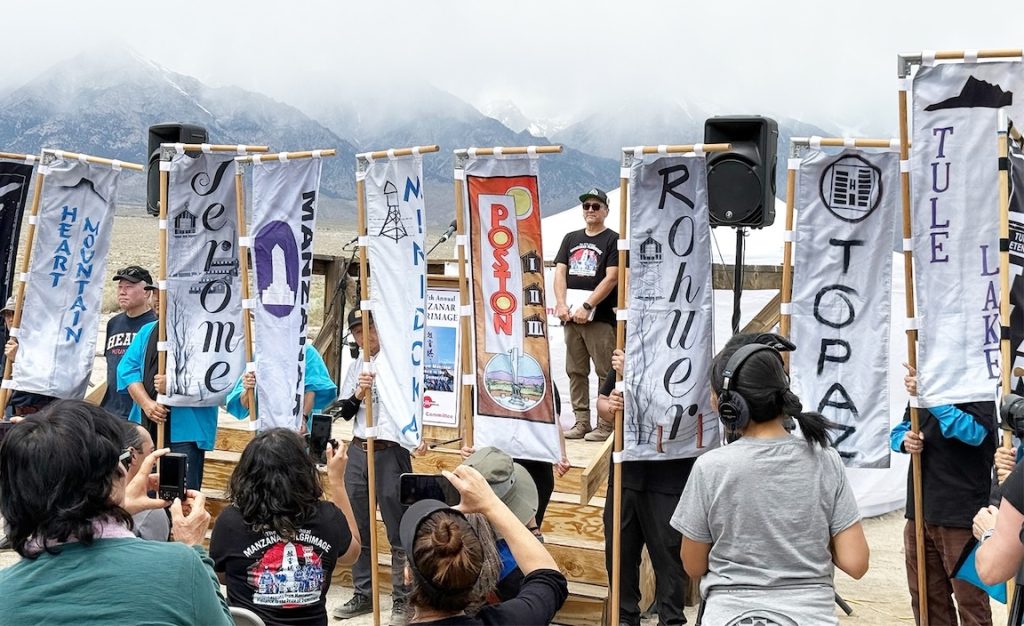
The 2026 camp roll call at the 57th Annual Manzanar Pilgrimage on April 25.
“Manzanar could become a symbol for democracy and healing,” Embrey continued, connecting to this year’s theme. He added that “those that seek to control the future must first control the past,” referencing what he described as efforts to erase history in national parks and government materials. Embrey asserted that “Manzanar and the National Parks are archives of resistance and survival.”
In his final remarks, Embrey outlined several calls to action, including repealing racist laws such as the Alien Enemies Act of 1798, reaffirming support for Indigenous tribes reclaiming ancestral lands, advocating for the abolition of ICE, pushing for immigration reform and supporting HR 40 and reparations for African Americans.
This year’s keynote speaker, Dale Minami, is co-founder of the law firm Minami Tamaki LLP and was a member of the legal team in the coram nobis case for Korematsu v. United States and several landmark cases for the AANHPI community. He recounted his family’s experience with incarceration, including that of his older brother, who was just a 1-year-old baby when the war began in 1941.
He spoke more broadly about the incarceration, calling it a “lie of national security,” and described how Japanese Americans had “all their rights taken away,” enduring “humiliation and loss of dignity” that led to long-term psychological and emotional harm, including intergenerational trauma.
Tying his remarks to the pilgrimage’s theme, Minami said, “Manzanar is a touchstone for all of us. Not just a symbol of the fragility of our democracy. But a symbol of the ugliness of politicians and racist leaders. As well as a symbol of hope and endurance.”
Minami concluded by reflecting on the present, noting what he described as “echoes of incarceration and forced removal” today. He pointed to threats of denaturalization, the weaponization of agencies such as ICE and deaths of American citizens at the hands of the government.
He closed by calling for renewed allyship, as seen during the Redress Movement, urging people to “continue to show up and take action in ways that cannot be ignored” and reminding attendees of the enduring importance of the adage “never again.”
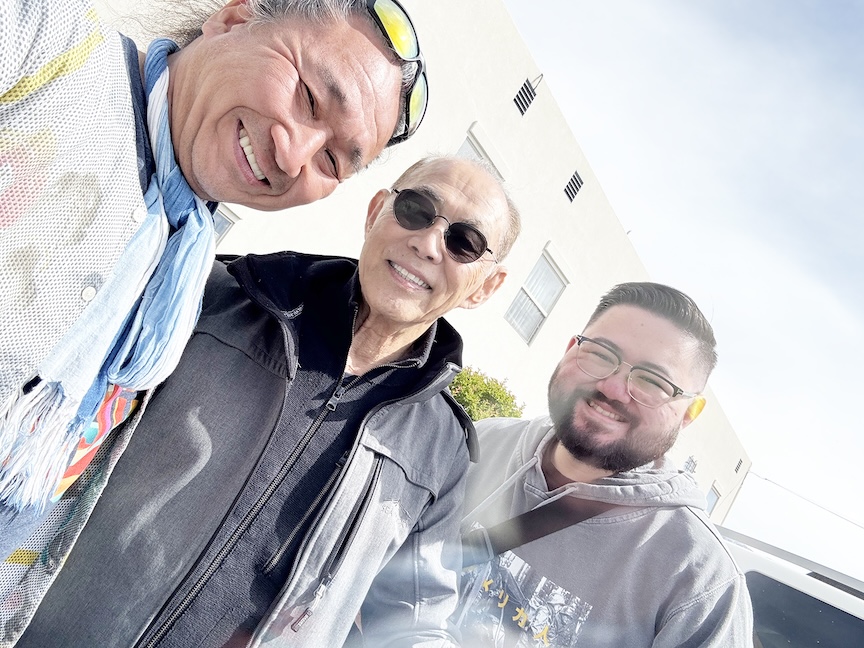
Pictured (from left) are Ken Koshio, Dale Minami and Matthew Weisbly
Following another musical interlude from UCLA’s Kyodo Taiko, Hussam Ayloush, executive director of the Council on American-Islamic Relations — Los Angeles (CAIR-LA), addressed the crowd. He thanked the committee and community for their decades of partnership and shared that he has attended the pilgrimage for nearly 20 years, bringing his children and now grandchildren to experience it as a way of “showing what real American history is.”
“Manzanar is not only a sad memory but a warning of what can happen,” Ayloush said, as he discussed ongoing civil rights challenges and the scapegoating faced by Muslim and Arab Americans, as well as other marginalized communities. “Injustice begins with suspicion and stereotypes and saying that our neighbors are the enemy.”
He concluded by emphasizing that the systems that enabled Manzanar still exist and warned that when media and government fail and when good people remain silent, fear and hate prevail.
Ayloush ended on a hopeful note, stating that “patriotism is demanding our country live up to its own ideals” and urging people to remember that “when history called us, we stood on the side of justice.”
Paul Boyea, a board member of the Terminal Islanders Assn., spoke next. He shared the story of his mother, who was born on Terminal Island and raised with a strong sense of social justice from her father, who advocated for Japanese fishermen’s rights in the early 20th century.
He described the struggles of Terminal Islanders, the first Japanese American community forcibly removed during the war, and highlighted his mother’s efforts to expand access to education — including securing a donation of 20,000 books for the Manzanar library.
At one point, she left Manzanar to continue her studies, later returning to help students apply to colleges on the East Coast. He closed with a call to action: “We will remember. We will speak out. And we will remain vigilant. Because vigilance is the price of democracy.”
The final speech was delivered by Jennifer Yamashita of UCLA’s Nikkei Student Union and one of the organizers of the Manzanar at Dusk program. She reflected on her upbringing in the Los Angeles area, home to one of the largest Japanese American communities in the country.
Like many others, she learned the importance of giving back but also about hardships and injustice. Yamashita shared that she came to understand that “belonging in community also means defending it.”
She then invited attendees to stay for the evening’s MAD program, emphasizing that though many never expected to face such challenges again, collective action can help protect and support all communities.
The pilgrimage was followed by the Manzanar at Dusk program, hosted by students from Nikkei Student Unions across Southern California. The program provides an opportunity for attendees to build connections and reflect on the day through both large and small group discussions.
(Note: Complete remarks for all speakers will be available on the Manzanar Committee website at www.ManzanarCommittee.org and on YouTube.)
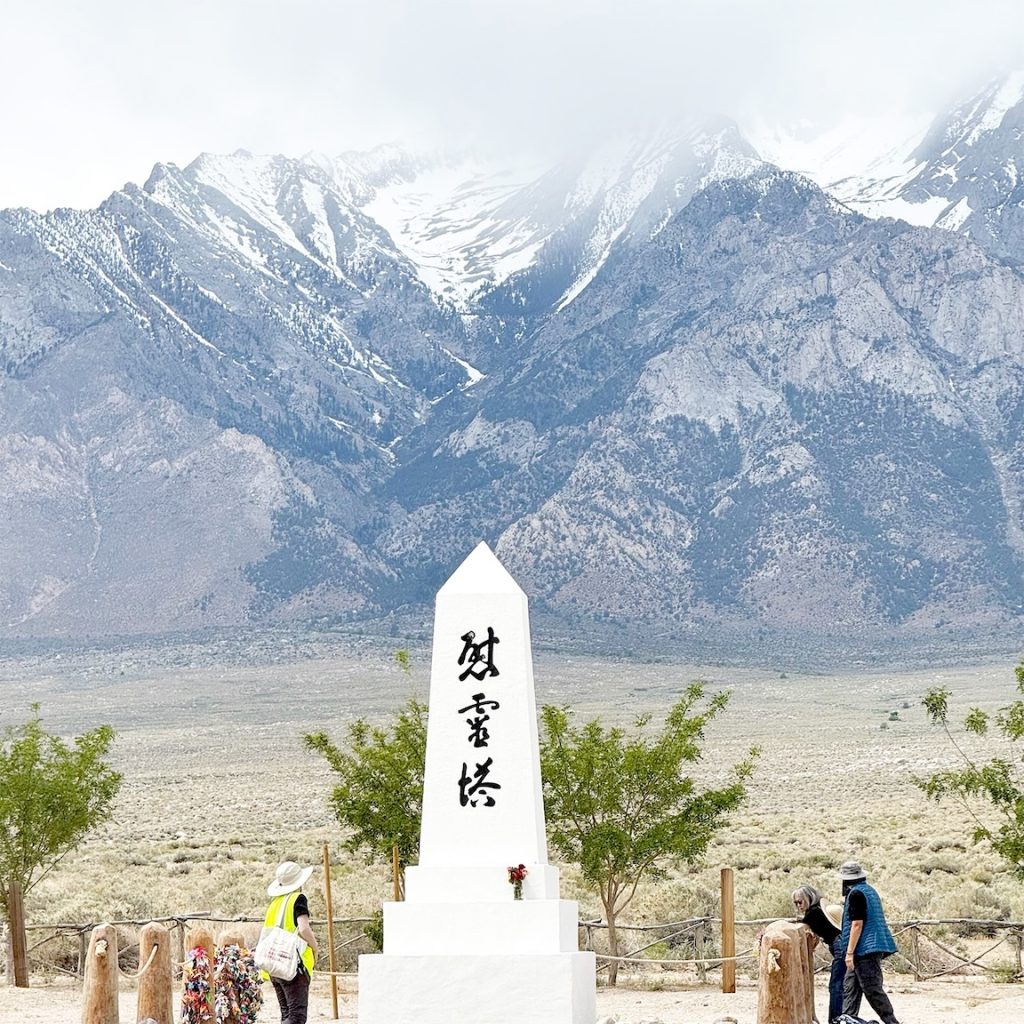
The Ireito, or “Soul Consoling Tower,” honors those who passed while at Manzanar during WWII.