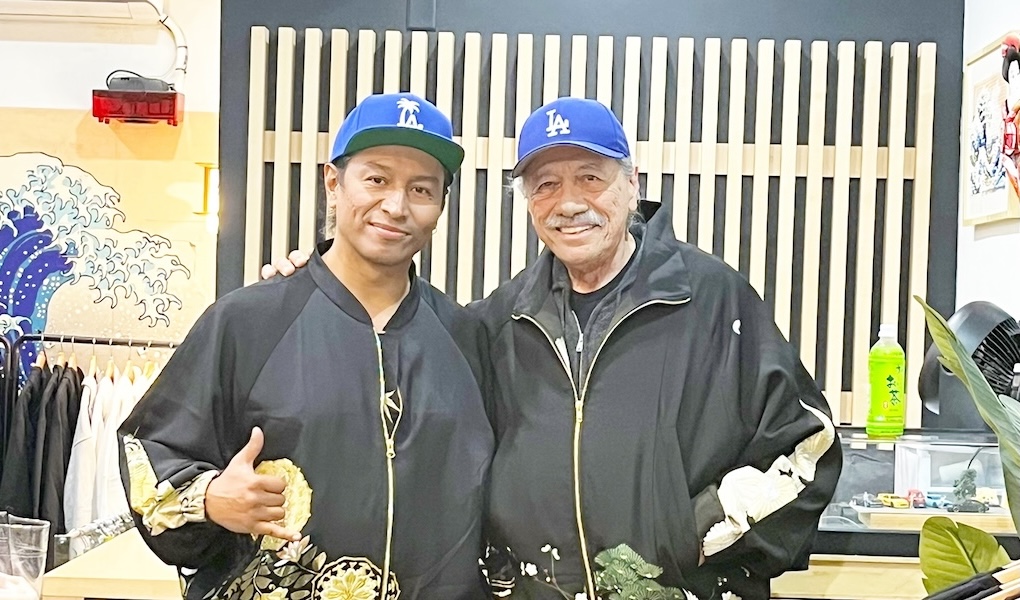
Robert Vargas (left) and Edward James Olmos at the Japangeles store wearing custom jackets by Kuroyanagi (Photo: Hiroshi Kuroyanagi)
Artist Robert Vargas gives new definition to the term, ‘Fresh Coat.’
By Athena Mari Asklipiadis, P.C. Contributor
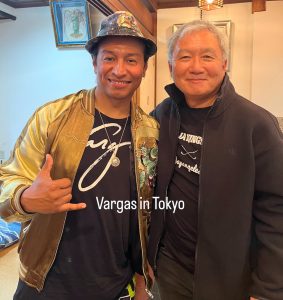
Robert Vargas (left) and Hiroshi Kuroyanagi in Tokyo
For artist and muralist Robert Vargas, a “fresh coat” has most often meant another layer of paint to transform blank walls into larger-than-life public masterpieces. Today, however, the Los Angeles creative, proudly born and raised in the Boyle Heights neighborhood, is giving the phrase “fresh coat” an entirely new meaning.
Vargas is preparing to step into fashion through a unique new line of kimono-inspired jackets. This new venture sets out to bridge cultures much like the murals he has created that have made him one of Southern California’s most-recognizable artists.
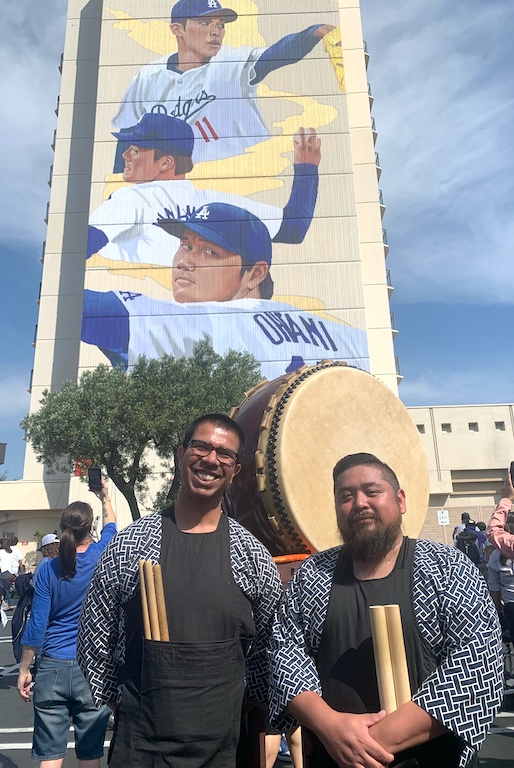
Members of the Los Angeles Taiko Collective pose in front of Vargas’ “Samurai of the Diamond” mural at its unveiling ceremony on March 24. (Photo: Athena Mari Asklipiadis)
This evolution is natural for an artist whose career has been built on storytelling, cultural pride and creating connections between communities.
Vargas, a sixth-generation Mexican American, has long been passionate about his pride for not only his own Latinx roots but also has been using art to express his respect and love for Japanese culture as well.
Whether painting towering tributes from civil rights icons like Dolores Huerta in Downtown L.A. to celebrating Los Angeles’ biggest stars in sports through murals honoring Kobe Bryant, Shohei Ohtani and Fernando Valenzuela to name a few, Vargas has consistently used his work to celebrate diversity and unite people.
One of his latest and most-anticipated murals, “Samurai of the Diamond,” completed on the exterior of the DoubleTree by Hilton in Torrance, Calif., continues that mission. Unveiled on March 24, the massive work depicts three Japanese Dodgers pitchers — Shohei Ohtani, Roki Sasaki and Yoshinobu Yamamoto — and it stands as both a tribute to athletic excellence and a celebration of Japanese culture (see April 3-16, 2026, Pacific Citizen).
Ten days into production of the mural’s creation, Vargas at the time described the project to the Pacific Citizen as one of his most technically challenging works to date. “This one was more detailed than other murals,” he explained. “It was [also a] completely different vision.”
Part of that challenge came from the building itself. Unlike many of his previous projects, the hotel wall featured an extremely corrugated and textured surface that required careful planning and execution. Yet, the mural’s significance extended far beyond the technical obstacles presented with the project.
“All of the Dodgers murals are about bridging cultures, creating unity through sport and through the players we choose to paint,” Vargas said. “If the Ohtani mural (located on the exterior wall of the Miyako Hotel in Los Angeles’ Little Tokyo) was about the new face and new era of the team and league, this mural is about the greatness of Japanese players as a collective, coming here and contributing to this city and country.”
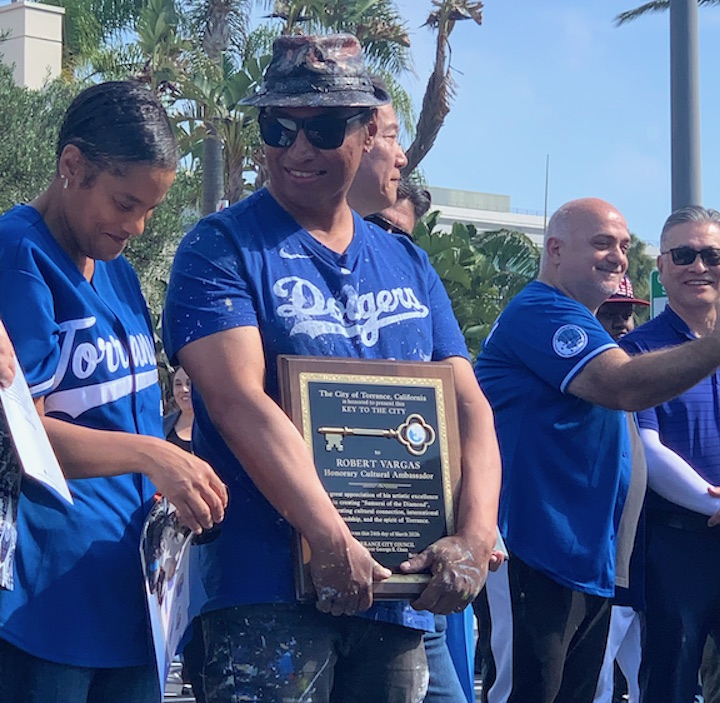
Robert Vargas was honored with a Key to the City of Torrance plaque by city officials at the unveiling of “Samurai of the Diamond” on March 24.
Photos: Courtesy of Athena Mari Asklipiadis
For Vargas, placing the mural in Torrance carries special meaning. Home to one of the largest concentrations of Japanese American populations in North America, the city also shares friendship-city relationships with regions connected to both Ohtani and Yamamoto — Ōshū City in Iwate Prefecture (home to Vargas’ 2025 mural “The Pride of Ōshū”) and Bizen City in Okayama Prefecture, respectively. Vargas was honored by the City of Torrance with a key to the city plaque during the unveiling ceremony.
Vargas personally proposed the Torrance mural project to the hotel and city leadership, helping navigate municipal hurdles that reportedly required local ordinances to be updated before the mural could move forward. These roadblocks are something Vargas was all too familiar with as he had gone through something similar in Los Angeles back in 2013.
At that time, he was a huge proponent of supporting changes to Los Angeles Ordinance No. 182706, amending public art mural regulations so that he and other artists faced less restrictions, bringing forth more large-scale art pieces to the city.
But the red tape and challenges Vargas faces during planning each of his works only seem to fuel his passion and dedication to his projects. Not backing down and producing poignant public displays of artistic activism makes his work not just pretty to look at but also makes a statement about his strength and the strength of the people he depicts.
With “Samurai of the Diamond,” Vargas wanted to create a work that would resonate with local residents and be something visitors from Japan would also seek out and embrace. Just as his 150-foot “L.A. Rising” mural of Ohtani on the Miyako Hotel’s exterior has become a destination for international tourists, Vargas believes that this mural will continue strengthening cultural ties between Los Angeles and Japan. And it will undoubtedly attract more tourism and visitors to Torrance as well.
This project also served as a career milestone for fellow artist Matthew Garcia, who worked alongside Vargas on the mural. Garcia, a native of Pasadena, Calif., is a professional muralist known for his acrylic and enamel work. He had known Vargas as a friend for several years before joining him on “Samurai of the Diamond,” their first full project together. Having first heard about another mural unveiling through Instagram years prior, Garcia welcomed the opportunity to contribute to a work with such cultural significance.
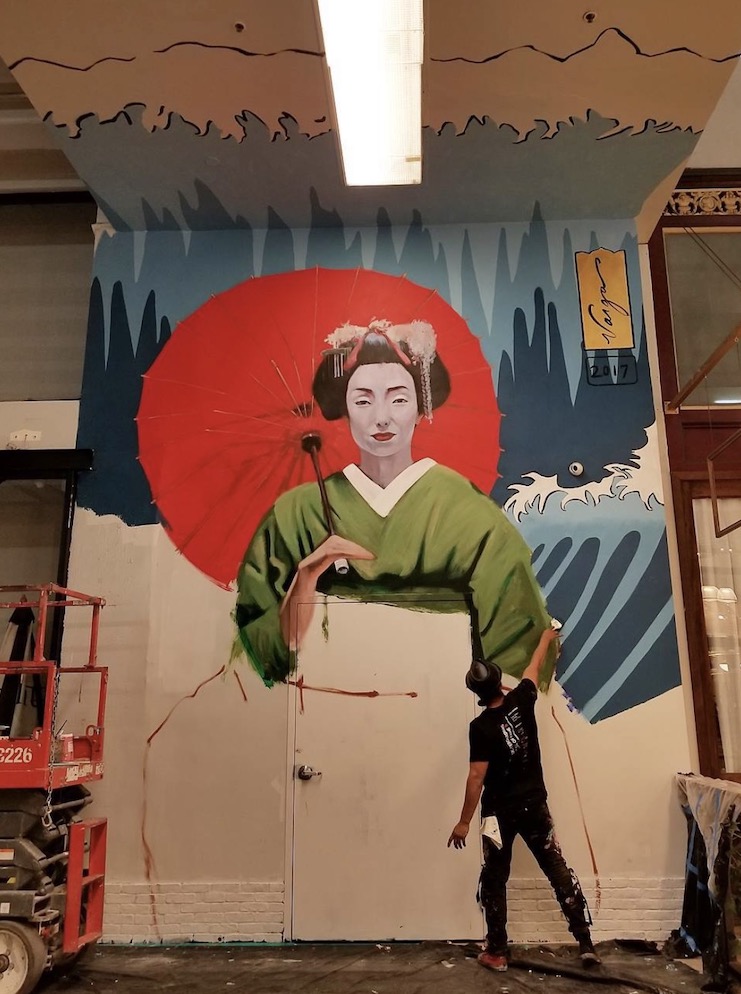
“Geisha Walking in a Dream” mural in DTLA 2017, inspired by Vargas’ trip to Kyoto.
In addition to his individual works that can be seen at glossolalianarts.com, Garcia paints for a commercial mural company that specializes in large-scale projects, including skyscraper installations. Like Vargas, he sees public art as a vehicle for inspiring younger generations.
Garcia believes murals can encourage youth to discover purpose and recognize their own potential, a philosophy that aligns closely with Vargas’ longstanding commitment to community engagement and the future.
That commitment has earned Vargas recognition beyond the art world.
In recent years, Los Angeles County and the City of Los Angeles have celebrated his contributions through official proclamations and the naming of Robert Vargas Square in Boyle Heights. Most recently, May 12 was designated “Robert Vargas Day” by the Los Angeles Unified School District in recognition of his impact on arts education and community pride. Mendez High School in Boyle Heights is also now home to the new Robert Vargas Library and Media Center, honoring his legacy of service and artistic achievement.
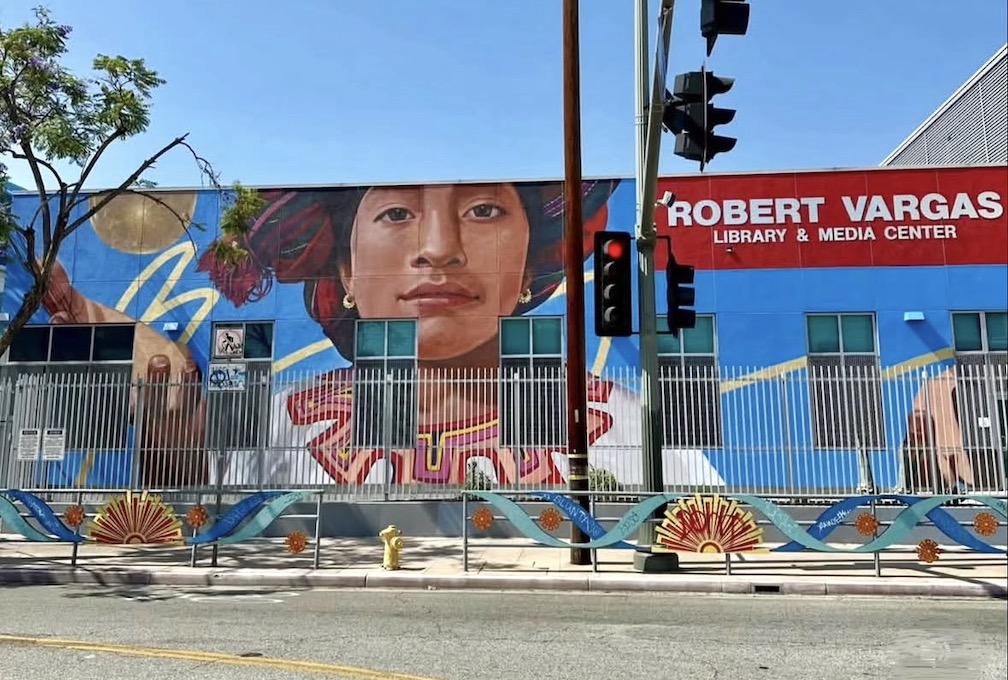
The Robert Vargas Library and Media Center at Mendez High School in Los Angeles
Speaking at the LAUSD dedication ceremony at Mendez High School just this month, Vargas reflected on the responsibility he feels while creating work depicted in his hometown.
“I’ve painted from Tokyo to Dubai, Paris to Melbourne, but when I create murals here at home in Los Angeles, I feel parental about the kind of messaging that I put out there,” he said. “I’ve always felt that an artist has the ability to shape the way a city’s history is written, and with each piece I am able to do just that.”
He also encouraged students to continue dreaming, creating and advocating for opportunities for self-expression through the arts.
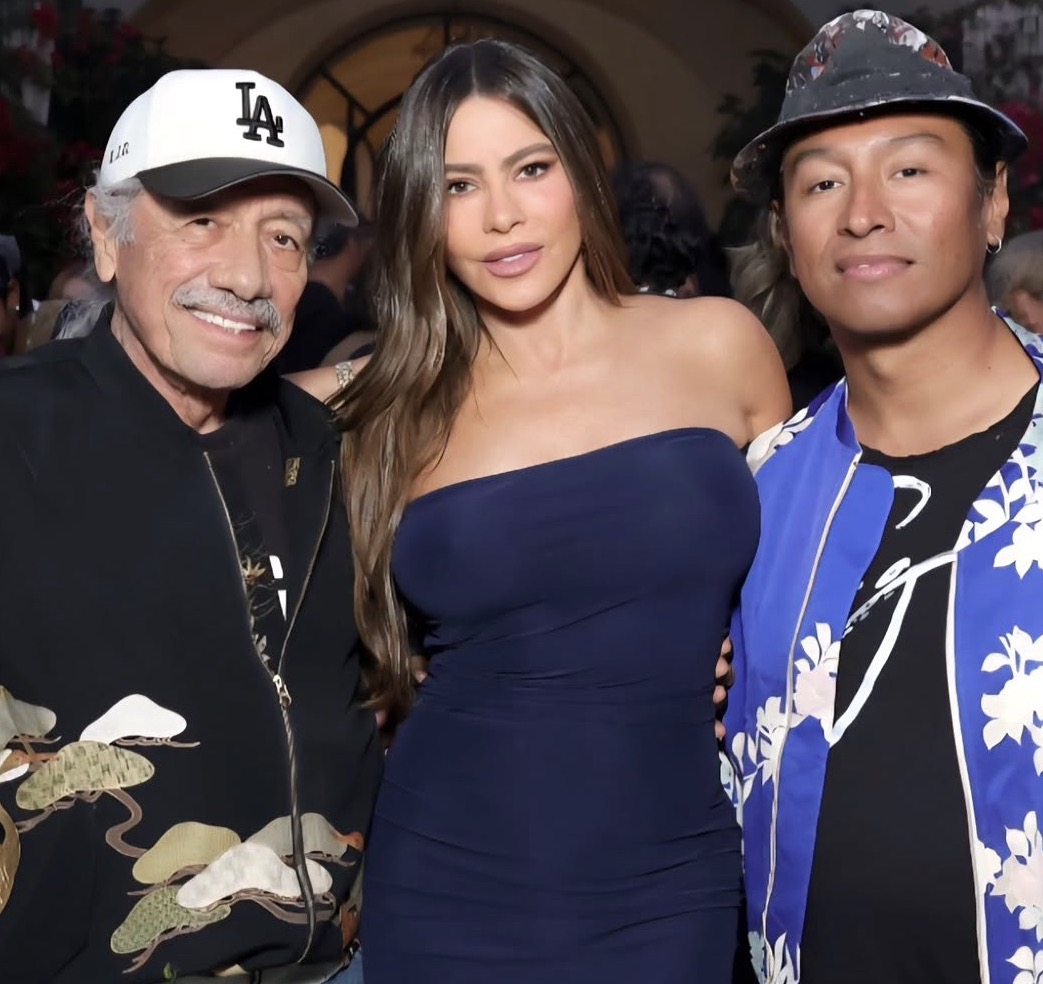
Edward James Olmos (left) and Robert Vargas, donning new pieces from the clothing line, flank Sofia Vergara at the recently held Culture Makers event in June.
That same spirit of cultural exchange is now extending into clothing. Not a complete stranger to fashion, Vargas has attended local Fashion Week events and even hosted fashion/art events in the past. Also known for painting live art portraits, Vargas has even been known to take a brush to clothing and even skin, producing instant wearable art. But his newest passion will bring a line to the masses by producing high-quality pieces.
For months, Vargas has been quietly wearing prototypes of kimono-inspired jackets while traveling between Los Angeles and Japan.
His upcoming collection, expected to launch in late 2026 or early 2027, will feature upcycled vintage kimonos transformed into contemporary wearable pieces including happi-style coats, blazer-inspired silhouettes, hooded jackets and streetwear designs. The garments will be unisex and sold in both Japan and the U.S., first online, but hopefully eventually in retail stores as well.
Leading the production effort in Japan is Hiroshi Kuroyanagi, Vargas’ Japanese counterpart and business partner, who has spent years developing the concept through his brand, J Samurai.
Kuroyanagi, a native of Fukuoka in Japan’s Kyushu region, refers to himself as a typical “Kyushu danji” (九州男児 ) even though he has spent equal amounts of time in both the U.S. and Japan.
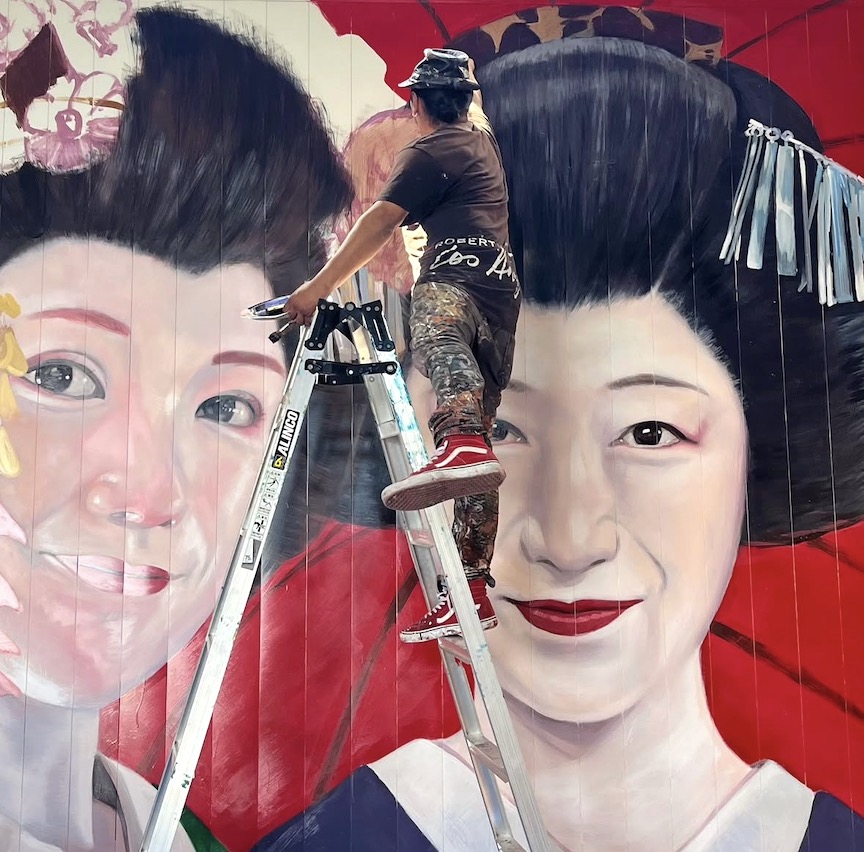
Vargas paints the 2025 completed mural “Generations,” located in Sakata, Yamagata, Japan, which captures Sakata Maiko.
Kuroyanagi first met Vargas while watching a Dodgers game in Little Tokyo at a local eatery with his son. If his last name sounds familiar, it’s because his son is actually Roy Kuroyanagi, founder of the popular Little Tokyo-based brand Japangeles.
Roy made the introduction between his father and Vargas, which led to him sharing examples of his kimono remake jackets. Vargas, accompanied by actor and friend Edward James Olmos, was immediately impressed with the jackets and loved the designs.
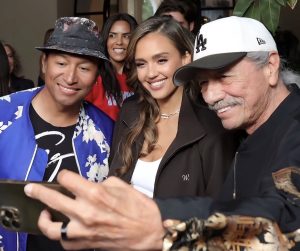
Pictured (from left) are Vargas, Jessica Alba and Edward James Olmos donning new fashion pieces at June’s Culture Makers event.
One of the pieces presented that evening had actually been custom-made for actor Nicolas Cage, but Hiroshi Kuroyanagi later fulfilled his promise to create original jackets specifically for Vargas and Olmos. Those designs have since become staples that both men have worn in their public appearances at multiple high-profile cultural and entertainment events throughout Los Angeles.
For Hiroshi Kuroyanagi, the project represents more than fashion. “The kimono is one of the most iconic symbols of Japanese culture,” he said. “By transforming kimonos into jackets that are easier to wear casually and comfortably throughout the year, I hoped to create opportunities for people around the world to connect with Japanese culture.”
He believes that Vargas is uniquely suited to help share that vision. “Robert is the ideal person to represent that vision,” Kuroyanagi said. “He has already created numerous outstanding murals celebrating Japanese and Japanese American culture. He genuinely loves Japan and possesses a deep understanding of Japanese culture.”
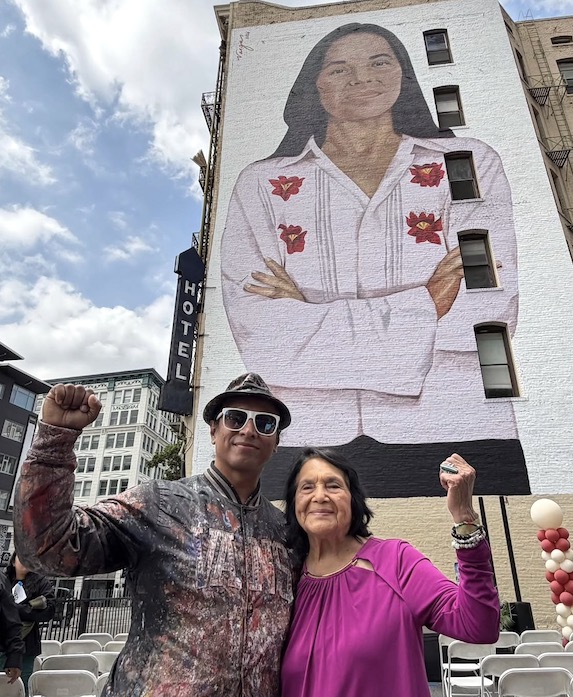
Robert Vargas and Dolores Huerta in front of his “Walking Into History” mural in Downtown Los Angeles.
Their partnership reflects a philosophy Vargas often speaks about: allyship. “Supporting each other is so important,” Vargas said. “If only one group is advocating for itself, that’s one thing. But when people from different backgrounds come together and support each other, the message becomes stronger.”
That belief can be seen in every chapter of Vargas’ career — from murals honoring Japanese baseball stars and civil rights icons to educational outreach and now fashion.
Whether wielding a paintbrush or reimagining centuries-old textiles into modern garments, Vargas remains focused on his mission. Although his canvas may be changing, the message remains unmistakably the same: building bridges, creating representation and pride and inspiring the next generation of creatives.
Keep up with Robert Vargas on his Instagram at @therobertvargas or visit www.instagram.com/therobertvargas. To learn more about Hiroshi Kuroyanagi’s J Samurai brand, visit https://j-samurai.com.
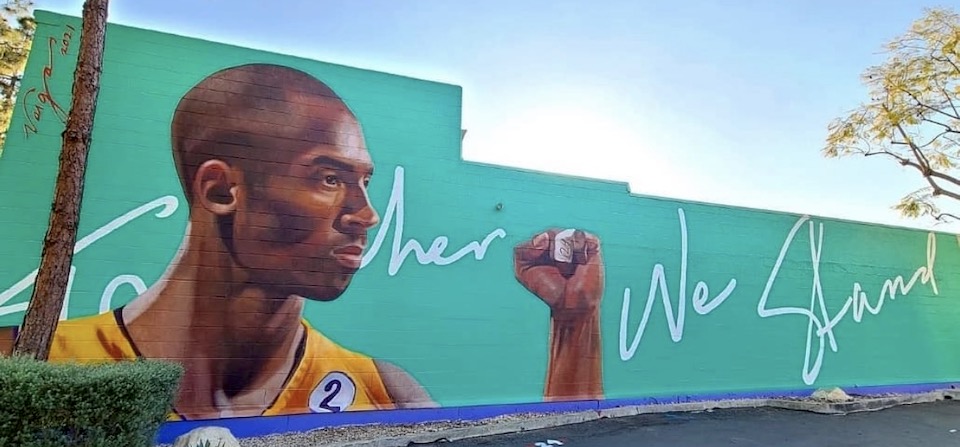
Vargas’ “Together We Stand” Kobe Bryant mural is located in Culver City, Calif.