
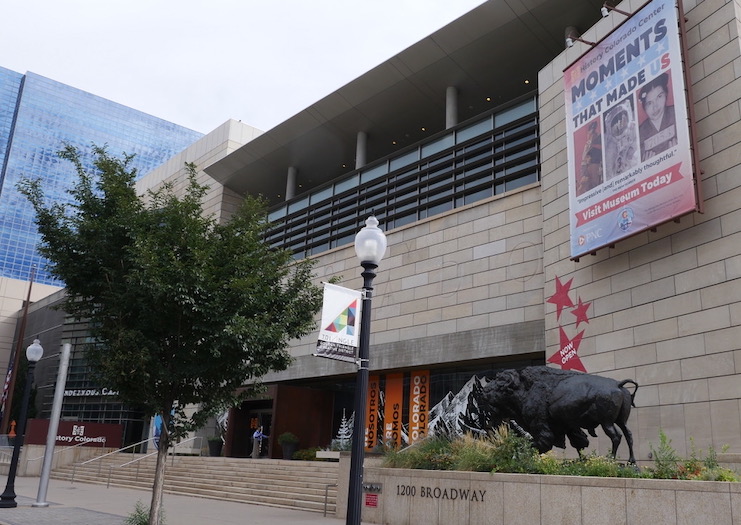
History Colorado Center was the primary venue of the APIAHiP four-day forum. (Photos: Gil Asakawa)
The biennial forum pays tribute
to the state’s deep history of Asian communities.
By Gil Asakawa, P.C. Contributor
APIAHiP, the only national organization that focuses on preserving the histories of Asian American, Native Hawaiian and Pacific Islander communities, held its biennial forum, a four-day conference that paid tribute to the often-forgotten history of the Asian diaspora through the U.S. with the spotlight focused on Colorado, from Sept. 10-13.
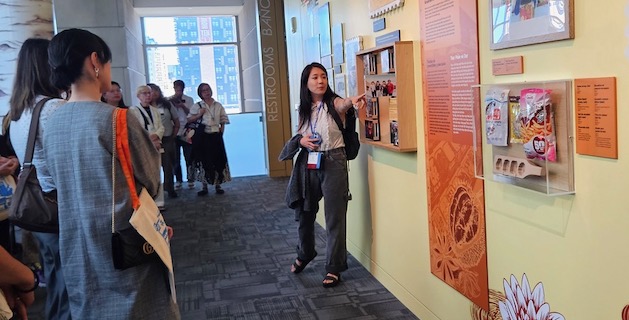
Joie Ha, executive director of CAPU, shows participants the “Big Dreams in Denver’s Little Saigon” exhibit at History Colorado Center.
The event was jam-packed with speakers, panels and presentations from morning to night, much of it held at the History Colorado Center, a museum that is currently displaying an exhibit chronicling the history of Denver’s New Saigon district and the region’s Southeast Asian diaspora.
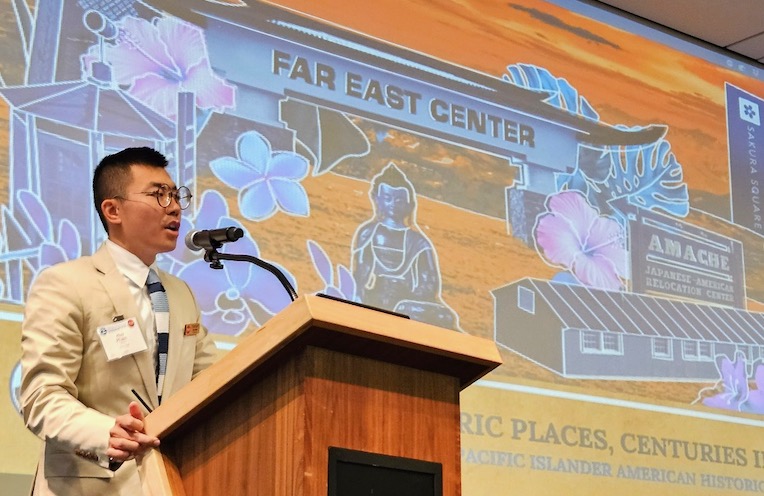
APIAHiP Executive Director Huy Pham offers opening remarks.
The museum in 2025 also hosted a groundbreaking exhibit that educated the public about the Chinatown that once thrived in the city’s Lower Downtown neighborhood and the remnants of Chinese immigration in the mid-1800s. Both of those exhibits were curated by Colorado Asian Pacific United, the nonprofit organization who partnered with APIAHiP, whose full name is Asian & Pacific Islander Americans in Historic Preservation, to bring the forum to Denver.
The event kicked off on Sept. 10 with welcoming words by leaders of APIAHiP, History Colorado and CAPU. APIAHiP Board Chair Rosalind Sagara noted that “in my new role as board chair, I have been reflecting on APIAHIP’s impact, our growth as an organization and where we’re going. For me, APIAHiP has been like a life raft on my own path into heritage conservation.” She embraced the more than 200 attendees as fellow travelers on the journey.
“Our theme this year is ‘Emerging Historic Places, Centuries in the Making,’ [and it] affirms that our histories are not new but are deep and rich,” she said. “We are proud of our histories, our stories, our communities, and we are meeting the moment.
“This theme also speaks to the core of APIAHiP’s mission,” she continued. “We believe in protecting and investing in living communities, intangible heritage and the cultural touchstones that tell a fuller story of America. Preservation is not just about safeguarding buildings or architecture.”
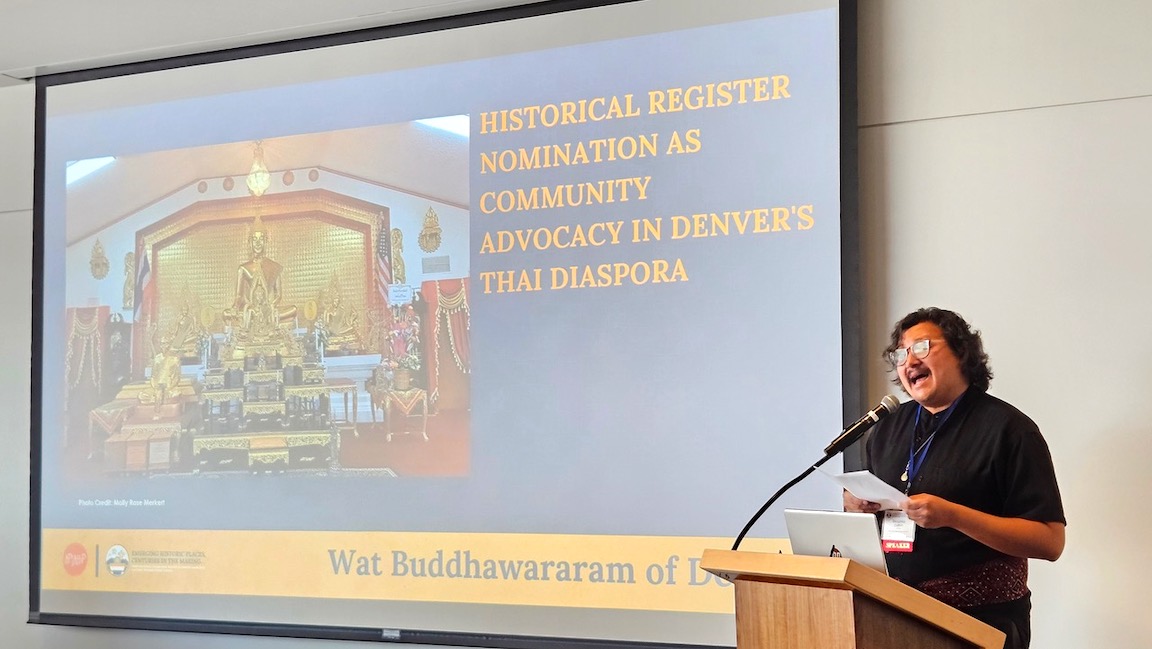
Prof. Ben Cefkin explains the history of the Thai Temple Wat Buddhawararam.
That theme has been at the heart of APIAHiP since its inception in 2007. The organization was the idea of Bill Watanabe, a familiar name to Los Angeles Japanese Americans, as he was the founding executive director in 1979 of the Little Tokyo Service Center, an organization that provides social welfare, community development and housing services, as well as focuses on cultural preservation. Watanabe attended a historic preservation conference in the early 2000s and was frustrated that Asian American history didn’t seem important to the movement.
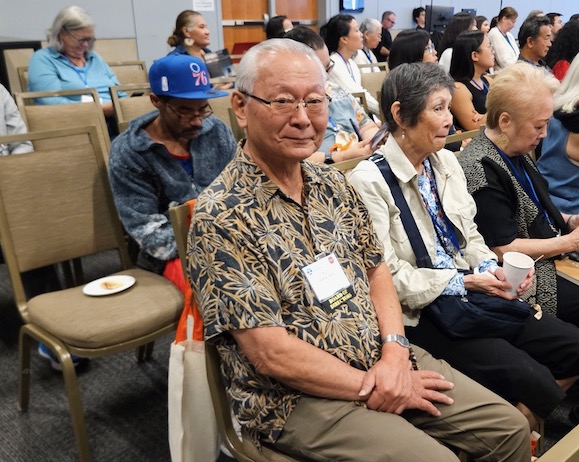
Bill Watanabe, founding executive director of the Little Tokyo Service Center, helped create the APIAHiP in 2007.
“At the time, the Chinese Historical Society, they were meeting already,” Watanabe said at the Denver forum, which he attended as a founding board member. Hoping to engage other Asian American communities to protect their heritage, he attended the 2005 conference of the National Trust for Historic Preservation.
“I looked around. I could count the number of Asians on one hand, and I thought, ‘Where’s all the Asians?’ Yeah. It’s like we didn’t count. We weren’t a part of it,” said Watanabe.
So, he helped create APIAHiP in 2007. “I thought, ‘Oh, maybe we need to start our own organization,’” he recalled.
The first forum was held in San Francisco in 2010. And compared to just a handful of Asians at the National Trust conference that inspired APIAHiP, there were about 100 attendees. This year, he said, 2,018 people registered for the forum.
Programming included panel discussions about national topics such as the Asian and Pacific Islander Americans’ Most Endangered Places (which included Paul Hiroshi Boyea of the Terminal Islanders Assn. and Barbara Takei of the Tule Lake Committee), challenges facing rural Asian American sites (which included JACLers Rob Buscher and Hanako Wakatsuki-Chong of the Japanese American Museum of Oregon) and a discussion of Lost Chinatowns.
There was also a panel featuring CAPU staff, “After the Buildings Are Gone: Preserving Denver’s Chinatown Without Walls.” And many of the other sessions turned the spotlight on Denver and Colorado AANHPI preservation efforts as well.
Among the topics: the history of Filipinos in the state; the timeline of Japanese immigration and the development of Denver’s “Tiny Tokyo” Sakura Square (moderated by this writer); the rise of the Korean and Vietnamese communities; historic designation for the oldest consecrated Thai Buddhist temple in the U.S., Wat Buddhawararam; the arrival of the Hmong and Nepali populations; and the impact of the area’s Native Hawaiians and Pacific Islanders.
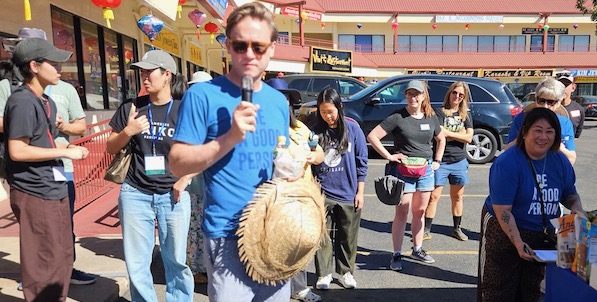
Denver Mayor Mike Johnston and City Council candidate Tran Nguyen-Wills (right) participate in the Little Saigon cleanup.
Sept. 12 was set aside for two field trips, one that featured walking tours of downtown Denver’s Chinatown and Sakura Square, then the Far East Center and Little Saigon Business District in west Denver, where the Southeast Asian community flourished. Then it was on to Koreatown and the eastern suburb of Aurora, which included lunch at a Korean barbecue restaurant and a walking tour of a Koreatown mall, followed by a stop at the newly created Korean War Memorial, which was dedicated on July 27. The trip ended with a reception at the Aurora History Museum, where an exhibit about the history of Filipinos in the city is on display. Other attendees took a bus tour to southeast Colorado to learn about and explore Amache, Colorado’s Japanese American concentration camp, which is now a national park historic site.
The final day began with a “Beautify Little Saigon” service project to pick up trash in the neighborhood, which was also attended by Denver Mayor Mike Johnston. The forum ended with closing comments at Denver’s Botanic Gardens, which includes a large Japanese garden, a historic teahouse and the Bill Hosokawa Bonsai Pavilion, which pays tribute the longtime Denver Post editor and Pacific Citizen columnist.
After four days of inspiring discussions and presentations, even cynical know-it-alls have to admit that they didn’t know everything, and everyone learned a lot about the history and heritage of AANHPIs in Denver and across the country.