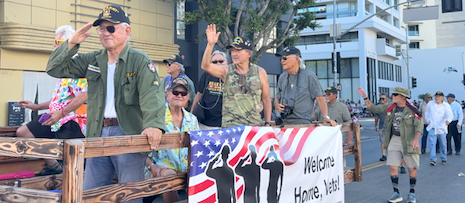
Army veteran Kiyo Fukumoto salutes the crowd from the veterans parade float during Nisei Week in Los Angeles. (Photo: Don Bannai)
By David Miyoshi
Japanese American military veterans once again stepped onto the streets of Little Tokyo in Los Angeles — not simply as parade participants, but as the living continuation of a proud tradition — when they participated in the Nisei Week Grand Parade on Aug. 16.
The veterans represented service across generations, from the Korean War and Vietnam to Iraq and Afghanistan. Different eras had shaped them, and different uniforms had once identified them, yet as they marched together in the parade, they shared a common purpose: to honor those who came before them, stand beside those who served with them and ensure that the Japanese American record of military service remains visible to the generations that follow.
Before the contingent stepped off, the veterans enjoyed a Hospitality Suite gathering hosted by the Veterans Memorial Court Alliance and the Asian American Community Media Project, where they had the opportunity to share old war stories.
Following the gathering, the veterans convened together at the Japanese American National War Memorial Court for a group photograph. This image captured more than a parade formation. It preserved a rare assembly of men and women whose service spans decades of American history — and whose presence affirms that the legacy of Japanese American military service did not end with World War II.
That legacy has deep roots in Nisei Week. Founded in 1934, the festival was suspended for eight years during WWII, when Japanese Americans were forcibly removed and incarcerated. When Nisei Week returned in 1949, Japanese American veterans marched in the parade for the first time. Among them were men who had served in the 100th Infantry Battalion, the 442nd Regimental Combat Team and the Military Intelligence Service.
Their march carried extraordinary meaning. They walked in uniform through the same Little Tokyo community from which families had been uprooted. Their presence embodied courage without bitterness, patriotism tested by injustice and a community determined to rebuild. What began in 1949 became one of Nisei Week’s most-honored traditions.
The veterans who marched in 2026 inherited that tradition, but they also enlarged it. They brought with them memories of the frozen Korean Peninsula, the heat and uncertainty of Vietnam and the deserts and mountains of more recent wars. Each answered the nation’s call in a different time. Together, they demonstrated that service is not confined to a single celebrated generation; it is a continuing commitment renewed by those willing to accept its burdens.
For spectators along the parade route, the veterans were a reminder that history can be encountered face to face. Their measured steps, shared formation and quiet pride joined past and present. They honored the Nisei soldiers who opened doors through sacrifice, the families who endured separation and loss and the veterans of later generations who carried the legacy forward in their own way.
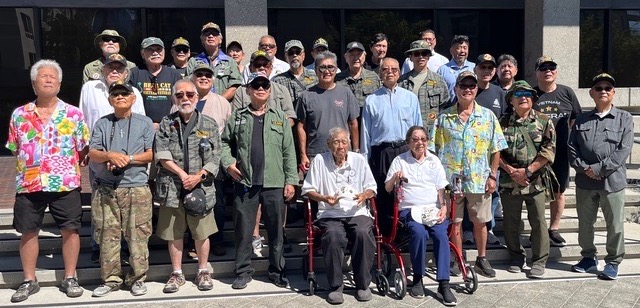
Veterans spanning several wars participated in a group photo before taking part in the 2026 Nisei Week Grand Parade.
Photo: Robert Horsting
The 2026 march was therefore more than ceremonial. It was an act of remembrance, fellowship and public witness. VMCA and AAcomp helped bring these veterans together and preserve the moment in photographs and video, but the veterans themselves gave the occasion its meaning. By marching, they made history visible — and reminded all who watched that the Japanese American tradition of service is not merely remembered. It is still moving forward.
(This article was first published in the Asian American Community Media Project (AAcomp) newsletter.)