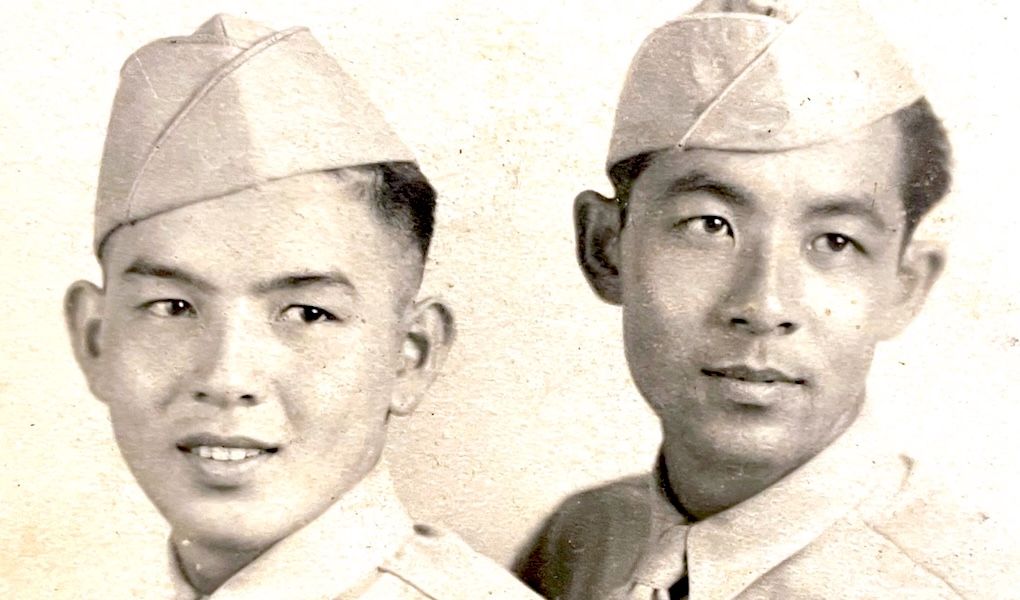
Brothers Albert “Oscar” Tsukayama (left) and Conrad “Joe” Tsukayama from Kailua, Hawaii, served in the 442nd RCT and 100th Battalion, respectively. Both experienced combat during World War II. (Photo: Courtesy of the Tsukayama Family)
By Hayley Tsukayama
(Editor’s Note: Following is the author’s account of her Sept. 2-10 participation in the Nisei Legacy Tour, which focused on the historical exploits of the 100th Battalion and the 442nd Regimental Combat Team’s combat experiences in Italy during World War II. Tsukayama’s grandfather and great-uncle were members, respectively, of the 442nd and 100th Battalion.)
The first solemn notes of “Taps” fill the air. It’s Sept. 9 in Anzio, Italy, and we’re at the Sicily-Rome cemetery of the American Battlefield Memorial Commission. We’re ending a weeklong tour tracing the steps of the 100th Battalion in this solemn place, where Italian umbrella pines shade the paths between rows of stark-white marble headstones.
We’re told as we arrive that our timing is perfect. Today is the first-ever “National World War II Italian Campaign Remembrance Day.” Could we participate in a small ceremony?
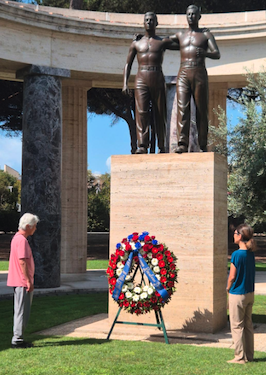
Members of the Nisei Legacy Tour place a wreath to commemorate the first-ever “National World War II Italian Campaign Remembrance Day” on Sept. 9, 2026. (Photo: Courtesy of Nora de Bievre)
The weather has been sweltering for days. Even the next three notes of the trumpet seem to hang in the languid heat. But as two members of our group lay a wreath in the central courtyard, I get goosebumps.
The 100th Battalion and 442nd Regimental Combat Team did some of their fiercest, most-decorated fighting in Italy. When they landed there in 1943, the roughly 1,300 men of the 100th Battalion joined the massive Fifth Army that swept up the peninsula toward Rome. The cemetery we visited honors nearly 11,000 American soldiers who died or went missing during the World War II battles between Sicily and Rome. Yet, the remembrance day we celebrated in Anzio was only officially designated by Congress last year, 80 years after the war ended.
These men liberated Rome, the first Axis capital freed from Nazi occupation, on June 4, 1944. They were then quickly overshadowed by the D-Day landings two days later. Because of this, the fighting in Italy is sometimes called the “Forgotten Campaign” or the “Forgotten Theater.”
That’s one reason we came on this Italian tour run by Nora De Bievre of Nisei Legacy Tours: to learn about an overlooked piece of our own histories. An atypical Italian vacation for tourists, we walked with our family ghosts from Salerno to Cassino to Anzio toward Rome. Along the way, we met the Italians keeping their stories alive.
Especially in its early days, the 100th Battalion — formed first and with some experienced troops — was thought of as a “big brother” battalion to the 442nd RCT. Our family reflects this relationship. My grandfather, Albert “Oscar” Tsukayama, was a 442nd RCT medic. His oldest brother, my great-uncle Conrad “Joe” Tsukayama, was already in the Army when America entered the war and served in the 100th Battalion. Both spent part of the war in Italy.
I had already researched where my grandfather had fought in Italy with the 442nd RCT. For Conrad, though, I relied mostly on family lore. I knew he had fought in the fierce Battle of Monte Cassino, a fact I could not reconcile with the loving man I remembered. I also knew he was the first one in the 100th to be injured and the first to go “reverse AWOL,” or discharging himself from the hospital to go back to the battlefield. That was easier to picture from what I knew of him, but I had never looked into the story.
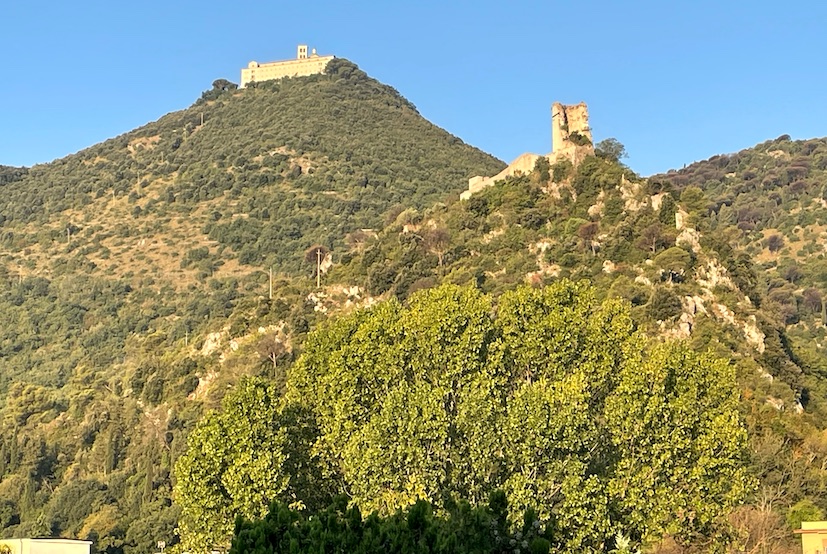
A view of Montecassino Abbey and Castle Hill, which the 100th Battalion fought to secure. (Photo: Dean Tsukayama)
On Day Four, we drove through the mountain town of Montemarano. We came from Paestum, near where the 100th Battalion landed on the beaches. The troops then marched and drove about 60 miles to this mountain town, climbing in rain and mud to nearly 2,700 feet above sea level. They pursued Germans who were methodically retreating toward their own defense lines. It wasn’t a particularly easy drive for us on paved roads with an experienced driver in 2026. To walk it during the war, carrying packs and constantly looking for German traps, must have been terrifying.
It was somewhere along that road, Nora told us, that a mine explosion caught my Great-Uncle Conrad and injured his face.
I looked around the small mountain town that, even now, seemed a bit isolated. I thought about Uncle Conrad and the man he was. Suddenly, I could see him deciding that taking mine shrapnel to the face was less important than bunking in the mud with the men he’d trained with. They were not in Kailua, Hawaii, anymore; they had to stick together. Even in idyllic sunshine rather than muddy terror, being where he’d been made the family stories real in a new way.
That happened countless times during the tour. Most people on the tour had some connection to the 100th. Their fathers, grandfathers and uncles had, in many cases, shared similarly vague outlines of stories but rarely in depth.
In some ways, one does have to see it to understand. The stories take on new depth when one understands the force of the rivers and the harshness of the terrain. At the engrossing Venafro Winterline Museum, run by two friends born after the war but raised in its aftermath, we saw the gear that soldiers carried and drove the ridges and passes they walked. We looked up to where German guns once perched on mountaintops and imagined being told to take those positions as death rained from the sky.
Later in the tour, we went to the spot where Lt. Young Oak Kim and PFC Irving Akahoshi, whose daughter was on the tour, both crawled 250 yards across an open field to take a German machine-gun nest. Let me tell you: Thinking about crawling that far is very different than seeing how far it really is.
Apparently the Germans, Winterline Museum curator Luciano told us, were surprised about the men who looked like their allies, but were not fighting for the Allies. They were even more surprised that the Japanese Americans particularly didn’t seem to duck or stop when they were shot at. They kept moving.
The Italians, however, did not focus on the Japanese faces under the helmets but rather their American uniforms. To the locals, they were just Americans.
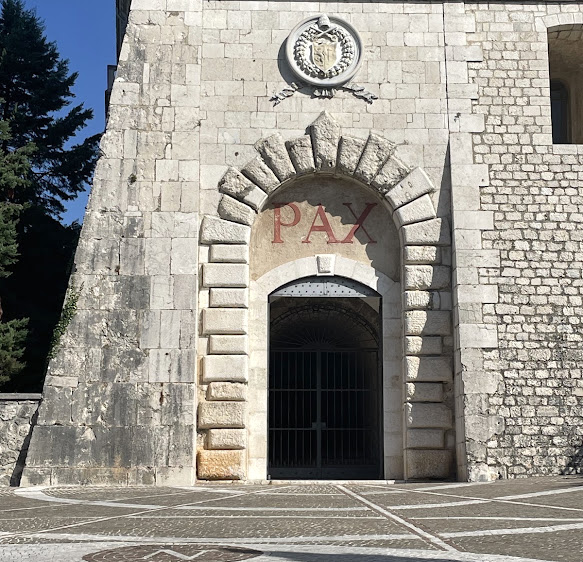
Pax Corner at Montecassino Abbey is the only part of the structure that survived a bombing attack in the Battle of Monte Cassino. (Photo: Hayley Tsukayama)
This was one thing I found refreshing about the history of the war as told by Italians. While they celebrated the Nisei soldiers and graciously sought to share those stories with us, they also put these men in a broader context.
At Montecassino Abbey, we learned about not only the Nisei and other Americans, but also the British, French and Canadian troops who fought there. We learned about Polish soldiers who fought for a country many never returned to, due to the post-war rise of Communism.
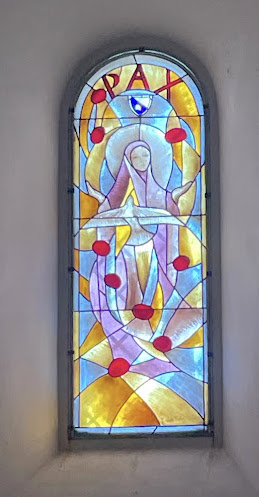
A stained-glass window commissioned by Nisei soldiers in Montecassino Abbey, featuring the 100th Infantry Battalion insignia (Photo: Hayley Tsukayama)
At the chapel there, the Nisei soldiers commissioned one of many stained-glass windows from different units. In Cassino itself, our hotel owner and local historian Pino Valente created a walking tour of the areas that includes a stop on Nisei soldiers.
That felt fitting. My grandfather did not like being called a hero, a common theme in veteran interviews. He and many other Nisei veterans wanted to celebrate their own history, of course, but also focus on their part in the broader war. Out of the American frame, I could see the whole picture more clearly.
Many Italians see the Japanese Americans as they, and even sometimes we today, were not seen at home — as just Americans. Early in the tour, as we listened to Nora talk about where the 100th Battalion landed on the beaches, an elderly woman approached us.
“Americani?” she asked. Yes, we said. A torrent of rapid Neapolitan Italian later, she told us how American soldiers saved her when she was 6 years old. Now in her 80s, Maria still feels deep gratitude for all Americans and had a hug for every member of the group who wanted one.
It was the first of many times I found myself in awe of the relationship the Italians we met hold with the history of their country. From the Winterline Museum curators Renato Dolcigno and Luciano Bucci, to Pino in Cassino, to cemetery staff in Anzio, people who were born long after the war are engaged deeply with their history. They have not forgotten and are determined none of us will either.
In contrast, a common theme among tour participants was the older generation’s reluctance to talk about the war at all. That is understandable, given that it is often painful. Still, the silence takes the reality of it away from future generations. It was notable to me that I was the only Yonsei on the tour, accompanying my parents.
In Italy, the history lives. It comes alive for us when we see it together, and we can say to each other what we can no longer say to those who are gone.
As we left the Anzio ceremony to place flags on the graves of 100th Battalion officers, I felt gratitude, grief and regret. We lost Grandpa in 2013; Conrad passed when I was in high school. While they were alive, I didn’t understand. Now, I can no longer ask.
I wished I could talk to them. In some ways, though, I felt like I just had.
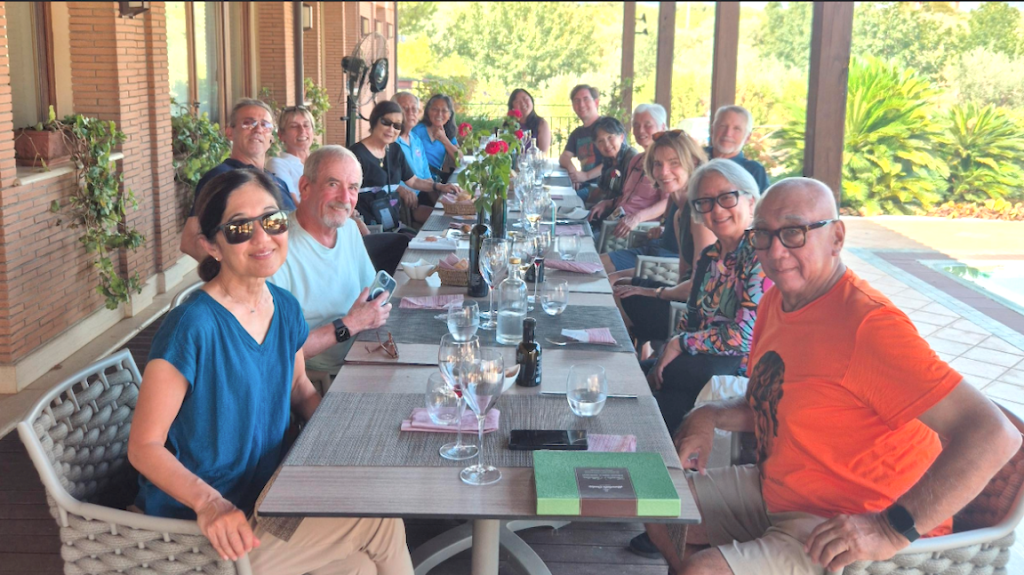
The Nisei Legacy tour group celebrates together at a local winery.