By Matthew Weisbly, JACL Education Programs Manager
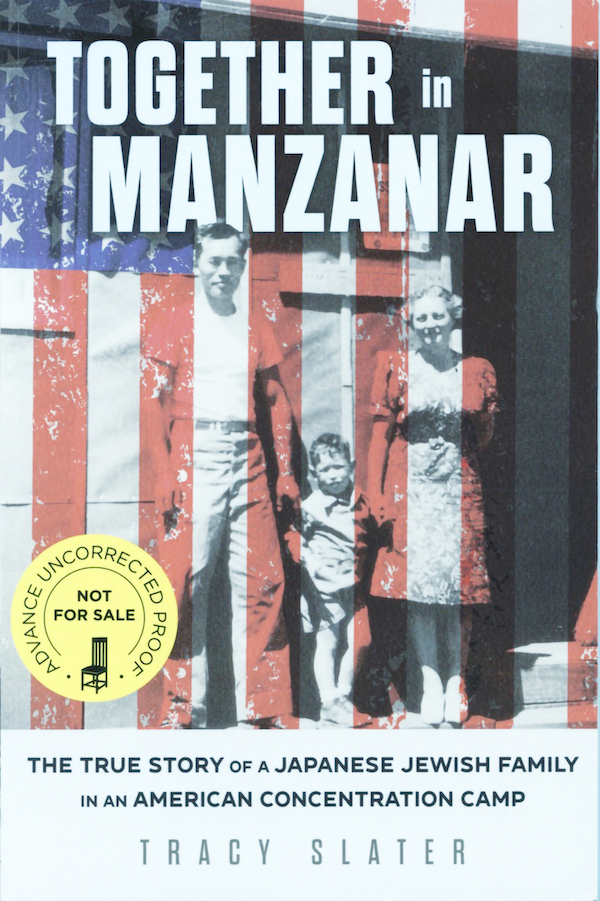 Growing up, I thought I was unique in having a Japanese and Jewish family. For much of my childhood, the only people who could relate to that experience were my siblings and some of my cousins, who also happened to be Japanese and Jewish. As I got older and went off to college, I finally found more people who shared that background and eventually discovered an entire community bonded by this identity.
Looking back on my family’s history with this unique heritage, I often thought about their experiences. On one side, my Sansei grandfather and his family were forcibly removed from their farm in Northern California and sent to the barren deserts of Arizona, where they remained even after the war ended. On the other, my more distant relatives in Ukraine and Poland, whose fates we would never truly know, were linked to the name Auschwitz-Birkenau in the small fragments we could uncover. It made me wonder if there had ever been anyone like me who lived through the war. For many years, I didn’t think there was, until I found out about “Together in Manzanar: The True Story of a Japanese Jewish Family in an American Concentration Camp.”
Written by Tracy Slater, an American writer based in Japan with her family, “Together in Manzanar” tells the true story of the Yonedas: Karl Yoneda, a Nisei labor organizer and activist; his wife, Elaine Buchman Yoneda, a second- generation Jewish American labor activist; and their son, Tommy. Together, they faced the horrors of incarceration.
Though not a long book, coming in at just under 250 pages without the index, it is rich in detail, deeply exploring the Yonedas’ lives, especially during the prewar years and throughout their wartime incarceration. While I’ll leave it to readers to discover more for themselves, the Yonedas were involved in some of the most significant events that took place in Manzanar during the war. In fact, the name Karl Yoneda may already be familiar to those who know Manzanar’s history particularly well.
It’s also worth noting that JACL’s own history plays a role in the Yonedas’ story. Again, I’ll leave it to readers to learn more as they go along, but it’s important to understand the role that JACL and its members played before, during and after the war. For some, that role was seen as invaluable and just in its actions; for others, JACL remains viewed as a collaborator that caused more harm than good within the Japanese American community.
This is a history that I believe is important for us, as both an organization and a community, to continue with which to reconcile. While that conversation lies beyond the scope of this article, this story could provide a meaningful starting point for some of these conversations.
In the end, the story of Karl, Elaine and Tommy reminds us that among the more than 125,000 people incarcerated during the war, there are truly 125,000 individual stories and experiences to be shared. Even now, 80 years later, we continue to uncover new stories that expand our collective understanding of and remembrance of the incarceration.
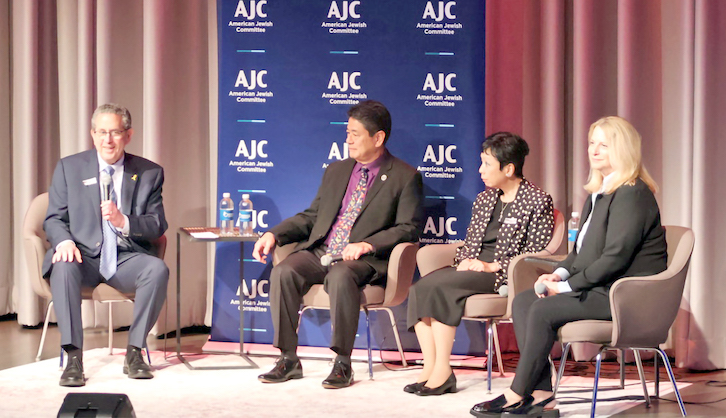
(From left) Richard Hirschhaut, Mitch Maki, Yuko Kaifu and Vivian Alberts participate in a panel discussion at the Los Angeles Museum of Tolerance on May 29 following the premiere of the short documentary “Pilgrimage to Manzanar.” (Photo: George Toshio Johnston)
As with many books that attempt to tell a comprehensive account of the incarceration, there is a lot to keep track of, names, locations, organizations and events, which may make the book feel a bit dense at times. Yet, that very detail adds depth and immerses the reader in the experiences of the Yonedas. For anyone who studies or reads about the wartime Japanese American incarceration, this book is certainly one to pick up and add to your reading list.
“Together in Manzanar: The True Story of a Japanese Jewish Family in an American Concentration Camp” is available for purchase online and in bookstores nationwide.
Sidebar: Shared Experiences in ‘Pilgrimage to Manzanar’
A short documentary premieres at L.A.’s Museum of Tolerance.
By P.C. Staff
Members of the Japanese American and Jewish American communities in Los Angeles joined hands earlier this year to celebrate the premiere of the short documentary “Pilgrimage to Manzanar” at the Museum of Tolerance.
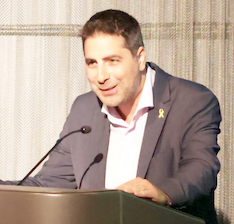
“Pilgrimage to Manzanar” filmmaker Odin Odzil (Photo: George Toshio Johnston)
The movie, directed by filmmaker Odin Odzil, recalls the Manzanar Pilgrimage that took place in 2023 (see May 19, 2023 Pacific Citizen, tinyurl.com/ykm9y3nr), when members of the American Jewish Committee, which produced the short, participated at the 54th annual gathering at the site of the former War Relocation Authority Center. More than 10,000 U.S. citizens of Japanese ancestry and Japanese nationals then-barred from becoming naturalized U.S. citizens were incarcerated at Manzanar, one of 10 WRA camps operated by the federal government during World War II.
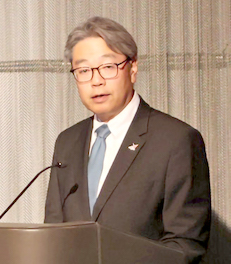
Naoshige Aoshima, deputy consul general of Japan (Photo: George Toshio Johnston)
The May 29 event was an opportunity for the two communities to explore unity amidst the shared experience of having been “othered” by dominant societal forces. Deputy Consul General of Japan Naoshige Aoshima addressed the audience, as did the AJC’s Marcie Goldstein; Odzil; and Vlad Khaykin, Simon Wiesenthal Center executive vp of social impact and partnerships, North America.
Following the screening, a panel discussion moderated by AJC Los Angeles Regional Director Richard Hirschhaut took place. It featured Go for Broke National Education Center President and CEO Mitch Maki, Japan House President Yuko Kaifu and AJC Intergroup Committee Chair Vivian Alberts, who helped organize the AJC’s participation in the Pilgrimage.
To view a trailer to “Pilgrimage to Manzanar,” visit tinyurl.com/mrnpv624.