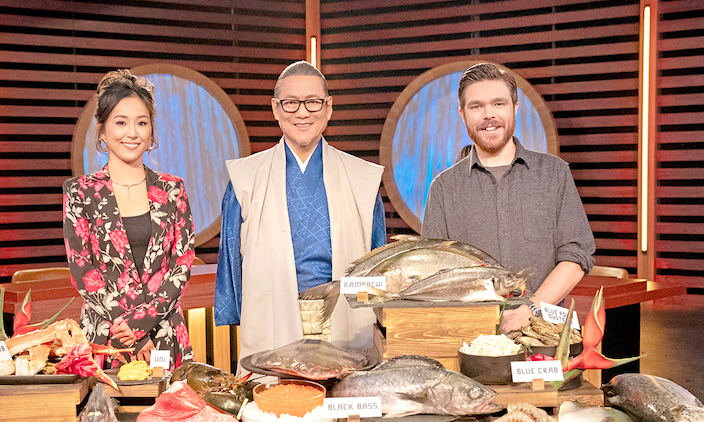
“Morimoto’s Sushi Master” features (from left) host Lyrica Okano, chef Masaharu Morimoto and judge Phillip Frankland Lee. (Photos: Courtesy of Roku Channel)
Chef Masaharu Morimoto continues to build
his food empire with a TV series and his ever-growing restaurants.
By Gil Asakawa, P.C. Contributor
You’d be hard-pressed to find a Japanese chef that’s better-known in the West as Masaharu Morimoto. Sure, Rocky Aoki brought Benihana to New York City in 1964, but he wasn’t a chef, just a brilliant entrepreneur who wanted to introduce elements of Japanese food to America. And Nobu Matsuhisa became famous for his international chain of high-end restaurants combining Japanese with Peruvian cuisines.
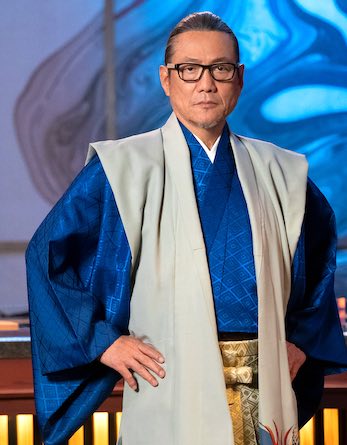
Chef Masaharu Morimoto
But Morimoto wins the celebrity sweepstakes hands-down because he has built his brand with a savvy mix of restaurants and TV appearances in the Food Network and streaming media age.
The 70-year-old Hiroshima-born chef came to the U.S. in the 1980s and eventually worked for Matsuhisa’s flagship Nobu restaurant in New York City. In 1998, Morimoto found his brand identity on the original Japanese version of “Iron Chef,” battling other chefs with creative, East-eats-West combinations of ingredients and presentations.
He became the most familiar Japanese face (except for part-Japanese and Filipino actor Mark Dacascos, who played the role of “The Chairman” in the long-running series) of “Iron Chef America” when Food Network brought the cooking competition to American audiences in 2005.
Morimoto wielded his knives on “Iron Chef America” until 2012 but focused mainly on running restaurants, including his newest, which opened this year, MM by Morimoto in Montclair, N.J. But in 2023, he returned to the small screen to helm “Morimoto’s Sushi Master” on the Roku streaming platform.
The series has sushi chefs from across the U.S. competing to win Morimoto’s nod as the champion after tackling a series of challenges making all types of sushi. The series, led by Morimoto and hosted by Lyrica Okano and featuring judge Phillip Frankland Lee, completed Season 1 with champion Frances Tariga, who took home a $25,000 grand prize; Season 2 is now available to stream for free on the Roku Channel.
Morimoto spoke recently with Gil Asakawa for the Pacific Citizen about his ever-growing global food empire, culinary career and what he thinks will be the “next big food” from Japan to make it big in the U.S.
The Pacific Citizen: How do you feel about pronunciations? So many Japanese words are mispronounced by non-Japanese and personally, including some of the chefs competing on “Morimoto’s Sushi Master.”
Masaharu Morimoto: Pronunciation is something I do notice. It is true that Japanese sounds can be challenging for people who do not speak the language, and I truly appreciate the effort everyone makes to use the Japanese words when they talk about our food. For me, this is not about needing perfect Japanese speech. It is about showing respect for the food itself, for its long history, and for the culture where it comes from. When you try to say the name of a dish or an ingredient correctly, it helps you feel a stronger connection to it. It makes the experience of enjoying the food even deeper. So, I am always grateful for the effort people put into trying.
The P.C.: You came to America pretty young in 1985, after having a restaurant in your hometown of Hiroshima. How did you come to develop your “fusion” vision for Japanese food in the U.S.?
Morimoto: When I came to America, it was a completely new environment for me. I first worked in traditional Japanese restaurants here. But I saw so many different ingredients available, some I missed from Japan, but also many wonderful things I had never used before. My idea of “fusion” didn’t start from a plan. It happened naturally. I wanted to use my Japanese cooking skills and spirit as the base because that is who I am, but also use the great ingredients and ideas I found here in America. It was just my way of cooking, growing and changing in a new place.
The P.C.: You worked for a time at Nobu in NYC — you have seen the acceptance of Japanese cuisine in America. Are you surprised at how Nihonshoku has been accepted even in Middle America, not just in the major cities?
Morimoto: Working at Nobu in New York was a great experience. We saw how much people in a big American city loved Japanese food, especially sushi, and it’s been great seeing the appreciation continue to spread throughout America. It makes me very happy. It shows that people are open, curious and like trying new foods. It is wonderful to see Japanese cuisine become something that people enjoy in so many different parts of the country, not just in big cities.
The P.C.: How do you feel about the fact that young people in the U.S. can today buy sushi in supermarkets across the country, not exactly the best quality but as a display of their sophistication?
Morimoto: The most important thing with sushi, especially for raw fish, is always the quality and safety. This is very important for your health. When you eat raw fish, I only recommend eating it if it is labeled “sushi-grade,” as it has been prepared under strict rules to control bacteria and parasites. If it does not have that label, eating it raw is risky. If you buy fish from the store, look for it to be firm and have a bright color. But even with that, you must still be very careful about eating it raw.
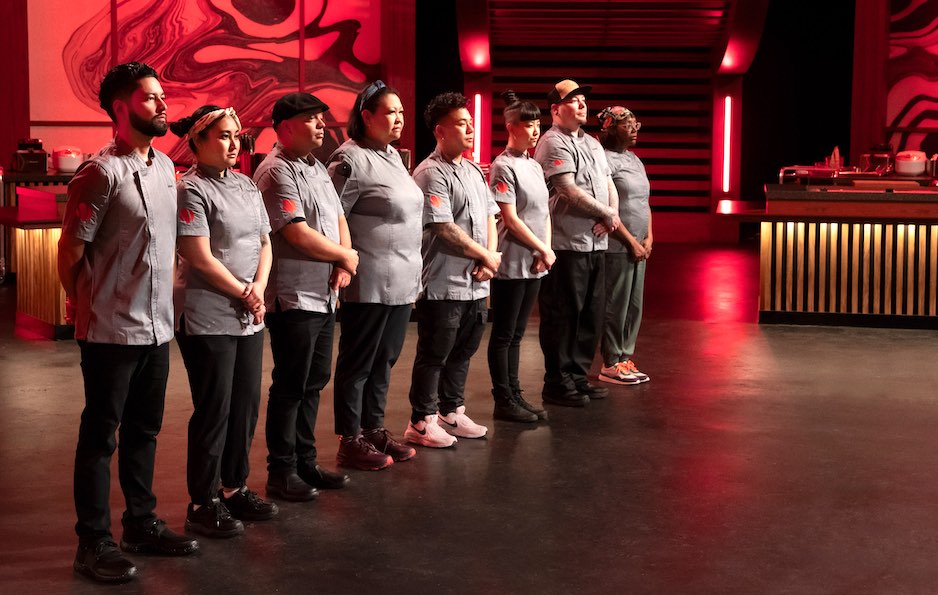
Eight new chefs are competing for the Season 2 title on “Morimoto’s Sushi Master.”
The P.C.: How do you feel about the California Roll, which my mother calls “inchiki (fake) sushi”?
Morimoto: It is true, it is not a traditional Japanese sushi roll, but it is very important. For many, many people outside of Japan, the California Roll was the very first sushi they tried. It was easy to eat because it has no raw fish and has helped millions of people feel comfortable trying sushi. It helped make sushi popular around the world. It is not traditional, but I respect its role in opening the door for so many people and appreciate kanikama (imitation crab) for the role it played in my upbringing.
The P.C.: You are the most familiar Japanese chef in the West, starting with your role in “Iron Chef.” Looking back on your career, are you surprised that you have become a worldwide celebrity, like a movie star of the culinary world?
Morimoto: Before the show, I was just a chef, focusing only on cooking good food in the kitchen. To be recognized all over the world is still surprising to me. I only wanted to be a better chef and share my passion for food. But if being known helps more people learn about Japanese food, about cooking, about enjoying meals, then I am happy for it. It gives me a bigger voice to talk about what I love. My work is still in the kitchen, but now many more people are watching.
The P.C.: After sushi and ramen and maybe tonkatsu, what do you predict will be the next Japanese dish or ingredient to become popular in the West?
Morimoto: I think the next thing to become really popular in the West could be different kinds of donburi. There are many kinds, like oyakodon, katsudon, or gyudon. Donburi is a complete, satisfying meal, and it uses ingredients that many people already know and like, served in a comforting way. I think donburi bowls are easy for people to try and love, and there are so many types that people won’t get tired of them.
Season 2 of “Morimoto’s Sushi Master” is available to view for free on the Roku Channel streaming platform at https://therokuchannel.roku.com/details/c362803410fcbd4a550cddfa99f908b3/morimotos-sushi-master.