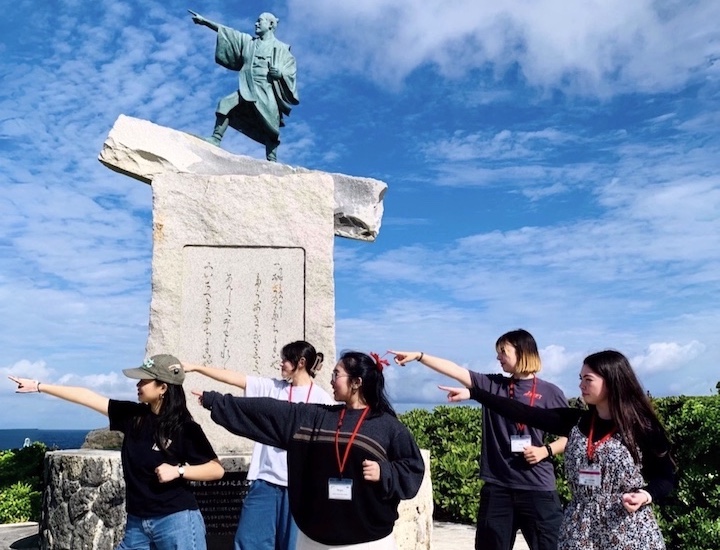
Kakehashi participants (from left) Jillian Stineman, Nanami Lillie, Megan Arakaki, Stella Saame and Annika Tamaki pose at the statue of Taiki, a Ryūkyūan diplomat of the Chūzan Kingdom during the late 1300s who is credited with establishing trade and cultural exchange with China. (Photo: Courtesy of Jillian Stineman)
Remaining curious helps one participant explore the roots of her identity.
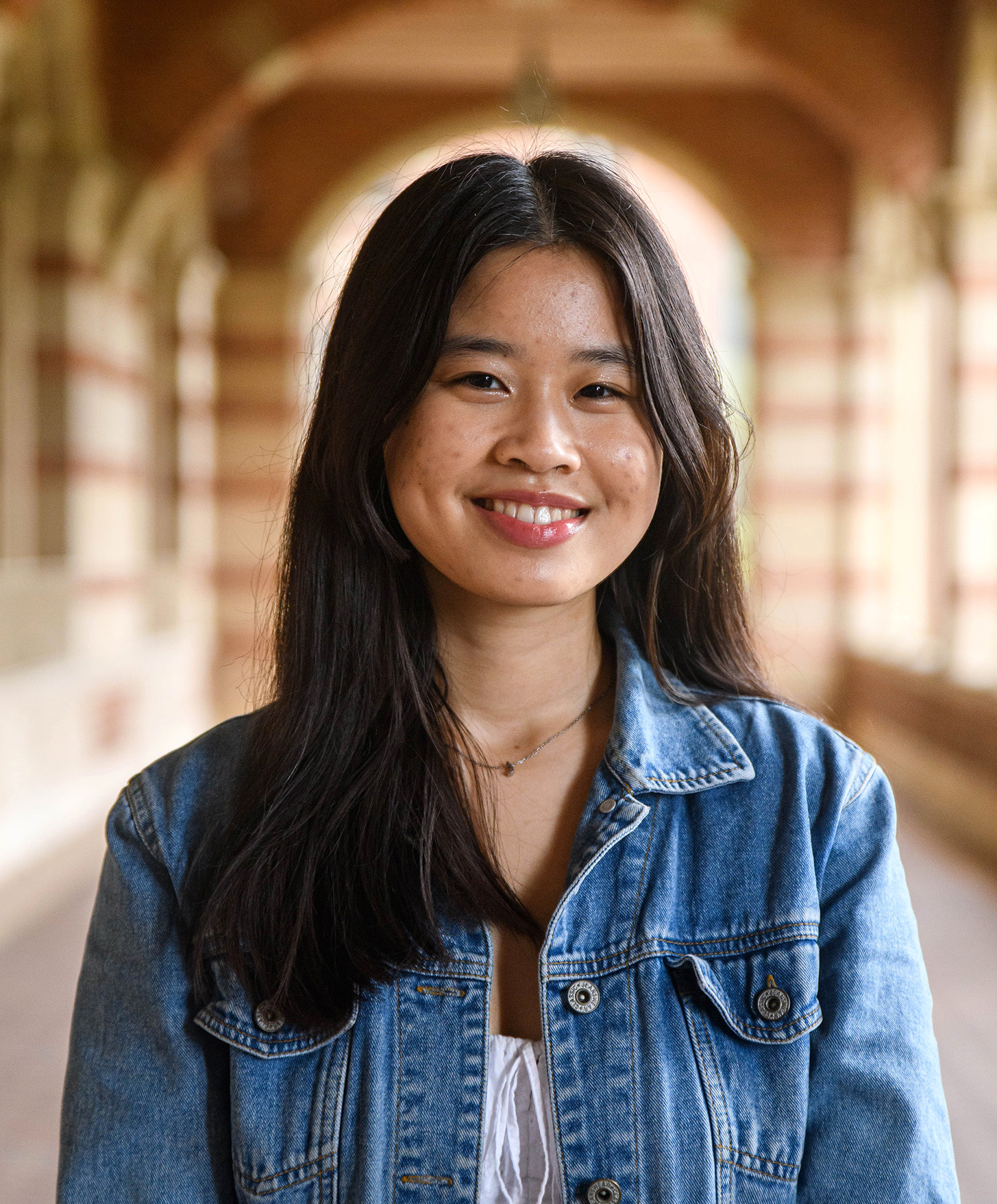
Jillian Stineman
Over the years, I have struggled to answer the question, “What constitutes the Japanese American identity?” and my acceptance into the December 2025 Kakehashi Program has also prompted me to reflect on my relationship to Japan.
Related story here.
Originally, I was born in China and was adopted by a Sansei Japanese American mother and a white father. I grew up isolated from the Japanese American community and struggled to understand my identities as an Asian American and an adoptee while experiencing anti-Asian racism.
I have always attended Obon observances in Southern California as long as I can remember, but those did not offer the reprieve I needed when the summer ended. When I went back to school, I distanced myself from Asian culture as a reaction to the racism I experienced.
I got very involved in the Los Angeles Japanese American community as a member of the UCLA Nikkei Student Union. My two years at UCLA were a mission to claim an Asian American identity, community and history.
But after, I realized that I had never made an attempt to connect to my Japanese cultural heritage, which motivated me to apply for the Kakehashi Program, which sent young professionals and students like myself to Japan from Dec. 10-17 through coordination by the JACL and the Japan International Cooperation Center (JICE) and support by funding from the Japan Ministry of Foreign Affairs.
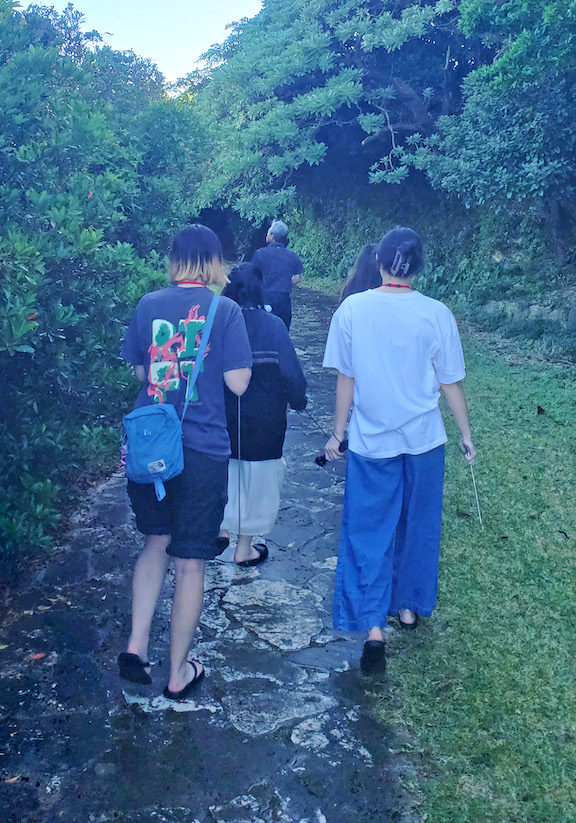
The Kakehashi homestay group explores Toguchi Beach in Okinawa. (Photos: Courtesy of Jillian Stineman)
After landing in Okinawa on Dec. 12, we were whisked immediately to the University of the Ryūkūs, where we met with Okinawan participants of the TOFU Kakehashi Program. We broke out into discussion groups to share our perspective as Americans and Okinawans.
We concluded our session with each group sharing key takeaways, and many similar themes of forced assimilation, language loss, generational trauma and resilience arose when we concluded our small group discussions.
I recommend that people look at the 2018 report from the Association of the Indigenous Peoples of Ryūkūs, in addition to the Minority Rights Group website to learn more about the discrimination and xenophobia Okinawans experience today as a minority group and an indigenous community in Japan.
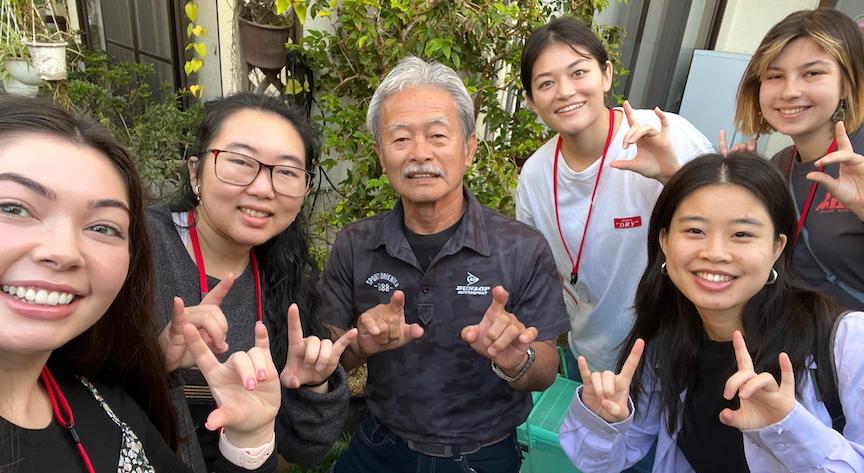
Pictured with Seiji Nakahara are (from left) Annika Tamaki, Megan Arakaki, Nanami Lillie, Jillian Stineman and Stella Saame.
My favorite part of the entire trip was my homestay with Seiji and Setsu Nakahara in Yomitan Village, which is located in Nakagami District in Okinawa Prefecture.
On what I would describe as a perfect day, my homestay group, which also included Stella Saame, Annika Tamaki, Nanami Lillie and Megan Arakaki, woke up at 7:30 a.m. to drive to Toguchi Beach during the lowest tide and spent the morning catching sea cucumbers, hermit crabs, sea stars, snails and clams before eating breakfast, which our obasan had prepared: sandwiches, fruit and tea.
Our ojichan pulled out one of his many shamisen, which he carved himself, and played many American and Okinawan songs.
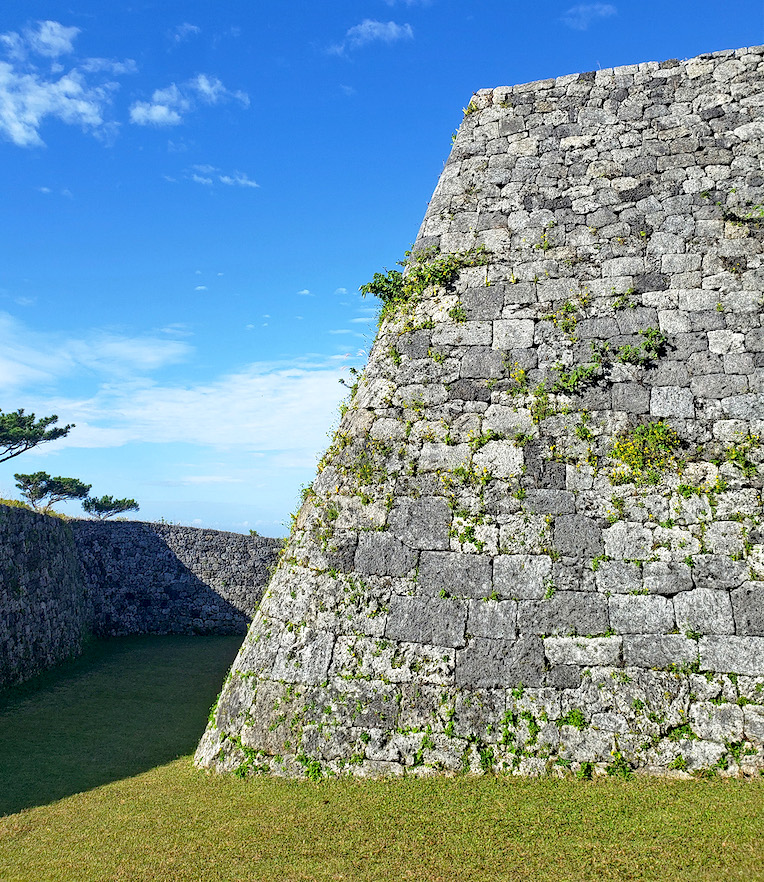
Walls of Zakimi Castle
After packing up, we visited the ruins of Zakimi Castle, which was built around 1420. The walls of the castle formed waves atop a hill high above sea level, which made for a stunning scene when you stood on them.
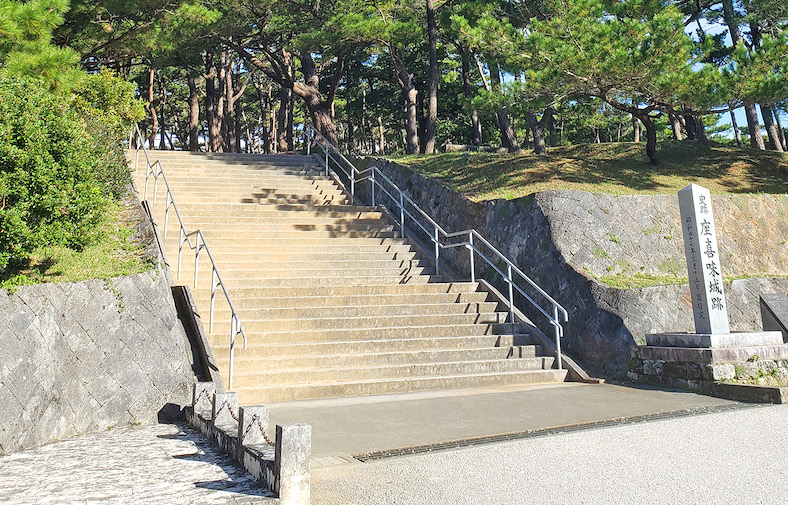
The steps to the Zakimi Castle ruins, a UNESCO World Heritage Site
We also visited the Cape Zanpa Lighthouse, located in a park with a statue of Taiki, a Ryūkyūan diplomat of the Chūzan Kingdom during the late 1300s who is credited with establishing trade and cultural exchange with China, greatly influencing Okinawa’s own culture and aesthetics from then on.
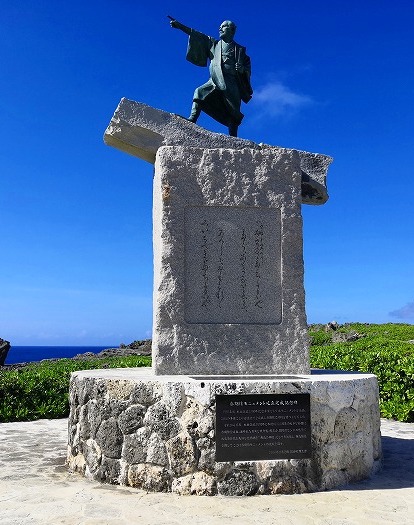
A statue of Taiki, a Ryūkyūan diplomat of the Chūzan Kingdom, is located at Cape Zanpa in Yomitan, Okinawa.
Photo: Facebook
On our last day on Okinawa, we visited the Chibichiri Gama and Shimuki Gama caves, which memorializes the Battle of Okinawa during World War II, where the United States Army and Imperial Japanese Army fought on the island, with many Okinawans tragically caught in the crossfire.
At the Chibichiri Gama Cave, 140 residents — women, children and elders — took refuge in the cave to hide from the Imperial Japanese Army, where only 40 percent survived a mass-coerced suicide after hearing lies from Japanese soldiers that the consequences of surrendering to the American military would be worse than death.
The cave is located in a small pocket at the bottom of a ravine, and after peering inside, it was easy to imagine the claustrophobia people might have felt, which contributed to people’s desperation.
In contrast, the Shimuku Gama Cave was able to hold 1,000 refugees who lived thanks to two men who had spent time in Hawaii and were able to persuade everyone to surrender.
I also loved our short visit at the Japanese Overseas Migration Museum in Yokohama, Japan. With an academic background in Asian American Studies, I was very excited to learn how Japan viewed and related to its diasporic communities.
I have visited museums made for and by the Japanese American community to memorialize the incarceration experiences of Issei and Nisei Japanese Americans during World War II. Exhibitions have since explored the Japanese American experience from the 19th century to present day and branched out into other aspects from mixed-race identity, pop culture and more niche topics like the car scene in Southern California, which is often accompanied by rich oral histories and personal stories attached to many artifacts.
I frequently find myself at awe when witnessing the depth and richness embedded in the breadth of Japanese American history, and I felt that feeling reignited while visiting the Migration Museum.
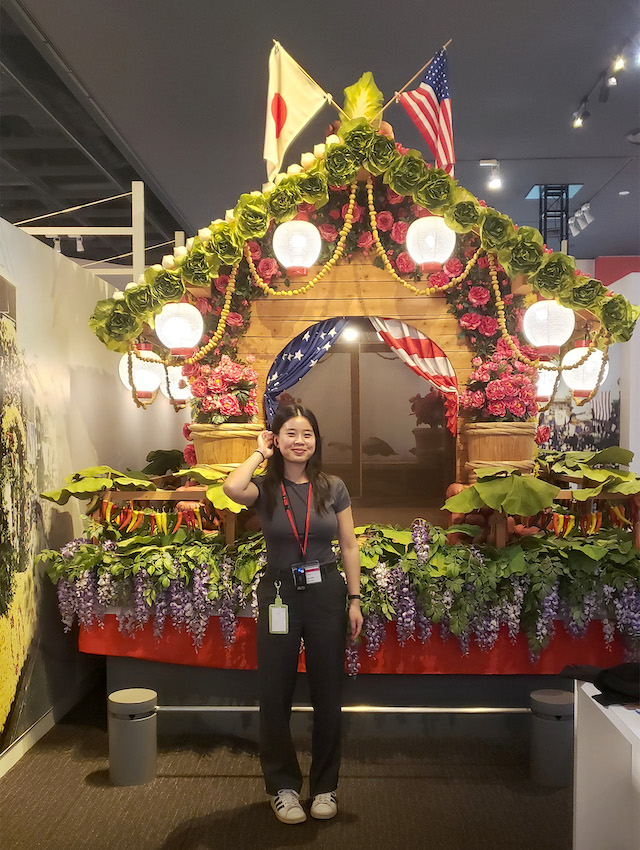
Jillian Stineman
While the majority of the museum focused on a short time span from the mid-19th-early-20th century, it was fascinating to place the Japanese American experience within a global context.
I was also delighted to see a list of researchers, staff and artists involved with the museum who were Japanese Latin American. I also saw a variety of pamphlets and audio guides in Japanese, English, French and Spanish showing that the museum was a learning space not just for Japanese people to learn about the experiences of the diaspora, but also for the diaspora to visit and trace their roots back to Japan.
While in Okinawa, the history of Japan’s forceful annexation and the current American military presence were ubiquitous. One of our courtesy calls was with Ginowa City Mayor Atsushi Sakima, who has made a political career with his strong stance to close and relocate the U.S. Marine Corps Air Station Futenma, located in the middle of the city.
Futenma Air Station was originally built by the U.S. during the Battle of Okinawa and is one of many military facilities located on the island. In fact, 70 percent of U.S. military facilities are located on Okinawa despite only being 0.6 percent of the land in Japan.
Anti-base sentiment was a deeply personal issue for many residents due to concerns about noise, pollution and safety. Accidents and crimes, particularly the sexual assaults and murders of Okinawan women and the crashing of a fighter jet into an elementary school have inspired large protests.
While the majority of the people we met expressed anti-airbase sentiments, there are also many caveats. Calling back to our discussion at Ryūkyū University, two of the TOFU participants in our group also recalled the U.S.-Japan alliance, citing that the American military would offer some form of protection in the case of an attack from another country.
It is also clear that the Okinawan economy is closely tied to the historical development of the airbases, which has also led to the development of a thriving tourism industry.
As much as I enjoyed my time in Okinawa, I was initially very scared to confront these truths head on, but I was eager to come to Japan and act as a “bridge” (kakehashi) by explaining the Japanese American experience during WWII.
I found instead that my thoughts and feelings took the backseat, and a large part of Kakehashi was to decenter my experience to wrestle with these ugly truths and witness how the U.S.’ unequal relationships to overseas communities manifests in people’s everyday lives.
The Kakehashi Program is a great opportunity for Japanese Americans to visit Japan, connect with other Japanese Americans across the United States and reconnect with one’s ethnic homeland and family history.
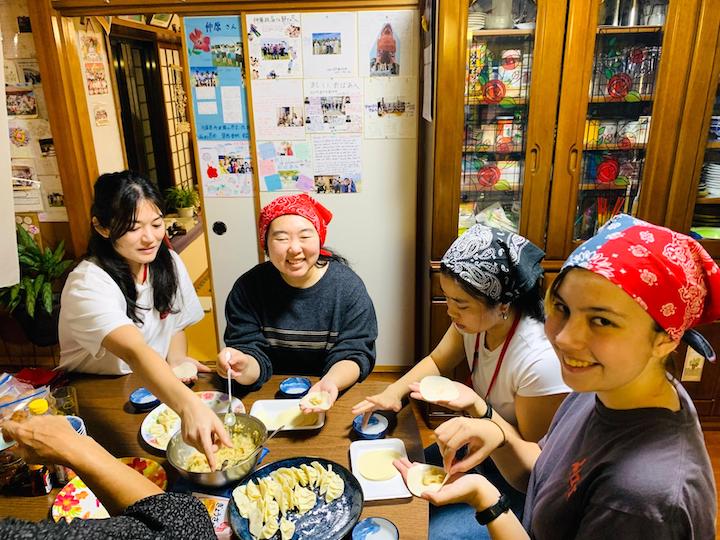
Making gyoza during their homestay are (from left) Nanami Lillie, Megan Arakaki, Jillian Stineman and Stella Saame.
The inclusion of a homestay visit is an opportunity to resist the easy choice of consuming and spectating Okinawa through a tourist gaze. My ojichan and obachan were very proud and eager to share their lives, culture and history with us so that we could share with others. I would encourage anyone eligible for Kakehashi to apply, remain curious on your trip and share what you learned.
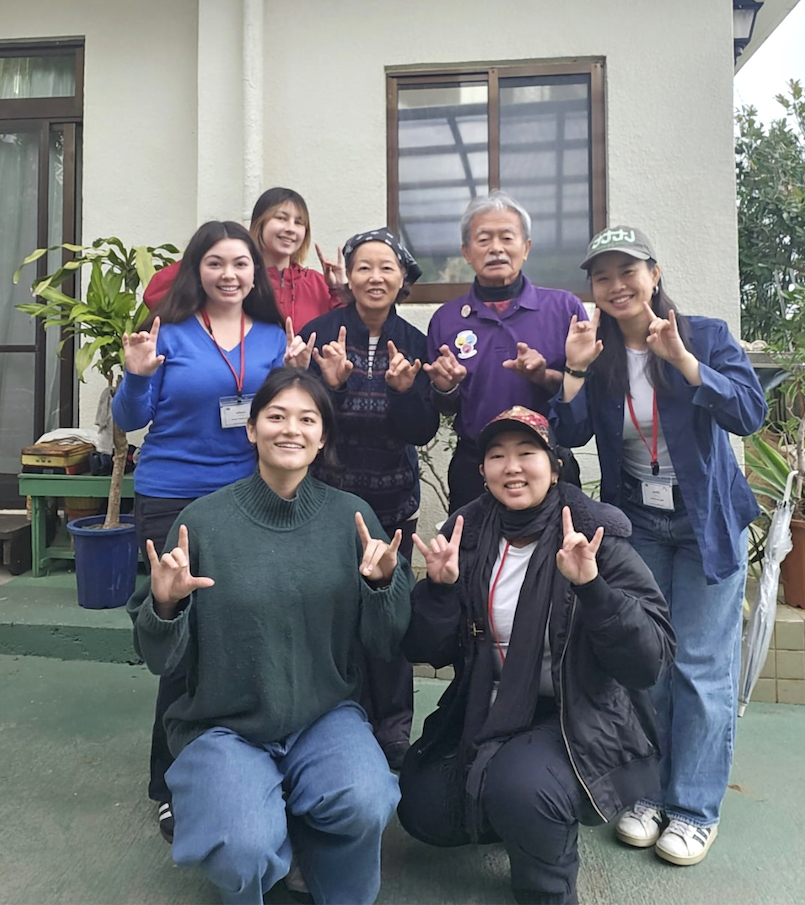
Jillian Stineman (standing, far right) with Stella Saame (third row) and (second row, from left) Annika Tamaki, Setsu Nakahara, Seiji Nakahara and (front row, from left) Nanami Lillie and Megan Arakaki.
Jillian Stineman is a recent graduate from UCLA with a bachelor’s degree in sociology and a minor in Asian American studies. She is looking forward to becoming a member of the Ventura County chapter of the JACL.