
Lifelong educator sought reconcilliation, harmony.
By P.C. Staff
Some knew her as Mrs. Oda. To others, she was Principal Oda.
To her friends, depending on where she was during her 80-plus years of life, she was Nancy; to others, Kyoko. It mattered not. As Shakespeare wrote, “That which we call a rose by any other name would smell as sweet.”
So it was for Kyoko Nancy Oda, who died May 15, just days short of her 81st birthday. By any name, she was formidable yet approachable, resolute yet understanding, a reflection of the meaning of her given name when she was born May 20, 1945.
In a video played at the 2024 Day of Remembrance in Los Angeles, Oda said: “When I was born, my father wrote a poem that said: ‘At this moment, the world is in chaos and the future is unknown. It is critical for the world and the family to be united as one and cooperate in harmony. Therefore, I name this baby Kyoko.’ Kyoko means harmony. So that poem has given me purpose to bring people together in peace.”
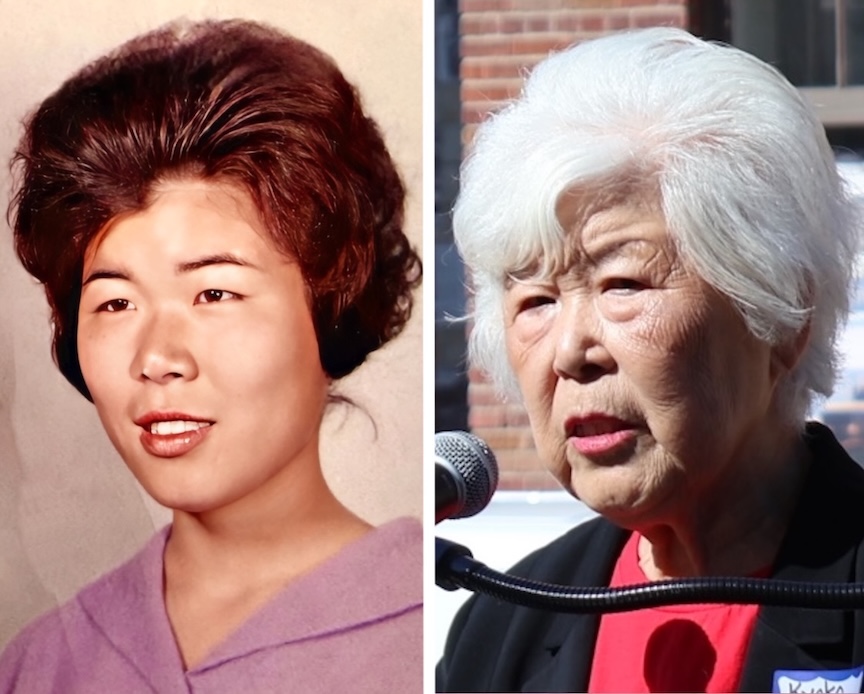
Kyoko Nancy Oda, left, as she was in her younger years to her students and right, more recently speaking in Little Tokyo on March 18, 2025 against misuse of the Alien Enemies Act. (Photos: Courtesy of the Oda family (left) and George Toshio Johnston)
As an educator whose 32-year-long career included teaching and serving as a school principal in the Los Angeles Unified School District, Oda also found purpose in uplifting others. One of her former students, Vivien Lou Chen, recalled in her LinkedIn account how, as a sixth-grader, she was bused to Riverside Drive Elementary School in Sherman Oaks, Calif. “Without Mrs. Oda, I would never have made it out of the barrio in East Hollywood, gone to college, or had a career in journalism. She served as my first bridge toward a better life.”
Born in the waning months of World War II to Yuriko and Tatsuo Inouye when they were incarcerated at an American concentration camp for ethnic Japanese that came to be known as the Tule Lake Segregation Center, Oda would dedicate a big portion of her life’s later years toward shining a light on lesser-known aspects of the Japanese American incarceration experience: as president of the Tuna Canyon Detention Station Coalition (the City of Los Angeles turned the site into a historic cultural monument), working on getting translated her father’s incarceration diary for subsequent publication as “Tule Lake Stockade Diary” in 2020 and organizing for the construction of a WWII Camp Wall in Torrance, Calif.
Oda also strove to live up to the spirit of her given name. She worked to reconcile not just the injustice visited upon her family and other ethnic Japanese by the federal government, but also any unfairness by elements within the Japanese American community, including some in JACL, against Tuleans, those from the camp that was for the so-called troublemakers.
As a member the San Fernando Valley JACL Chapter, she worked with others to have JACL apologize for its treatment of Tule Lake incarcerees, not dissimilar to how JACL itself worked to have the federal government apologize for its treatment of mainland Japanese Americans in 1988 (see Aug. 16, 2019 Pacific Citizen, tinyurl.com/pubecaw9).
It was a contentious issue that prompted letters to the editor to Pacific Citizen from those opposed to an official apology from JACL. (See Oct. 11, 2019 Pacific Citizen, tinyurl.com/mtfh47f9). Even after JACL made an official apology, Oda worked to hold JACL’s feet to the fire regarding 2019’s Resolution No. 3. (see April 21, 2023 Pacific Citizen, tinyurl.com/39te89fb).
After the 10 War Relocation Authority-operated camps closed with the end of World War II, Oda’s family returned to the Boyle Heights area of Los Angeles. As a child, she attended Maryknoll School in Little Tokyo.
Among the many achievements and accolades Oda received in her life: earning the rank of shodan in judo, being awarded a Women of the Year award in 2010 from the Japanese Women’s Society of Southern California and the Downtown Los Angeles JACL Chapter; and, from the Japanese government, an Order of the Rising Sun, Gold and Silver Rays, for “enhancing the social welfare of Japanese American society and promoting the friendly relationship between Japan and the United States.”
Oda, who lived in Van Nuys, Calif., was a lifelong member of the San Fernando Valley Japanese American Community Center, at which she had served as president of its board of directors.
Kyoko Nancy Oda was predeceased by her son, Daron Tatsuro Oda, and her sisters Frances Takeda and Ernie Jane Masako Nishii. She is survived by her husband, Kay Oda, and their son, Jon (Monique) and daughter-in-law Yvonne.
A celebration of life is scheduled for Sunday, June 7 at 3 p.m. at the Nishi Hongwanji in Little Tokyo.
To view a video featuring Kyoko Oda on the book “Tule Lake Stockade Diary” that was presented by San Fernando Valley JACL Chapter, visit tinyurl.com/ycyd3y5h.