By George Toshio Johnston, P.C. Senior Editor
Missiles and rockets.
It would not be inaccurate to say those two words bookended the 32-yearlong Army career of William S. Chen, who retired in 1993 as a major general, making him one of the highest-ranking Chinese Americans to have served in the U.S. Armed Forces.
Very early after receiving his commission, he served at a North American Air Defense Command center, the Washington-Baltimore Army Air Defense Command Post, at the time of the 1962 Cuban Missile Crisis, one of the tensest periods of the Cold War with the Soviet Union.
That was preceded, famously, by the U.S.S.R.’s launch of Sputnik 1, the first artificial satellite to orbit Earth, launched into space by rocket, which coincided with when Chen was an ROTC cadet.
“Today, you would Google missiles, rockets, etc. I went to the library. I wanted to learn as much as I could about Army missiles and rockets, and that’s how I learned,” said Chen. “And I said to myself, ‘When I go on active duty, I want to be in Army missiles and rockets.’” Decades later, by the end of his career, missiles were again part of his active-duty status quo.
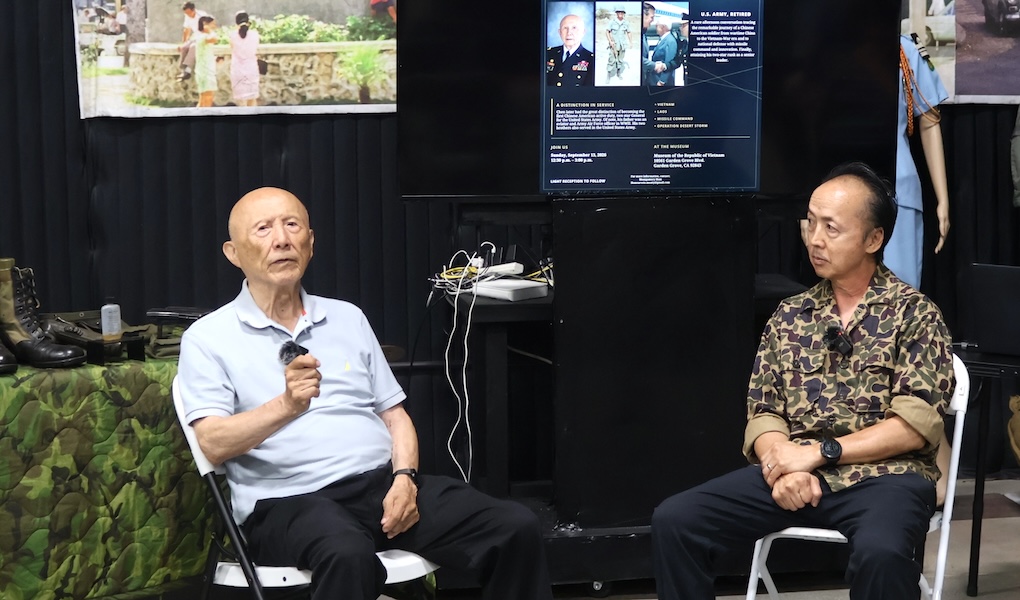
“As a major general, I commanded the U.S. Army Missile Command, 1989-92, and that was during the first Persian Gulf War,” the third-generation Chinese American told those gathered to hear him speak on Sept. 13 as part of the Asian Pacific American Military Oral History Series, organized by military historian Montgomery Hom and held at the Museum of the Republic of Vietnam in Garden Grove, Calif.
That Chen’s appearance took place at the museum, which is largely dedicated to the Army of the Republic of Vietnam, was fitting since he served two tours in country. It was during his second assignment, which he volunteered for, when his career took off, thanks to an accelerated promotion he received after working with Hmong military leader Maj. Gen. Vang Pao. “During the bulk of the Vietnam War, he and the Hmong soldiers conducted the majority of operations against the Viet Minh and the North Vietnamese,” Chen said.
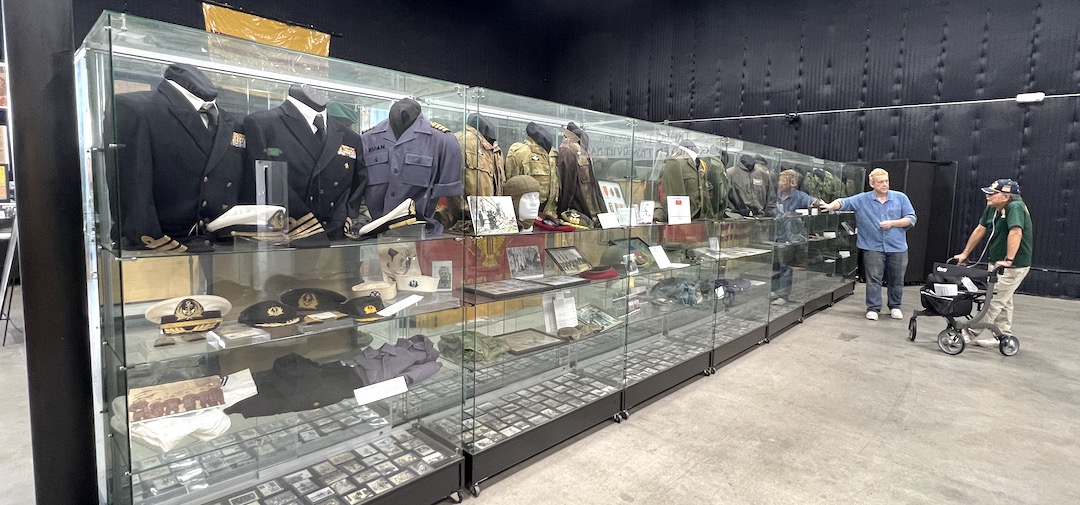
Onlookers view a display at the Museum of the Republic of Vietnam
“I was in the part that dealt with military assistance and advising the Royal Lao Army,” Chen said of his second tour of duty. “We had a special project at that time, at a location called Long Tieng.” Located in Northern Laos, Long Tieng has been described as a secret military base for the Hmong army, operated by the CIA.
“The project that I headed was called the Long Tieng Logistics Improvement Project, where we gave him more facilities, more supplies and ammunition,” Chen said. “It was largely a construction project, and everything had to go up by air because the roads were insecure. So, we used Air America C-130s to actually bring up the construction equipment, the ground crews, and then once they completed their construction project, then bring up all the ammunition. We had to build an ammunition supply point for them.”
The foundation for Chen’s trajectory into the upper reaches of the U.S. military is all the more remarkable because of the societal obstacles and institutional racism faced — and overcome — by his forebears. His China-born grandfather immigrated here in 1878 and worked on the second transcontinental railroad.
“Afterwards, all the workers were released. He migrated to Georgia, North Carolina, then settled in Ohio, and so Ohio was where my father was born,” he said. Unfortunately, Chen’s father became an orphan at 15.
Chen noted that his father had to work his way through high school and college, graduating in 1932 with an aeronautical engineering degree. “That was the middle of the Depression, and he couldn’t find a job working for an aircraft company for two reasons. One is the Depression, and second, at that time, unfortunately, aircraft companies were not hiring Chinese Americans, even those that were American-born.”
Using his passion for aviation as fuel, he saved up enough money to take flying lessons. “In New York at Roosevelt Field, Long Island, that’s where he got his pilot’s license, and then in 1936, where he got his commercial pilot’s license. Then, he went to China in 1936 and began a career as a commercial airline pilot,” Chen said of his father. Three years later, he was born in Shanghai.
As someone interested in rockets and missiles would surely know, what goes up must come down. Chen would learn that firsthand during his first tour in Vietnam, from 1966-67, when a helicopter he was in crashed. “I was assigned to the Military Assistance Command, and I was an adviser to a Vietnamese infantry division, the Fifth Infantry Division, Army of the Republic of Vietnam, and this was located at Phu Loi, part of Binh Duong Province.”
The crash happened when he was assigned to help set up a communications radio relay at the top of a mountain. “We went up by U.S. helicopter, and that crashed. There were a number killed,” he said, noting that afterward he was covered in blood — but it was not his. Although he survived, it took until the next day for the effect of what happened to sink in. He was in another helicopter, just sitting on the ground, when the sound of the rotors and the smell of the helicopter literally left him shaking.
In addition to missiles and rockets, another keen interest of Chen’s is leadership. “I can tell you that I was not born a natural-born leader,” he said, describing himself as reserved and reticent when he was growing up. “I had a tendency not to speak up, and so I recognized that I needed change, and so that was part of my leadership journey.”
It was this self-recognition that would eventually lead him to achieving the rank of major general. “We can get educated on how to be a leader, but it takes hard work,” he said. “It takes dedication, practice, simulation, and so it’s something that you can develop, but you have to consciously self-assess.” Fortunately, he has written a book on that topic, titled “Blend In, Stand Out,” which is scheduled to be published next July.
Sometimes that recognition can come from interesting places. “After I retired, I was in the Twin Cities in Minnesota, where there’s also a large Hmong population, and we had an event there. It was to honor Hmong Americans who were in the U.S. Armed Forces.” Not only was Chen a speaker, so, too, was Maj. Gen. Vang. “People treated him like a king,” Chen noted, adding that it was the first time he had seen him since he was in Laos.
“I was a major in Laos at that time,” Chen recalled, “and he was glad to hear that I got promoted to major general.”