By Hanako Wakatsuki-Chong, Executive Director, Japanese American Museum of Oregon
August marked the 80th anniversary of the atomic bombing of Hiroshima, a milestone that drew survivors, descendants and peace advocates from around the world to Japan’s Peace Memorial Ceremony on Aug. 6. I was among them, and my journey to Hiroshima carried profound personal significance — a pilgrimage to honor family, reconnect with ancestral roots and facilitate an unexpected act of historical reconciliation.
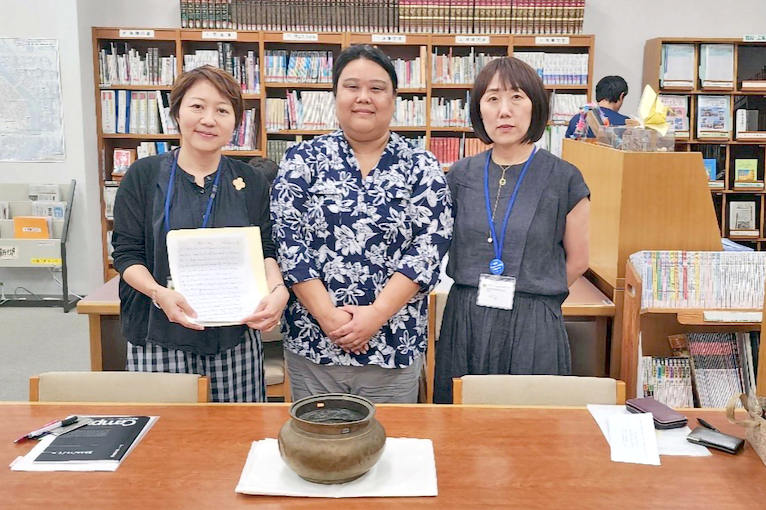
(From left) Natsuki Okita, Hanako Wakatsuki-Chong and Mari Shimomura following the transfer of the brass vessel to the stewardship of the Hiroshima Peace Memorial Museum on Aug. 5 (Photos: Courtesy of JAMO)
The ceremony drew approximately 55,000 attendees, including representatives from 120 countries and territories. United Nation’s High Representative for Disarmament Affairs Izumi Nakamitsu delivered a message from Secretary-General António Guterres, paying tribute to the hibakusha — the atomic bomb survivors — whose voices have become a moral force for peace.
The ceremony followed its traditional format: At exactly 8:15 a.m., the moment the bomb exploded 80 years ago, attendees observed a moment of silence while the Peace Bell rang. Hiroshima Mayor Kazumi Matsui warned of the dangers of rising global militarism, criticizing world leaders who argue that nuclear weapons are necessary for national security.
With the number of surviving hibakusha now below 100,000 and their average age exceeding 86, this 80th anniversary holds a particular poignancy as likely the last major milestone many will witness.
A Personal Calling
My journey began not with meticulous planning, but with something deeper. Last year, I experienced what can only be described as an ancestral calling — a profound yearning to return to Japan for this commemorative event. The pull was intensely personal: My grandfather’s cousin perished in the bombing eight decades ago, one of an estimated 140,000 who lost their lives by the end of 1945.
I felt compelled to be there. It was about honoring my ancestor and finally connecting with the land my family left behind so long ago.
That connection became literal when I stood on the shores of Hiroshima Bay, my feet touching the sand and water — a symbolic reunion with my ancestral homeland after generations of separation.
An Honored Guest of the Sasaki Family
The experience took on even greater significance when I received an invitation to attend the Peace Memorial Ceremony as a guest of Masahiro Sasaki and his family. Sasaki is the older brother of Sadako Sasaki, whose story has become synonymous with Hiroshima’s message of peace. (Related story here.)
Sadako, who developed leukemia as a result of radiation exposure from the bombing, famously folded paper cranes during her illness, inspiring the international symbol of peace that now graces Hiroshima’s Children’s Peace Monument.
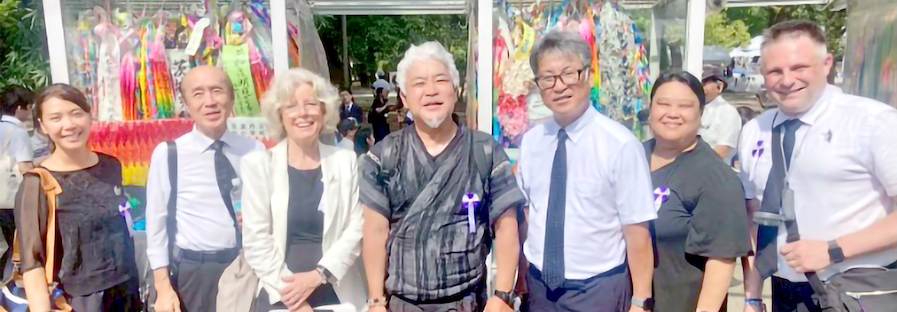
Pictured (from left) are Ched Magaspar, Masahiro Sasaki, Sue DiCicco Smith, Sumiyuki Sasaki, Yuji Sasaki, Hanako Wakatsuki-Chong and Noël Southall at at the Children’s Peace Memorial on the 80th anniversary of the bombing of Hiroshima event at Hiroshima Peace Memorial Park on Aug. 6.
It was incredibly emotional and touching to be with the Sasaki family on this day to honor my ancestor alongside them and commemorate all who lost their lives on that fateful morning. Words cannot fully capture what it meant to share that space with a community I had never been a part of, yet felt completely welcomed. I felt loved and cared for. That’s what true community is supposed to be.
An Unexpected Mission of Repatriation
What began as a personal pilgrimage evolved to include an unexpected responsibility. Before departing Oregon, Andrea Agana, a supporter of our museum, introduced me to her friend, Dan Ball, an Oregonian who possessed a remarkable artifact with its own Hiroshima story.
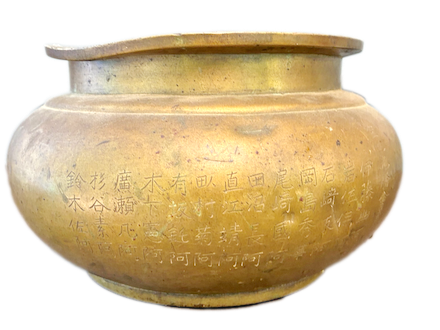
This brass vessel survived the Hiroshima bombing. Inscriptions are the names of people who donated to create this vessel.
Photo: Andrea Agana
The object — a brass vessel believed to have served as an incense holder in a Buddhist temple — had survived the atomic bombing 80 years ago. As a child, Ball’s father served as a judge advocate general, stationed in Tokyo. His family visited Hiroshima in 1950 or 1951, where his mother asked his father to purchase this brass vessel.
During that visit, a moment occurred that would shape young Ball’s understanding of war’s true cost. Speaking to a man by a ditch, the boy asked innocently, “Why are there so many dragonflies?” The man looked at him and replied, “Your bombs killed many birds. They are no longer able to control the insects.”
It was in that moment that Ball felt the bitter legacy of war and the use of the atomic bomb — a realization of the destruction wrought not only upon humanity but also upon the environment itself. He never forgot, and he resolved that such devastation should never be repeated.
Ball had long wished to return the vessel to its homeland, and my journey provided the perfect opportunity. I had met Yoshifumi Ishida, director of the Hiroshima Peace Memorial Museum, earlier this year in March as part of the Japanese American Leadership Delegation and was able to communicate Ball’s wish to donate the artifact to their museum, which they gladly accepted.
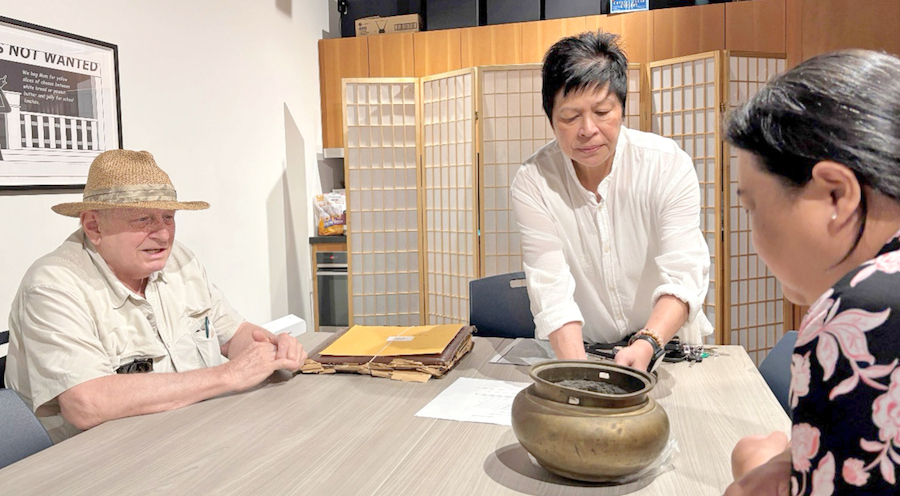
(From left) Dan Ball, Andrea Agana and Hanako Wakatsuki-Chong observe the vessel on July 23 at the Japanese American Museum of Oregon. Its next destination: returning to Hiroshima. (Photos: Courtesy of the Japanese American Museum of Oregon)
Being able to facilitate the repatriation of this object and fulfill Ball’s wishes made the trip even more meaningful for me. It felt like another piece of history coming full circle, another small act of healing across the decades.
I delivered the brass vessel to the Hiroshima Peace Memorial Museum, where it now resides in its collection. It will serve as both artifact and testament — a silent witness to destruction that ultimately found its way home, carrying with it the story of a child’s awakening to war’s true cost and an adult’s commitment to remembrance and reconciliation.
Finding Myself in the Land of My Ancestors
This experience was nothing short of extraordinary. Standing in my ancestral homeland, surrounded by a community I had often felt disconnected from, something profound shifted within me. For the first time in my life, I truly felt Japanese — not as an abstract concept or a distant heritage, but as a lived reality, rooted in the soil of Hiroshima and embraced by my people.
The sense of belonging I experienced has transformed me. I know now that I will return to Japan to continue deepening this connection that has awakened in my soul.
But beyond my own journey, I hope that my story inspires others to seek out their own ancestral homelands to walk the paths their families once walked and connect with their ancestors in whatever way feels meaningful to them.
These connections — to land, to community, to those who came before us — have the power to heal, complete us and remind us of who we truly are. We are never as disconnected from our roots as we might believe; sometimes, we simply need to take that first step home.
Hanako Wakatsuki-Chong is executive director of the Japanese American Museum of Oregon. She is a booster of the Portland chapter of the JACL.