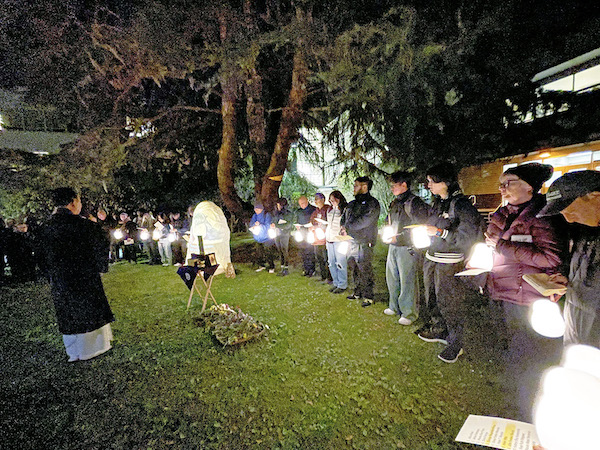
SFSU Nisei students who were forced into concentration camps during WWII were remembered in a lantern ceremony featuring the Wakasa Spirit Stone. (Photos: Courtesy of Nancy Ukai)
The university recognizes the scholars during a Day of Remembrance ceremony
featuring an exhibition of the Wakasa Spirit Stone and a screening of the short film ‘DUST.’
By Nancy Ukai, P.C. Contributor
In early 1942, my Nisei mother, Fumiko Takayanagi, was a 21-year-old art student in Los Angeles. But that dream cratered when on Feb.11, she boarded a train with an “enemy alien” travel permit that was stamped with her fingerprint. She was returning to Berkeley, Calif., so that the family wouldn’t be separated into different concentration camps. Mom was incarcerated at the Tanforan racetrack and the Topaz, Utah, prison camp. She never returned to art school.
Similar scenes played out all across the West Coast following the issuance of Executive Order 9066 by President Franklin D. Roosevelt on Feb. 19, 1942.
In the San Francisco Bay Area, several thousand students at the University of California, Berkeley, were forced to withdraw from classes and leave school. At San Francisco State College, 19 students were ripped from their classrooms.
The SF State group was a small sample, but their lives took dramatically different paths.
Norman Noboru Koyama was incarcerated at Marysville and Tule Lake and from there joined the 100th/442nd Regimental Combat Team.
Tom Satoshi Yoshiyama refused to comply with the loyalty questionnaire at Topaz and was sent to Tule Lake, became a renunciant, was interned at Santa Fe, N.M., and deported to Japan, never to return to the U.S.
Mary Masako Hata (Sadataki) was sent to the humid and swampy region of the Rohwer, Ark., camp and eventually resettled in Ohio, where she worked to support JACL’s redress efforts in the 1980s.
To recognize the unlawful incarceration of Japanese Americans during WWII, the university dedicated in 2002 the Garden of Remembrance by artist Ruth Asawa, her final installation, located between Burk Hall and the Fine Arts Building.
Listed on a bronze, scroll-shaped marker adjacent to the garden are the names of the 19 SFSU students and the 10 War Relocation Authority concentration camps.
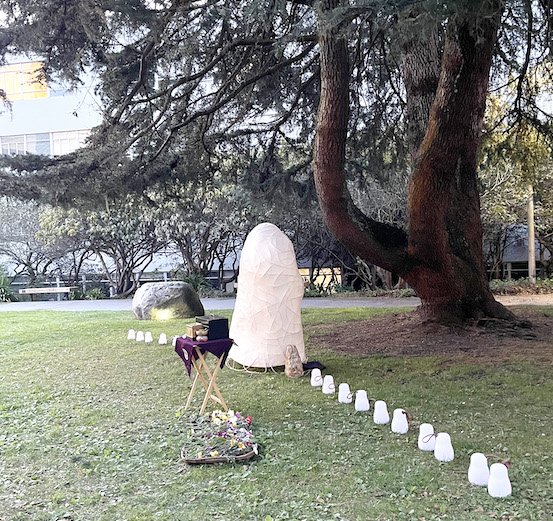
A Buddhist altar and lanterns were set up before the evening DOR ceremony on Feb. 19.
A cascading waterfall flows nearby, signifying the return of people of Japanese ancestry to the coastline following the conclusion of the war. Ten large boulders, set on a peaceful stretch of lawn by master rock expert Shigeru Namba, represent the location of the 10 WRA camps erected during WWII.
“This was my favorite place on campus to sit and enjoy a peaceful moment,” said Jon Funabiki, retired SFSU professor of journalism, of the garden.
On Feb. 19, the Asawa garden was the site of a Day of Remembrance event to honor the 19 Nikkei students, none of whom are still living, and recognize the unlawful incarceration of Japanese Americans living on the West Coast during WWII.
Led by professors Cassie Miura and Wesley Ueunten, Buddhist Church of Oakland Rev. Michael Saito and the Wakasa Memorial Committee, represented by myself and artist Glenn Mitsui, a night ceremony was held that welcomed more than 100 students, camp survivors and descendants.
A tall, white paper mache stone made of washi, called the Wakasa Spirit Stone, was the event’s focal point. The names and photos of each WWII student were projected on the sculpture’s facade in a video titled “We Were Students,” created by Mitsui.
As each name was read aloud by Rev. Saito, a hand lantern was turned on by a university student or relative of the Nisei student. At the end, 20 small lanterns glowed softly in the darkness, one for each student and Asawa, who was in high school in Southern California when she was removed to Rohwer in Arkansas. Attendees offered incense and placed a flower at the foot of the lantern.
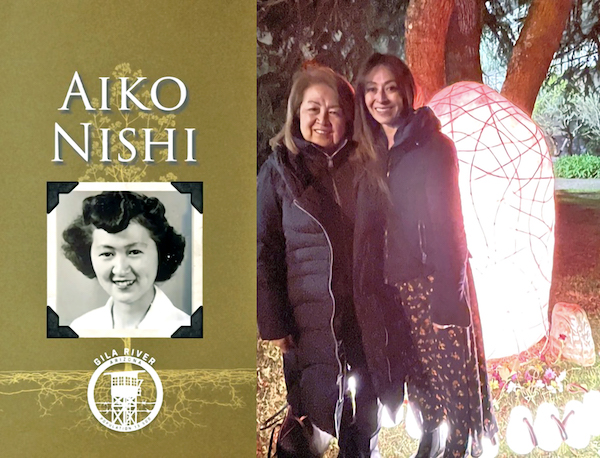
Two generations honor Aiko Nishi, whose slide (left) was part of a memorial video by Glenn Mitsui. Pictured (at right) are Nishi’s daughter, Vivian Nelson (left), and granddaughter, Maryn.
Vivian Nelson, the daughter of Aiko Nishi, flew from Orange County, Calif., with her daughter, Maryn, to honor her mother. Nishi’s family sold their belongings before camp and returned to a hostile environment in Florin, Calif., where her father attempted to rebuild their lives by picking grapes. Nishi ended up studying bacteriology at Capital University in Columbus, Ohio, thanks to the Quaker program to support Nisei students, Nelson said.
Robert Kikuchi-Yngojo, the son of John Kikuchi, who excelled in boxing and football, wore his father’s letter jacket and performed a musical piece in an earlier program in which a short film, “DUST,” directed by Mitsui, was screened. It featured poems written by Yonsei writer Brandon Shimoda about the
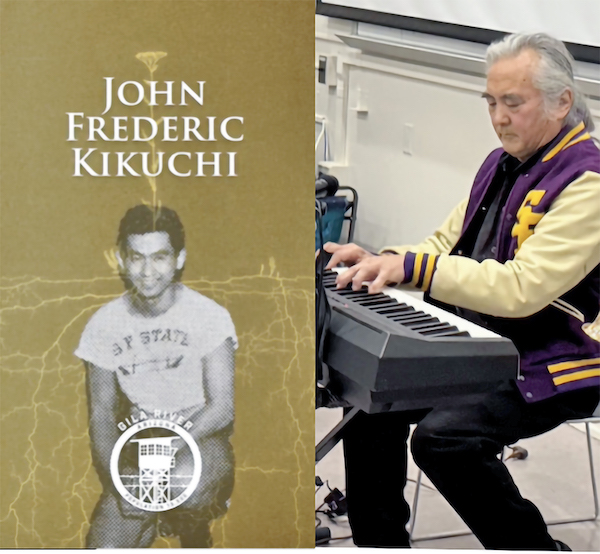
John Kikuchi, a student at SFSU in 1942 (left), was incarcerated at Gila River, Ariz. His son, Robert Kikuchi-Yngojo (right), played a musical piece in remembrance.
Artworks: Glenn Mitsui
eight Issei and Nisei men who were killed in the camps by military police.
When the Asawa garden first opened in 2002, three of the Nisei SFSU students were able to attend the commemorative ceremony arranged by the university’s associate vp at the time, Carole Hayashino.
This year, with ICE raids removing immigrants, citizens and children from homes, schools and sidewalks, the DOR ceremony was a remembrance not only of the past but also for those who are being seized now, Rev. Saito said to the crowd.
Despite the passage of 84 years, connections were made with descendants of the WWII students, thanks to genealogical research.
Hiroyuki Yoshiyama, whose father had been deported to Japan, was born there and wrote to the event organizers from Yokohama, emailing a photo of his father for use in the video. His mother, who also was a renunciant at Tule Lake, eventually returned to the U.S. and lives in Northern California now, he said. She is 106 years old.
Following are the names of the SFSU students recognized on the bronze marker located adjacent to the garden: Hatsune Arita, Percy Fukushima, Mary M. Hata, George Hirose, Kathryn Kawamorita, John Kikuchi, Kaya Kitagawa, Norman Koyama, Grace Matsuda, Helen Mayeda, Yoshiko Miya, Aiko Nishi, Akiko Nishioka, Helen Nitta, Dora Sato, Tomiko Sutow, Tom Yoshiyama, May Yoshino and Atsuko Yusa. (Shizuko Mabel Yamamoto also is listed in university documents.)