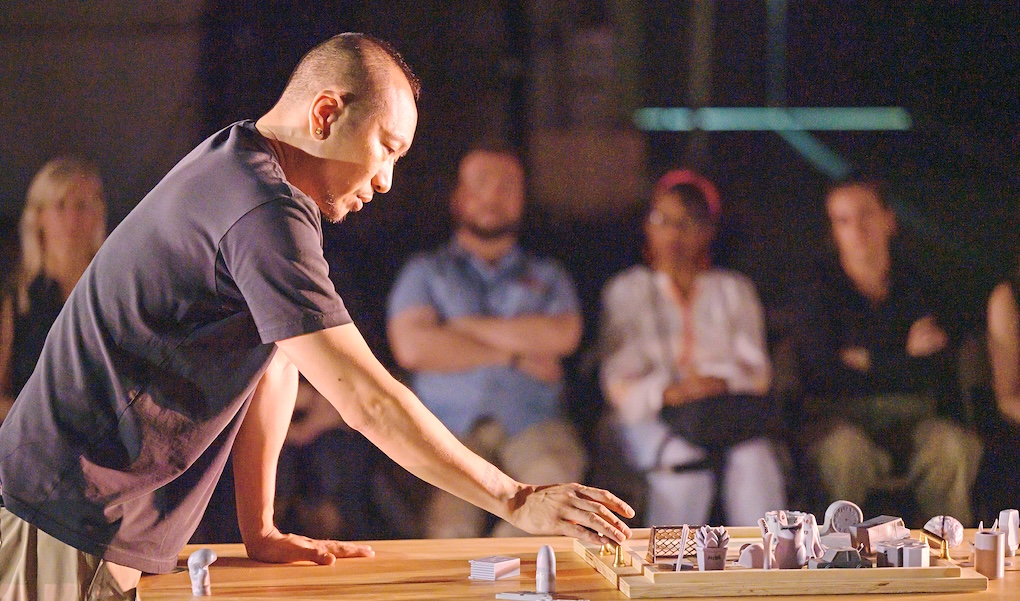
Makoto Hirano uses miniature objects to recall specific details related to each of the 50 interviewees. (Photos: Johanna Austin)
Lead artist Makoto Hirano offers his thoughts on the current landscape
of gun violence and lessons learned from the production’s co-creation process.
By Rob Buscher, P.C. Contributor
In August 2025, Team Sunshine Performance Corporation performed the latest iteration of “The Great American Gunshow,” an interview-informed devised theater performance exploring American gun culture, gun violence and trauma, as well as the tension within U.S. society over the “right of the people to keep and bear Arms.”
The performance was held over three nights at Safe-Hub, a nonprofit organization that provides a physically and emotionally safe space for young people in the Kensington/Harrowgate neighborhood of North Philadelphia.
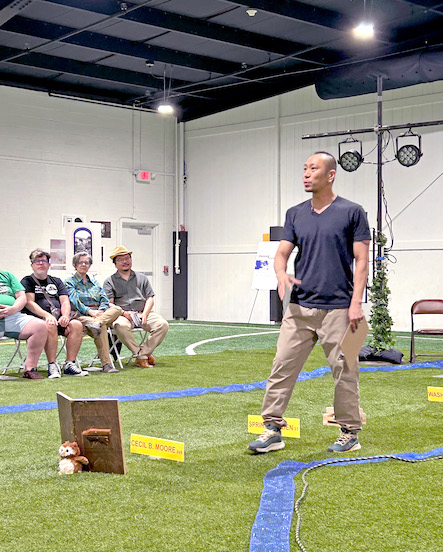
“The Great American Gunshow” lead artist Makoto Hirano
Helmed by lead artist Makoto Hirano, “Gunshow” documents, maps, archives and reflects society’s collective experience through a theatrical presentation designed as a unique hybrid of a live performance event and a participatory forum. The son of Shin-Issei immigrants raised in Chicago, Hirano is no stranger to guns, having served in the US Marine Corps prior to getting his bachelor’s in fine arts degree in dance at Temple University.
Created through 75-plus hours of interviews with Philadelphians experiencing different aspects of gun culture, “Gunshow” explores the humanity at the heart of the issues surrounding guns and invites the audience to engage in a more nuanced discussion as a way to imagine a better future for Philadelphia.
Hirano participated in an interview with Pacific Citizen during the summer of 2021, when the project began in earnest. In that year, U.S. gun deaths were reported at an all-time record high of 14.6 deaths per 100,000 people. This alarming statistic was accounted for through a significant increase in gun homicides during the pandemic. That year also recorded the highest number of gun suicides in a single year since the Center for Disease Control began recording such data in 1968. Gun suicides have continued to rise, reaching their current peak in 2023 with a recorded 27,300 deaths. Although there has been a decrease in gun violence in the past two years, guns remain the leading cause of death for children and teens.
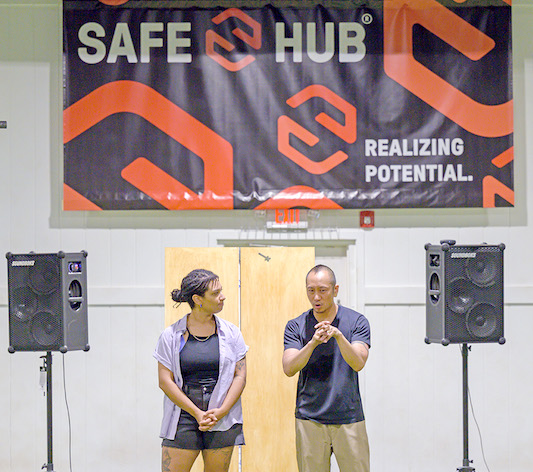
Lead artists Makoto Hirano and Jackie Soro during the performance.
In an interview conducted after the Philadelphia production concluded, Hirano offered his thoughts on the current landscape of gun violence, as well as lessons learned from the intensive co-creation process.
Rob Buscher for the Pacific Citizen: Since our first interview in 2021, how has the project progressed, and what was the timeline for the recent Philadelphia production in August 2025?
Makoto Hirano: In 2021, our pilot phase began in Bloomsburg, rural Pennsylvania. . . . We started that project without a map at all. We did a thing called snowball sampling — we met people through other participants until we had enough interviews. August of ’22 is when we did our Bloomsburg performance. We also did a performance of that same version in Philly. The rest of ’22, all of ’23 and most of ’24 — almost two years was spent designing the process for our most recent production.
Buscher: There are obvious differences between rural Bloomsburg and Philadelphia, but what specifically led to this lengthy retooling of the devised theater process?
Hirano: Ultimately, it was our conversations with Michael O’Bryan. He’s a local who really knows Philly and a super smart dude. We brought him on as a local adviser/mentor. In one of our first meetings, he said, “You can’t do what you did in Bloomsburg here in Philadelphia.” I’ll never forget this. Mike said, “If you go about it the way you did with Bloomsburg, without a map, you might accidentally leave out the people who are most affected by gun violence in Philadelphia.” And that had never occurred to me. We were eight months out from starting interviews, and we paused everything. We had to rethink the whole project, the whole process, everything about it. That process took like an extra year.
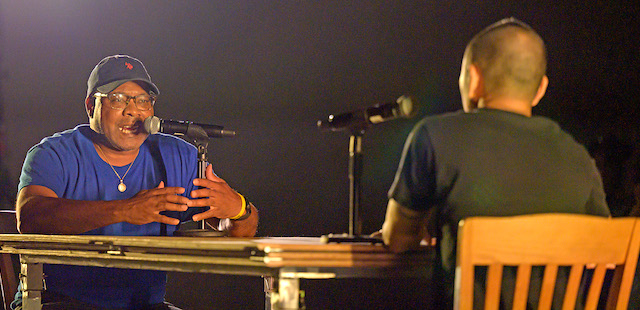
John Pace of the Youth Sentencing & Reentry Project re-enacts a scene from his interview with Makoto Hirano during the show.
Buscher: It sounds like Michael had a profound impact on the direction of this production. Were there other people in Philadelphia who helped develop a more intentional model for engaging the populations who are most impacted by gun violence?
Hirano: There’s another person named Kevin Carter, who we met through Mike. Kevin is a counselor and a licensed clinical social worker. He has run a lot of grief counseling groups throughout the city and other places. Kevin said, “You want to interview people who are at the highest risk of gun violence, the people that this is a regular thing for?” And we were like, “Yes, not just them, but yes, absolutely.” And he said, “For those people, what are you going to offer them that’s going to address their urgent, immediate safety concerns? If you’re not going to somehow address that, why would they want to meet you?” I had no answer for that . . . because then they’re just retraumatized, right? Then, we had to ask: “Is the project in service to them, their story and anything that supports them?” I didn’t have an answer for that. Michael O’Bryan first challenged us about the process, and then Kevin Carter asking us that question was the second whammy. We realized we were nowhere close to putting out a call for interviews.
Buscher: How did you move forward from that point in the project?
Hirano: Alex Torra was my partner in crime, who serves with me as co-director of Team Sunshine. Sarah Branch served as a community liaison for about two years of this process, which eventually became kind of a co-creator, co-thinker role. The three of us were making decisions together, regularly brainstorming and having ideas, meeting with Mike.
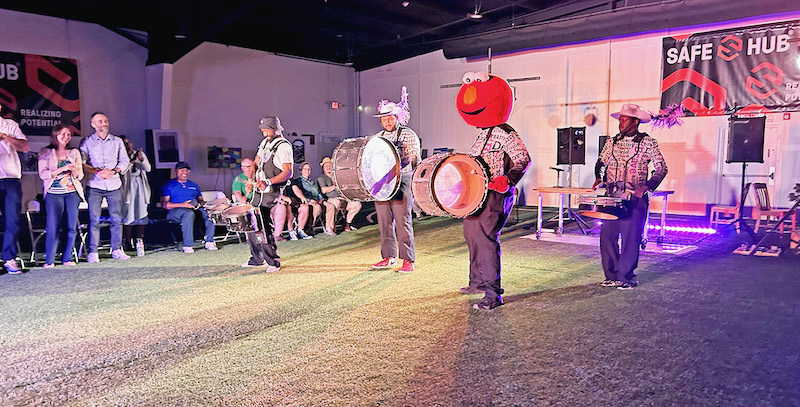
Positive Movement Drumline performs at the conclusion of the “Gunshow” performance. (Photo: Rob Buscher)
We decided to focus based on something that came straight out of Mike O’Bryan. He said, “Who are the most at risk of being shot at or killed?” I didn’t know. Mike said, “Black men.” Then, we found this interactive website where you could look up Philly gun violence data. In a given year, you could look at specific time spans, where the shootings happened and in what zip codes.
Through that, I figured out the highest level of gun violence was in four zip codes in North Philly. They’re right next to each other. Kensington, Nicetown-Tioga, Hunting Park and Frankford. We knew we had to do the project there. We had to focus a lot of our interviews with people from those neighborhoods and do the performance there.
Another thing we learned from that website was that between 2014-24, if you were Black, male, between the ages of 18 and 25 and outside between 8 p.m. and 3 a.m. in any of those four zip codes, it’s very likely you would get shot because that’s who’s being shot the most. Immediately, it was about race. And I thought that we have to focus on young Black men. So, in that sense, race played a huge role.
Buscher: Speaking of race – in our 2021 interview, you shared this driving
question of “How safe do I feel as a Japanese American?” That was during a moment when more people were buying guns during the pandemic. How did you navigate the conversation of race in this version of the project?
Hirano: Since we started “Gunshow,” race was always a topic. It never isn’t. But the way we talk about race in Philadelphia and in Bloomsburg as it relates to guns is so different. We focused on it a lot in the Bloomsburg version because I was a person of color going into their predominantly white community, asking a bunch of questions and making a show about it. So, race was an inescapable part of the project.
In a different way, it’s inescapable in Philly because of crime and redlining and because of economic inequalities that are all race based. In the early days, I was thinking of this project as the intersection of being Asian and gun violence. That was my early hunch of what this project was going to be about. During the pilot phase, we released our notions about Asian-ness as the intersection because as it turns out, guns are the intersection of almost everything. The points of intersection are slightly different in each community, but it’s multifaceted wherever we go.
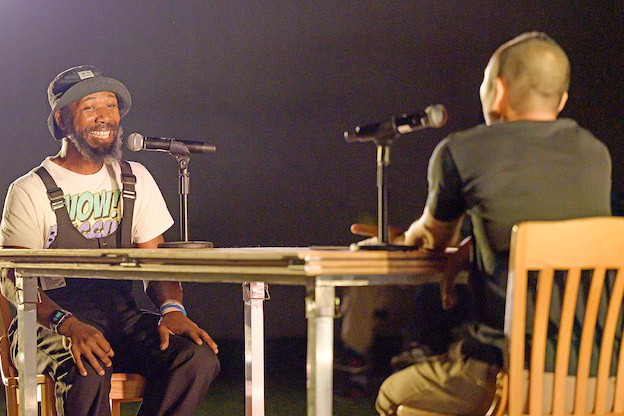
Positive Movement Drumline Founder Tony Royster sits with Makoto Hirano during a live interview sequence, before ending the show with a short drum performance.
Buscher: How did you source your interviewees, and can you tell us a little about the interview process?
Hirano: We started with an intake form. . . . We ended up interviewing 50 people in total, with a heavy emphasis on the local residents of the four zip codes where gun violence is most prevalent. . . . The interviews were free-flowing. I told participants we could start anywhere. At times, I would try to steer us toward a particular topic related to what the person shared, but for the most part, we just let it flow. I love connecting with people like that, and it feels like one of the ways that I’m in my zone.
Buscher: It sounds like you might have experienced some secondary trauma delving into these subjects with victims of gun violence. How did you and the creative team navigate self-care?
Hirano: Since I was the main person interfacing with interviewees, in some ways that made it really simple. I became the funnel – the one-human filter for the rest of the team. I’m changed now because of those people. If we had stopped the project for some reason and didn’t make a show, I was already changed. I definitely never experienced that before.
Buscher: What was it like turning all of this input into a show?
Hirano: We went through the hardest, most challenging artistic process that I’ve ever had the pleasure of being part of. . . . It was so hard, and it was so exhilarating to do it because every single day for the eight-week rehearsal process, it felt like we were moving something forward.
Buscher: To your earlier point on creating a digestible show, how did you balance the heavy subject matter with the overall audience experience?
Hirano: It took a while to figure that out, but we realized the solution was to highlight the people and organizations who are doing the incredible work already. These people are not in the news and so often not being recognized by the city, but they are the ones who are addressing the needs of people on the ground level.
Buscher: What are some of the solutions the interview participants shared with you?
Hirano: We learned so many things from so many people, but everyone shared the same thing: You can’t solve guns because guns in Philly isn’t one issue. Even if we magically made guns disappear, we still have the underlying issues that are causing the violence. It’s because people are suffering. People are in need on many levels, and their needs are not being met.
Buscher: Having done this version of the show, are there any lessons learned or things that you’ll take into the next iteration of the project?
Hirano: One of the many huge things that we learned in this project is that there are five or eight different versions of Philadelphia that people are living in, as it relates to guns. Gun violence for some people, it’s their daily life whether they choose it or not. And some people, it’s out of sight, out of mind. There’s no attempt to understand it by many who do not experience gun violence directly. I feel really sad about it, and that makes me want to do this project more and in other places.
Doing this production, I’ve learned a lot that will inform how we go forward. “Gunshow” is really a project about how we are in relationship with each other. How we are navigating the identity of “we” together. Maybe “we” can do it better? And then using guns as the excuse to gather. Simply put, it feels like a vehicle to have really fascinating yet effecting conversations.
To read more about “The Great American Gunshow” and support future productions, visit www.teamsunshineperformance.com/gunshow.