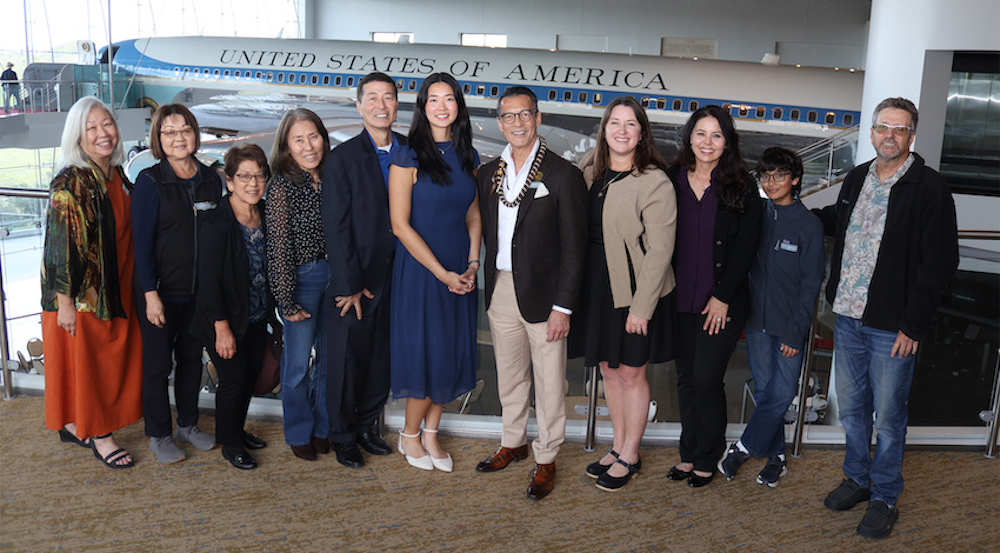
Standing in front of the decommissioned Air Force One at the Ronald Reagan Presidential Library and Museum are (from left) PSW’s Nancy Takayama; Ventura board members Anne Chilcott, Janice Tanaka, Akemi Ketchum, Donn Taketa and Sarah Taketa; guest speaker David Ono; chapter Co-Presidents Megan Gately and Lily Anne Welty Tamai; Kai Tamai; and board member Mark Chilcott. (Photo: George Toshio Johnston)
As Ventura County JACL installation’s guest speaker,
the TV newsman reveals his storytelling motivations.
By P.C. Staff
Whether reporting on disasters like Hurricane Katrina, Haiti’s earthquake and Japan’s tsunami or covering royal weddings, popes and presidents, multiple-award-winning TV journalist David Ono’s calling has been telling other people’s stories. (See “Oh Yes to David Ono’s Career,” Dec. 20, 2024 Pacific Citizen, tinyurl.com/23a8984h)
And while Ono did indeed share some stories on video as the guest speaker at the Ventura County JACL’s 46th installation on Jan. 25 at the Ronald Reagan Presidential Library and Museum in Simi Valley, Calif., the ABC7 Eyewitness News anchor and reporter also shared with those in attendance some of his own backstory and what motivated him to relay manifold stories about Japanese American servicemen during World War II that, while revered within the Japanese American community, were still largely untold and unknown to the wider public.
Following lunch and recitation of the Pledge of Allegiance, chapter Co-President Lily Anne Welty Tamai introduced Ono, citing his record of professional accolades, which includes Emmys, Edward R. Murrow awards, Asian American Journalists Assn. and Society of Professional Journalists awards and a Lifetime Achievement Award from the Los Angeles Press Club.
Noting that he didn’t have nor really care for “any formal speeches” and preferring “to be a little bit more interactive,” Ono began by telling the audience about his journey, including how his white American father met his Japanese mother while serving in the Army, stationed in Japan.
“We ended up in San Antonio, Texas, Fort Sam Houston, and that’s where I lived for several years,” Ono said. “And then when he was going to be transferred out is when he decided to retire because he didn’t want to move yet again. So, I ended up growing up in San Antonio, Texas. My mother’s family is from Kumamoto, Japan.”
Ono then explained his reason for using his mother’s surname professionally. “I use my mother’s name on the air, but my real name is Johnston, as in George Johnston, right over there,” he said, getting laughs from the audience. “I use Ono because Ono is a tribute to my mother. But also it’s very simple for TV, forwards, backwards, upside-down. And I did love my own ethnicity. I wanted to embrace that a little bit more as I went on the air.”
Ono also spoke of how his father’s military background led him to becoming interested in anything related to the military and military history. “I read, I thought, every book there was about WWII, from Guadalcanal to the Flying Tigers to Pearl Harbor. I thought I had a broad gamut of knowledge about WWII,” he said.
But early in Ono’s TV news career, when he spent three years in Sacramento, Calif., prior to moving to the Los Angeles TV market, he came to realize there was a huge gap in his knowledge regarding America’s concentration camps for Japanese Americans during WWII, not to mention the experience of Japanese Americans who served in the U.S. Army. “I had never heard of the Nisei soldiers,” he said.
In no time, Ono was being approached by members of Sacramento’s Japanese American community and was asked to emcee different events. It was the beginning of a re-evaluation of what he thought he knew.
“I would show up, and they would say, ‘Were your parents incarcerated?’” Ono was also asked if his father was in the 442. “I’m like, ‘I have no idea what you’re talking about.’ I started to learn,” Ono said. “I was a history buff, yet there’s no mention of this chapter in any history book in Texas.”
It was when Ono moved to Los Angeles when his re-education really began. He had to re-evaluate not just himself and his knowledge but also his abilities as a journalist. Ono had to ask himself a fundamental question: “How could I have lived this long and not known this story?”
Fortunately, Ono was a journalist and not only was it his job to learn, it was also his job to share what he had learned, to educate. “I started diving into the history and telling these stories on the air. And through that, you start building a deeper knowledge, to where people actually start to go to you for some of the details, which would have been such an absurdity 30, 33 years ago. But today, I do know a lot more thanks to your help and all these different organizations that I’ve been associated with.”
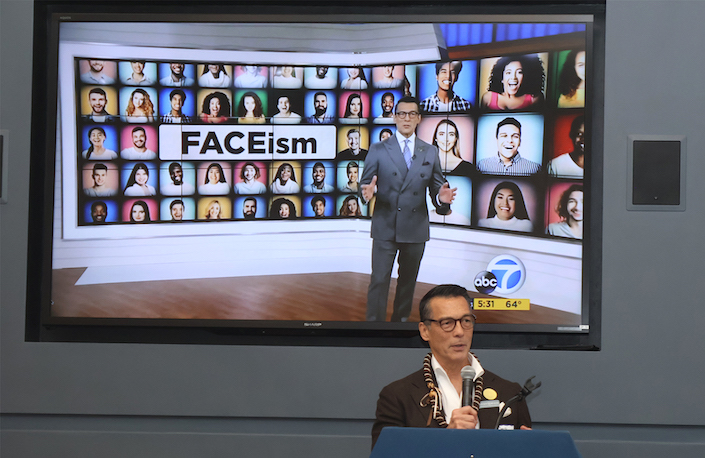
David Ono introduces an installment from his “FACEism” series.
Photos: George Toshio Johnston
Ono shared some of what he learned via some short videos of news stories he worked on, such as the 2011 earthquake and tsunami in Japan, a story on Japanese American photographer Toyo Miyatake and his award-winning documentary series “FACEism,” which, according to the ABC7.com website, exposes “chapters in our history that have gone hidden and ignored.”
In addition to sharing some of his videos with the audience, Ono also touted the latest iteration of his well-regarded “Defining Courage” program (see “Nisei Vets’ WWII Saga Goes Live and In Person,” Nov. 4, 2022, Pacific Citizen, tinyurl.com/2sb722vw).
Before turning the microphone over to Ventura County JACL Co-President Megan Gately, who in turn introduced Ventura County JACL scholarship coordinator Sarah Taketa, Ono said, “I came to that conclusion that really educating people is the most important part of storytelling.”
Taketa reported that in 2025, the chapter awarded nine scholarships ranging from $500-$1,500. “While the dollar amount is important and the quantity of students is important, I think for me and really our committee, what matters more is what the scholarships represent and what they can really unlock for the students, which is that feeling of momentum, confidence and also just the power of knowing that you’re worth investing in, you’re worth believing in and that there’s a community behind you.”
The oath of office for the 2026 Ventura Chapter board was conducted by Nancy Takayama, representing the JACL’s Pacific Southwest District. The office of Ventura County Supervisor Vianey Lopez provided the newly sworn-in officers with certificates of recognition.