Historical marker on Hwy. 35 makes amends 81 years after Hood River Incident.
By Eder Campuzano
A historical marker placed Nov. 11 on Oregon Hwy 35, just outside Hood River, Ore., pays homage to the contributions Nisei soldiers made to the U.S. military during World War II.
It sits along a highway pullout frequented by travelers looking to catch a glimpse of Mount Hood. Two years ago, this stretch of road was officially designated Oregon Nisei Veterans World War II Memorial Highway.
Bend, Ore., resident Eric Ballinger, along with local historian Linda Tamura, led the charge to dedicate the highway and the historical marker.
“I think these events have created a space that really helped further the healing process, within Hood River and within the Japanese Americans community,” Ballinger said.
That healing was years in the making.
Nearly 81 years ago, the local chapter of the American Legion removed the names of 16 local Nisei soldiers who had been included on a military honor roll installed on the Hood River County Courthouse. The act, which became known as the Hood River Incident, made headlines across the state and nation.
Hundreds of letters poured into the American Legion, and, in early 1945, American Legion leadership voted to restore the names. Legionnaires held on to the correspondence, much of which is available to view via the Japanese Museum of Oregon website (tinyurl.com/2upew8me).
Historians, elected officials and military officers highlighted that history during a 2025 Veterans Day ceremony in Hood River. Former Oregon Gov. Ted Kulongoski told the stories of Shin Sato and Frank Hachiya, Nisei soldiers whose families were sent to Idaho’s Minidoka War Relocation Authority Center.
“We are grateful for their valor and their service,” Kulongoski said during the service.
More than 33,000 Nisei served in the U.S. Armed Forces during WWII, and 433 of them were from Oregon.
Japanese farmers settled near Hood River because of the region’s promising agricultural fields, which bore harvests of apples, pears, cherries and other fruits. This section of the Columbia River Gorge became home to the second-largest population of Japanese immigrants in Oregon, second only to neighboring Multnomah County (tinyurl.com/2w47f97s).
Frank Nakata, 99, was living in Portland when his family was incarcerated and relocated to the Minidoka camp in Idaho alongside 13,000 other Japanese Americans. He was drafted into the military in 1944 and served in the Army Air Corps for one year.
“We did what we had to do,” Nakata said. “That’s the way it was. It was my duty to go.”
Eric Ballinger’s daughter, Mia, was one of six descendants of Nisei veterans invited to share their family history during the ceremony. Her great-grandfather, Harry Morioka, served in the 422nd Regimental Combat Team.
“It meant a lot to present on the history of the Nisei soldiers, knowing they were so disrespected,” Mia Ballinger said. “It was really about bringing back some of our culture.”
Like many Japanese Americans in the aftermath of WWII, Morioka didn’t talk much about his time in the service. But in the 1990s, Eric Ballinger became engrossed by Tamura’s writings on Japanese American history in Oregon.
Those readings inspired him to, along with Tamura, push Oregon leaders to recognize the Nisei’s historical contribution to the region and the war effort. In 2022, he successfully lobbied the Oregon Legislature to designate Hwy 35 as the Oregon Nisei Veterans World War II Memorial Highway.
The next year, while he and Mia were home sick with Covid-19, the father and daughter filled out the paperwork necessary to get a historical marker placed on the side of the highway. And on Veterans Day in November 2025, Mia cut the red ribbon that signaled the marker was now ready for visitors.
While several people were instrumental in the dedication of the highway and the placement of the historical marker, Eric Ballinger said the members of American Legion Post 22 and its commander, Carl Casey, deserve kudos for the effort they put forth to right historical wrongs.
“For them to collaborate with the Japanese American community is a great example of how we can create change and work out historical differences,” Eric Ballinger said. “I can’t say enough to applaud them.”
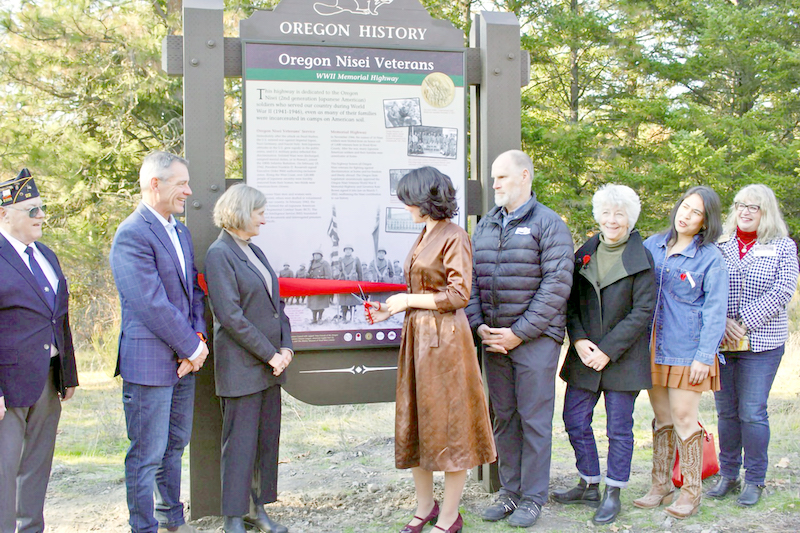
Mia Ballinger (center) cuts the ribbon during the Nov. 11, 2025, dedication ceremony for a historical marker that commemorates the contributions to the World War II effort by Nisei soldiers. Ballinger’s great-grandfather served in the 422nd Regimental Combat Team. Also pictured (from left) are Commander Carl Casey (American Legion Post 22), Oregon Rep. Jeff Helfrich (District 22), Hood River County Commissioner Jennifer Euwer, Hood River Mayor Paul Blackburn, former Hood River Mayor Kate McBride, Hood River City Councilor Gladys Rivera and Lisa Commander, executive director of the History Museum of Hood River County. Photo: Eder Campuzano