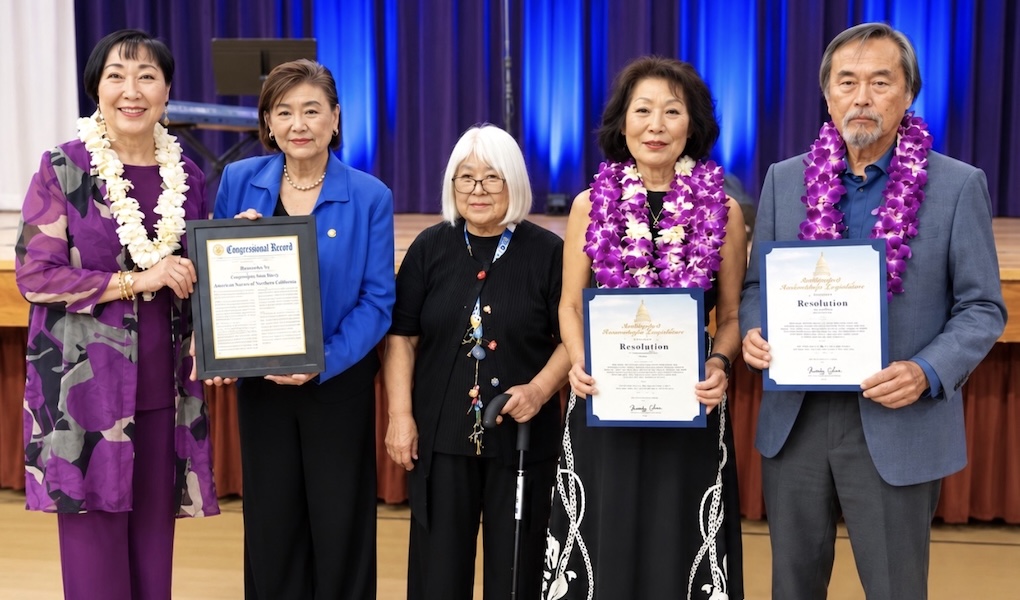
Pictured (from left) are Darlene Kuba, Rep. Judy Chu, Setsuko Nakama, Beverly Ito and Don Tahara. (Photos: Alex Luu)
The event also honors Beverly Ito, Setsuko Nakama and Don Tahara.
By Alex Luu, P.C. Contributor
Little Tokyo Nutritional Services has been serving congregate and home delivery meals to Japanese American/Japanese seniors in Little Tokyo and Boyle Heights since 1976. Its storied history speaks of determination, commitment and perseverance — and the community convened to celebrate its extraordinary mission on Oct. 3 with an anniversary celebration at L.A. Hompa Hongwanji Temple Social Hall.
Before he took to the podium to welcome the evening’s guests, William T. Fujioka, chair of the Japanese American National Museum’s board of trustees, brimmed with pride as he relayed exactly how LTNS came to be such an impactful and necessary organization.
To hear Fujioka tell it, LTNS’s origin story has the undeniable mix of the African proverb “It takes a village to raise a child” and the Old Testament story of David and Goliath.
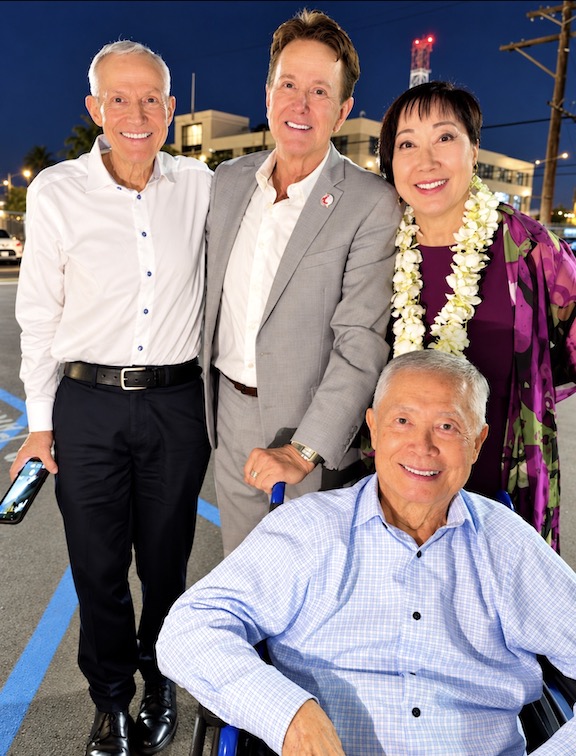
Darlene Kuba with (clockwise from top left) Brad Takei; Broadway star Davis Gaines, who performed during the evening’s festivities; and George Takei, whose father helped start LTNS.
“Fifty years ago, a group of community leaders, including Emi Yamaki and Takekuma Norman Takei (George’s father), met with the late-Councilman Gilbert Lindsay to ask for a culturally appropriate nutrition program for seniors living in Little Tokyo and Boyle Heights,” Fujioka said. “Gilbert turned to his young Deputy Council Member Darlene Kuba and said, ‘Write me the motion and go get me the votes,’ and she wrote the motion and it passed unanimously, and since 1976, they have served 2 million meals with their at-home delivery and congregate meals for our senior citizens.”
Kuba, now the board president of LTNS, echoed that sentiment of pride as she addressed the mostly Nisei attendees and thanked the countless community activists, volunteers and city officials for their support of LTNS.
“LTNS is a very small but impactful community nonprofit organization, and your participation tonight is important,” she said. “I want to acknowledge first the incredible actor, community advocate and activist George Takei and his husband, Brad. George’s father was part of the group that met with the late-Councilman Mark Lindsay, and Takei’s mother, Fumiko Emily Takei, was a longtime LTNS volunteer.”
“During the past 50 years, we have served over 2 million meals, and currently, we serve 700 meals per week, and our seniors range in age from 74-108 years old,” Kuba continued. “But our seniors come together to have more than just a meal. Most of our seniors live alone, and our program allows them to enjoy the company of others. They participate in classes, origami, mahjong, yoga and many other activities, and so they eat, sing and laugh, and they have a great time socializing and being together and seeing their friends.”
In addition to the meals and social events, LTNS’s staff and volunteers also perform a wide variety of tasks such as taking seniors to their medical/dental appointments, picking up prescriptions and conducting wellness checks. For many of the seniors who live alone, the wellness checks are the only social contact they get on a weekly or monthly basis.
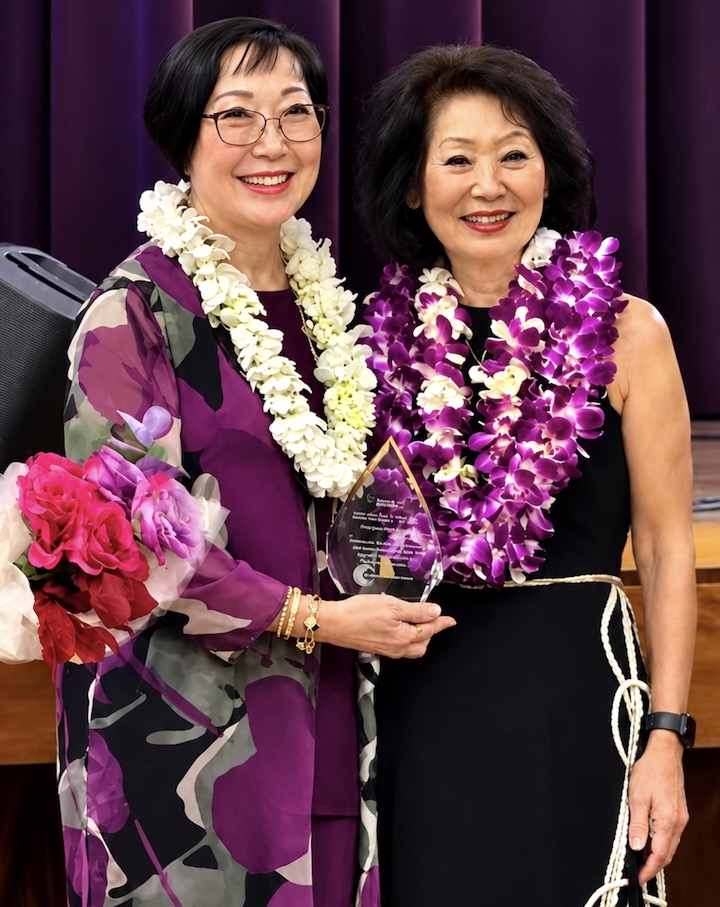
Darlene Kuba with honoree Beverly Ito, Keiro president and CEO of Keiro. (Photo: Jane Matsumoto)
For honoree Beverly Ito, her involvement with LTNS parallels her own dedication in serving the Japanese American community as president/CEO of Keiro, the senior health-care center that has served and improved the quality of life of countless Japanese American seniors since its inception in 1961.
“I would say that LTNS sets the ‘gold standard’ for organizations in our community, serving older adults,” Ito said. “We have partnered with LTNS through our Grants Program and have valued the partnership that we have with them and the funding that we’re able to provide to help them sustain their services.”
“Mother Teresa said, ‘If you can’t feed 100 people, feed just one,’” Ito added. “Why do these volunteers pound the pavement and pull their wagons of food throughout the streets of Little Tokyo or hoist those ice chests full of packaged meals into their cars for home delivery? The ‘why’ is because they understand the need of older adults facing food insecurity and at risk for depression and hopelessness from social isolation that a hearty, nourishing meal and a warm smile can save a life.”
The infectious pride with what LTNS has achieved also went hand-in-hand with a deeper and more grounded sense of humility, as shared by fellow honoree Don Tahara, restauranteur, chef and community leader who has run and transformed the iconic Far East Cafe into the hip Far Bar, the local “watering hole” for so many diners in Little Tokyo and beyond.
Asked about how he felt about being honored by LTNS, Tahara was quick to play down his integral role in helping to keep LTNS afloat throughout some recent challenges and setbacks.
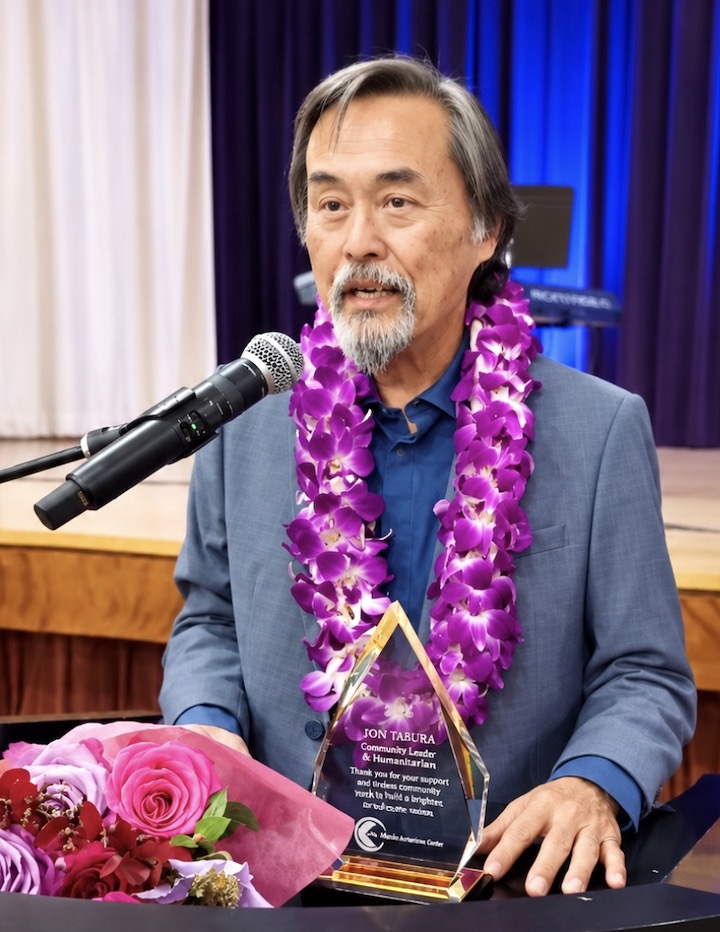
Honoree Don Tahara (Photo: Alex Luu)
“I feel honored, I’m just a cook, what can I say?” said Tahara. “About 12 or 13 years ago after I established Far Bar, Brian Kito, who’s involved in LTNS, asked me to help him roast 12 turkeys for the senior citizens at Little Tokyo Towers. During that period of time, they needed somebody to take on the daily lunches on a regular basis, so he basically volunteered me. So many volunteers don’t ask for anything in return, which is remarkable, so you get swept up with that whole culture of volunteering, and we’ve just kept doing it all these years.”
Bruce Saito, chief of the Conservation Corps, introduced Tahara and told a story about him that most folks outside of Little Tokyo would not have known.
“Not too long ago, LTNS had one of those vendors (whose name will go unnamed at this moment) [that was] delivering the meals every day, but they weren’t paying Don and Far Bar to the point where Don had to tap out his credit card to pay over six to eight months of overdue payments,” Saito recalled. “And he did that not because he was making a lot of money — it was because of his passion, dedication and service not just to the Little Tokyo community but also to the seniors and hundred or so folks that received and depended on these meals each and every day. That speaks volumes to not only his commitment but his respect of the culture and the people of L.A.”
Another recent obstacle that LTNS has faced happened when the previous funding agency decided to no longer serve Japanese food. According to Kuba, funding for the meals was received from the Los Angeles Department of Aging through a separate funding agency that had a contract to oversee the allotment of funds for LTNS.
“The funding agency questioned the cost of Japanese food and unilaterally decided to only provide standard food (in the form of ham sandwiches) that was not consistent with the culturally appropriate food that LTNS has served in the past,” Kuba said. “Staff, volunteers and seniors were extremely disappointed. LTNS went from 130 congregate meals to 30 each day. The home delivery meals were either rejected or not eaten.”
Kuba approached Assemblyman González, who immediately offered to help and connected her to YMCA, which became LTNS’s current funding agency. YMCA then entered a contract with Tahara/Far Bar; seniors receiving meals have had Japanese food ever since.
In addition to Ito, Nakama and Tahara, González and YMCA representative Omar Torres received a special Recognition Award for being, in the words of Kuba, “Little Tokyo’s nutrition champions.”
In thanking Kuba and LTNS, González reiterated the evening’s recurring theme of resilience and humility in the face of daunting challenges.
“When we heard about some of the services that were getting cut by the current administration, not just in Little Tokyo, but through Boyle Heights, through K-Town, through a number of parts of my district, this was something that was not new to me,” González stressed. “Food is something that means a lot to people. But you have to have the right food that feeds your soul. Building that partnership with the YMCA and securing the dollars that we did last year from the state goes right back into the community. And we’re going to keep fighting for those dollars every single year.”
The highlight of the evening came when Rep. Chu took the podium and announced that LTNS’s crucial role in community service has transcended the local areas of Little Tokyo and Boyle Heights.
Chu presented a Congressional Record for LTNS’s 50 years of service. “A Congressional Record is something that is submitted on the floor of the House in Washington, D.C., to honor outstanding individuals and organizations in our nation,” Chu proclaimed. “And because it is submitted there right on the floor of the U.S. Capitol, your record of achievement will be in our U.S. Archives for life.”
Chu also presented certificates of Congressional Recognition for Ito, Nakama and Tahara, as well as the Congressional Record to Kuba.
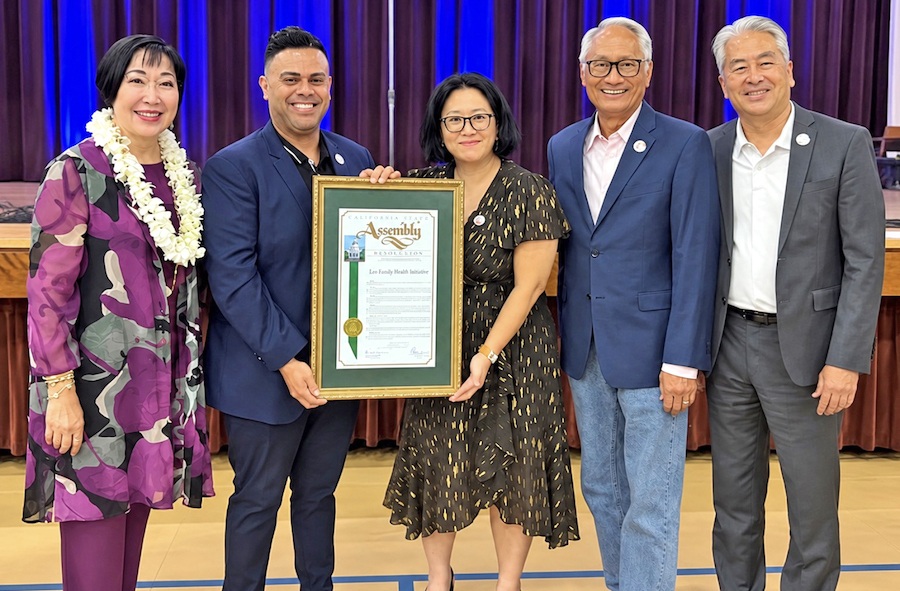
Pictured (from left) are Darlene Kuba, LTNS board president; Assemblyman Mark González; Fay Katayama, LTNS board vp; Bruce Saito, LTNS board member; and Assemblyman Al Muratsuchi with the California State Resolution for the nonprofit’s 50th anniversary. (Photo: Hiroko Higuchi)
Throughout the evening, each and every honoree and speaker was quick to praise Kuba’s herculean efforts in her 50-plus years of making the impossible possible for LTNS.
“I never want to be on Darlene’s bad side,” Tahara half-joked. “She’s a force, and she made things happen, which really impressed me. It made me want to work harder. That’s the value of good leadership.”
But instead of just resting on her laurels, Kuba keeps LTNS and its next 50 years in sharp focus. “The principal challenge for any community nonprofit is funding and support,” Kuba stressed. “Although the YMCA has stepped up, this funding source cannot be viewed as permanent. More than ever, community support through donations and services is extremely important. The LTNS board, staff and volunteers have committed their personal and professional lives to supporting our seniors.”
Perhaps the most profound statement that encapsulated LTNS’s 50-year legacy was offered by honoree Nakama, a woman of few words who is widely considered as the “heartbeat” of LTNS as its executive director. Said Nakama, “As Jesus said, ‘I did not come to be served, but to serve.’”