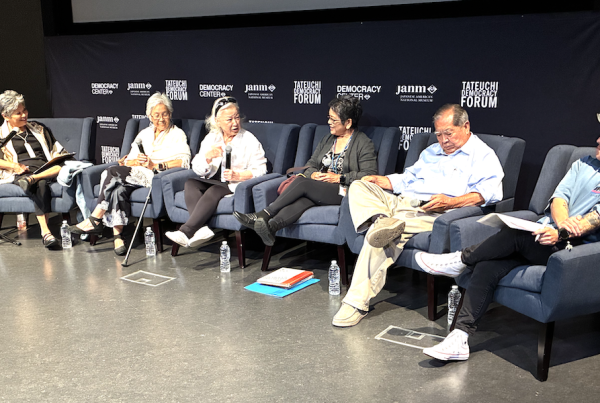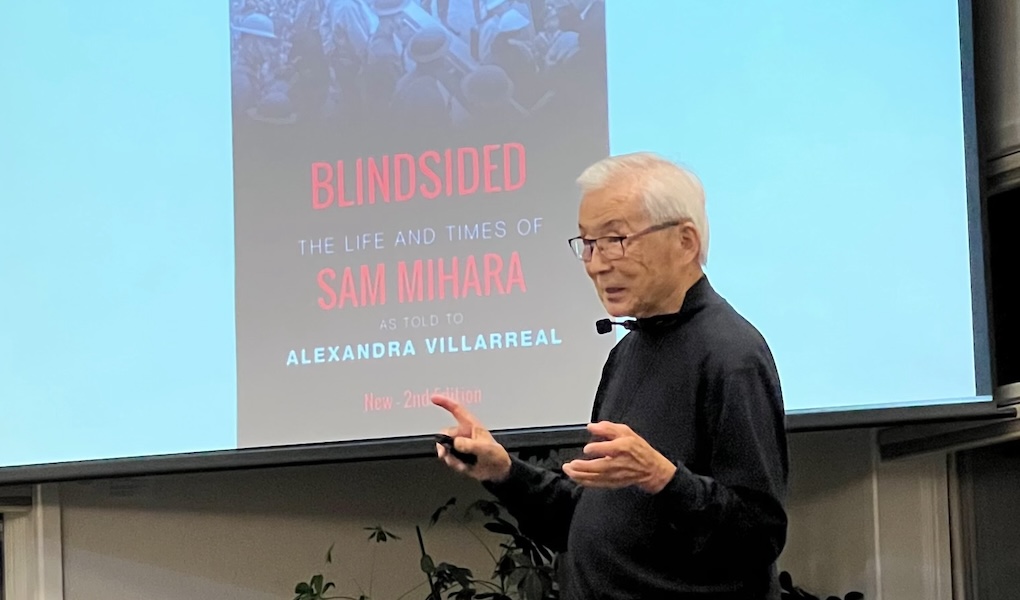
Sam Mihara stands in front of a slide of his book, “Blindsided,” during his presentation in Anchorage, Alaska. (Photos: Marie Matsuno Nash)
Fortuitous circumstances bring
the award-winning speaker to Homer and Anchorage.
By George Toshio Johnston, P.C. Senior Editor
Sam Mihara more than anyone knows for him, along with his innate interest and aptitude, that education was a key component to his 42-yearlong aerospace career with Boeing.
“I went to Berkeley, UCLA grad school, majored in engineering, became a rocket scientist, helped develop rockets that went to the moon, rockets that put up satellites,” Mihara said to the audience gathered to hear his presentation, “Memories of Injustice,” held the evening of Oct. 9 at Alaska’s Anchorage Unitarian Universalist Fellowship.
Education, it turns out, is also why the 92-year-old began a new mission in life as a public speaker who can remember and relate what he witnessed and experienced as a 9-year-old boy who, with his family, was uprooted from life in California and incarcerated at Wyoming’s Heart Mountain War Relocation Authority Center following President Franklin D. Roosevelt’s issuance of Executive Order 9066.
“After I retired, I do what I’m doing today,” he told the audience. The Nisei’s “new career” began in 2011 after the Heart Mountain Wyoming Foundation asked him to speak about his life experiences. Because of that event, Mihara would become an in-demand speaker as he embraced his role as a witness to and participant in American history.
Since then, Mihara has been recognized with the National Council for History Education’s Paul A. Gagnon Prize (2018), given to those who have made “a significant contribution to history education”; the Salem Award for Human Rights and Social Justice (2023), which “honors an individual or organization that is speaking out and taking action to confront discrimination and stand up for human rights and social justice”; and a Japanese American of the Biennium Award (2022) from the Japanese American Citizens League (see the Aug. 26, 2022, Pacific Citizen, pacificcitizen.org/together-again/).
Mihara said he keeps track of the headcount of the audiences he has addressed over the years. “I’ve reached over 160,000 people, young people mostly,” he recalled.
He can now add to that the total number of those who showed up for the two presentations he gave on Oct. 9, the first in Homer that morning, the second in Anchorage that evening. For members of the Alaska JACL chapter, it was a set of fortuitous circumstances that brought the Huntington Beach, Calif.-based Mihara from Southern California north to Alaska.
According to Alaska JACL Chapter President Dennis Arashiro, it was thanks to the Alaska Historical Society in Homer that paid to bring Mihara to the nation’s 49th and largest state.
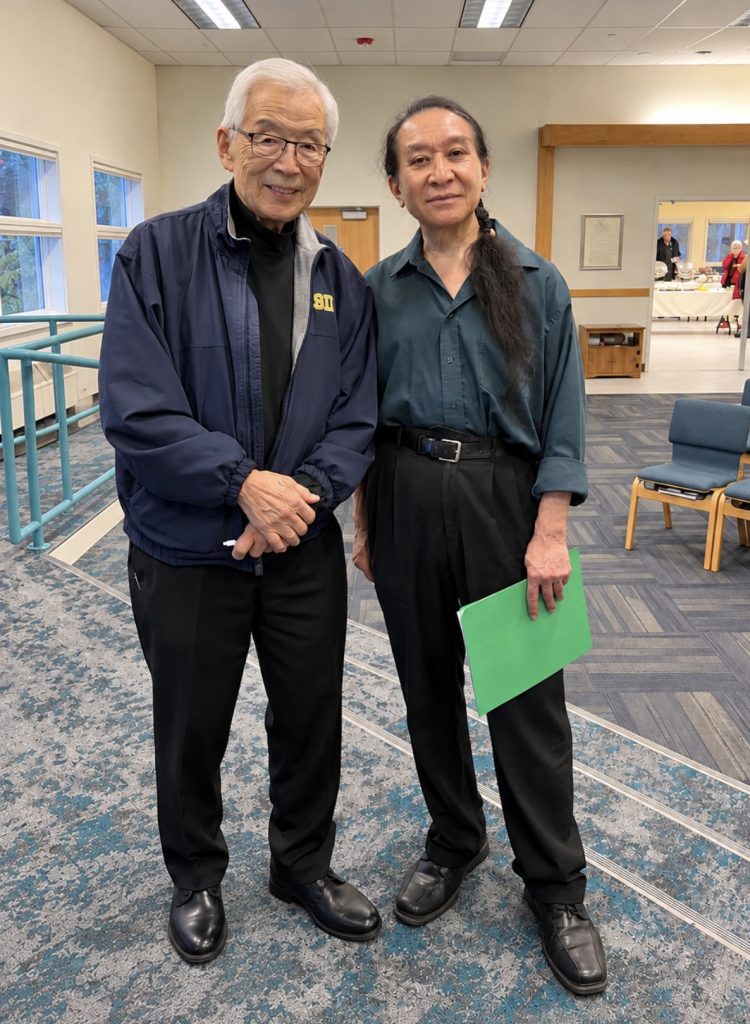
Guest speaker Sam Mihara (left) with moderator Dennis Arashiro, who also serves as executive board president of the JACL Alaska chapter and is a member of the Anchorage Unitarian Universalist Fellowship.
“They arranged everything: his flight, his lodging, all of that stuff,” Arashiro told the Pacific Citizen. “I got word of his visit after the fact. Apparently, Sam asked about whether there was a JACL chapter here that he could connect with, and that’s how I learned about this.” It didn’t hurt that Arashiro also happened to know the president of the Alaska Historical Society.
“When I found out about his travel plans and such, I looked at his schedule. … He was supposed to fly into Anchorage at 5:45 in the evening, and then his schedule is basically to be lodging overnight in Anchorage before his flight back home Saturday morning. So, I said, ‘Wait a minute here, I wonder if there’s an opportunity?’ … I found that window for him to speak, and I checked to see if he was amenable to it, and he says, ‘Oh, OK, sure.’”
As it would happen, the church that Arashiro was a member of turned out to be the ideal venue for Mihara’s presentation. Not only was it set up with microphones, speakers and a stage, but also chapter members were able to attend. So, too, were congregants of the Anchorage Unitarian Universalist Fellowship and members of the Alaska American Civil Liberties Union, not to mention several who attended virtually via Zoom.
Accompanied by a slideshow, Mihara gave the broad overview of what happened to Japanese Americans who lived along the West Coast in the aftermath of Japan’s Dec. 7, 1941, attack on Pearl Harbor, America’s declaration of war that thrust the nation into WWII and the ill-conceived, knee-jerk presumption of guilt by ancestry that would affect more than 125,000 ethnic Japanese, mostly U.S. citizens, by putting them into government-operated concentration camps.
Mihara’s presentation explained many of the major commonalities of the Japanese American incarceration experience during WWII: Roosevelt’s Executive Order 9066 and individuals such as Fred Korematsu who in their own ways defied aspects of it, the role played by the Army’s Western Defense Command’s Gen. Lt. Gen. John L. DeWitt in forcibly removing ethnic Japanese from the West Coast, how many Japanese Americans who wound up at WRA centers were initially held at assembly centers before getting sent to one of its 10 camps, awful food, conditions and temperature extremes, the divisive and poorly worded loyalty questionnaire and in the slideshow, one of Dorothea Lange’s many iconic photos, including one with two girls with contrasting expressions as they recited the Pledge of Allegiance.
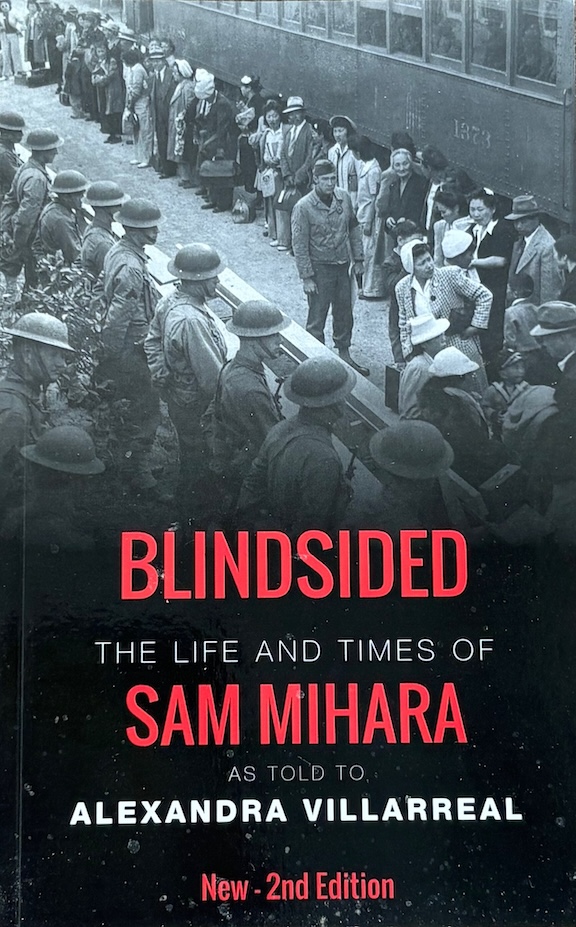
Cover art for Sam Mihara’s book (Photo: Courtesy of Sam Mihara)
Later, during the Q&A session, an audience member remarked how she attended school in the 1960s and ’70s but did not remember learning anything about any of this in her history books and only first learned of what happened to Japanese Americans when she was in her 30s. It was the perfect setup for Mihara.
“I’ve discovered by talking all around the country that this topic is not being well-taught. At best, there may be a mention that there was such an event, but no description of why, and most important, how do we make sure it doesn’t happen again.”
But it was Mihara’s personal family history that was most compelling. “My father had … glaucoma of his eyes, and I remember he really had a difficult time. But in San Francisco, he was seeing a specialist who was able to maintain his eyesight. But once he came to the camp, none of the doctors knew how to take care of glaucoma. They were general practitioners. They were not specialists,” he said. “As a result, my father went blind in camp.”
Another personal story shared was about his grandfather, who “died a horrible death” in camp. Later, when Mihara was able to access his grandfather’s medical record, the camp’s general practitioners thought he had colon cancer. The best they could do was prescribe a laxative. “That told me a lot about the poor quality of medical care that we had,” he said.
Mihara, nevertheless, was able give his presentation a positive spin. There was, after all, President Ronald Reagan’s signature on the Civil Liberties Act of 1988, which provided monetary compensation to still-living Japanese Americans and a letter of apology signed by his successor, President George H. W. Bush.
Mihara then asked if anyone remembered Lange’s iconic image of the two girls reciting the Pledge of Allegiance seen in his slideshow. The girl on the left would go on to have a special place in Mihara’s life.
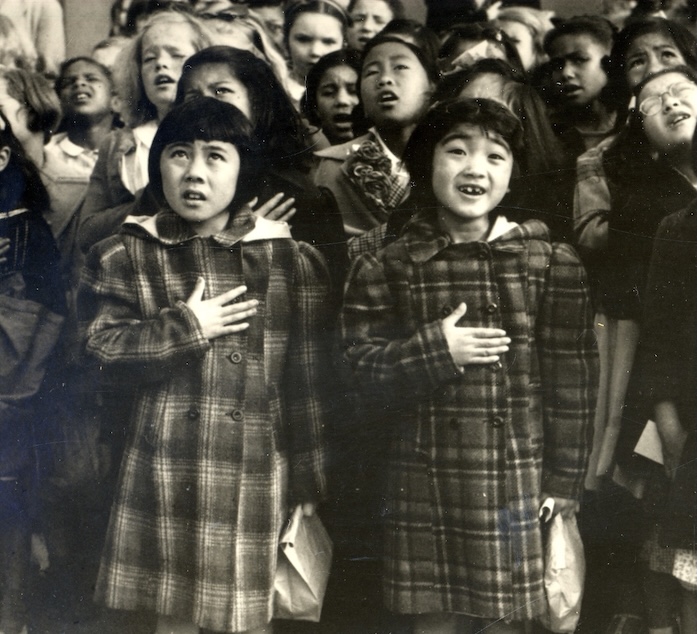
Part of Sam Mihara’s slideshow is this Dorothea Lange photo of two schoolgirls taken in April 1942 in San Franciso that shows the contrasting expressions of Hideno Nakamoto (left) and Yoko Itashiki as they face a yet-to-be-determined future. Nakamoto and Mihara remain married to this day.
“She still looks the same. Her eyes and nose are still the same, but she changed her name twice. Her first name used to be Hideno, a Japanese name, and she changed it to Helene, easier to pronounce. Her last name used to be Nakamoto, another typical name, and she changed it to Mihara. We’ve been married for 70 years, and we have two daughters, two grandkids and they all graduated from college. So, we’re OK.”
He also noted that he’d be happy to sell and autograph the 20 copies of “Blindsided — The Life and Times of Sam Mihara” that he brought with him from California. “It tells a story about what I remember, some good times I had at the camp, some problems like my mother was almost shot by a guard and other things,” he said.
One might say it doesn’t take a rocket scientist to accurately conclude that the book and his presentations are all part of Mihara’s one-word mission today and what allowed him to have his career earlier in his life: education.
Said Mihara, “I give talks all over and try to educate people on what really happened to make sure it doesn’t happen again.”
(Editor’s Note: Copies of Sam Mihara’s “Blindsided” are available for purchase at sammihara.com/product/the-life-and-times-of-sam-mihara/.)