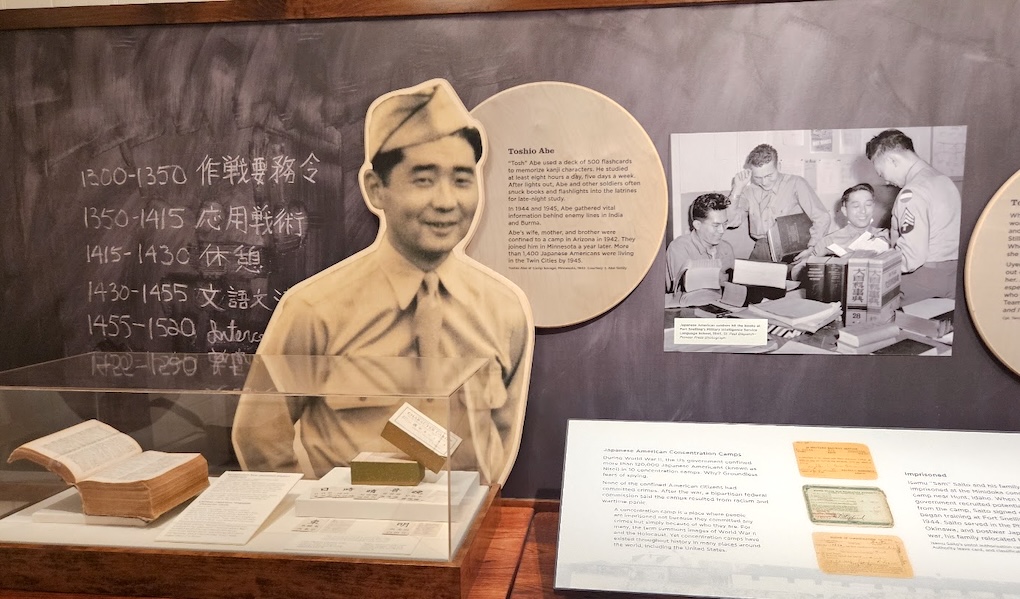
This display at Historic Fort Snelling, operated by the Minnesota Historical Society, highlights the experiences of one of the thousands of Nisei who attended the Military Intelligence Service Language School during World War II. (Photo: Gil Asakawa)
By Gil Asakawa, P.C. Contributor
When people think of Japanese Americans fighting during World War II, the “Go For Broke” Nisei of the 442nd Regimental Combat Team, comprised of the 100th Battalion from Hawaii and bolstered by recruits from the mainland concentration camps, come to mind. They fought in Europe and remain today the most-heralded combat group in U.S. military history for its size and length of service. But there’s another group of Nisei who served during WWII but didn’t get the recognition and medals (or Hollywood movies) of the 442nd: the soldiers of the Military Intelligence Service, who served across the globe in the Pacific and across Asia and in Japan.
If you wander around the old stone barracks of Fort Snelling in Minneapolis, across the highway from the city’s airport, it’s hard to picture it as the birthplace of America’s Cold War and Pacific Theater intelligence operations. But back during WWII, this sprawling Minnesota outpost became an unlikely hub for a band of young Japanese Americans whose language skills — and absolute grit — helped shorten the war in the Pacific and change the course of history.
“Military Intelligence Service Language School. It’s a mouthful,” explained Kimmy Tanaka, senior director of Inclusion, Outreach and Community Engagement for the Minnesota Historical Society. Earlier this summer during an Asian American Journalists Assn. conference in Minneapolis, she led a walking tour of conventiongoers at Fort Snelling.
“It was started in California, in San Francisco at the Presidio, about a month before Pearl Harbor, with like 50 or 60 students in a class. It started because there was an Army officer, Kai Rasmussen, who had spent some time in Japan and knew that Japanese was somewhat of a complicated language. He knew also that potentially the war with Japan would be imminent, and that we would need people who could speak the language to translate documents, be interpreters and [help] the war effort.”
Rasmussen’s goal was to recruit and train soldiers, including Nisei, for the program. But then Pearl Harbor was attacked, followed by the issuance of Executive Order 9066, which resulted in more than 125,000 people of Japanese ancestry being forcibly removed from the West Coast and placed into concentration camps. A large amount of the soldiers, about a third of them, were recruited from the incarceration centers while their family members were imprisoned behind barbed-wire fences.
“So, after Pearl Harbor, the commandant of the school started looking for a new location,” Tanaka explained, “but at the time, a lot of the different areas that he met with did not want Japanese people, Japanese American people, in their state. So, he came to the Midwest, met Gov. Harold Stassen, the governor of Minnesota at the time, who was like, ‘You’re welcome here.’ ”
The MISLS was first placed at Camp Savage about 20 miles west of Minneapolis, but because it was attracting so many recruits, it was moved to Fort Snelling, a military base closer to the city that had been originally built decades before the Civil War.
Even as the federal government was herding more than 125,000 people of Japanese descent behind the barbed wire of American concentration camps, the War Department was quietly recruiting those exact same citizens to master Japanese military terminology, translate captured documents and interrogate prisoners of war. Another program at the University of Colorado in Boulder trained mostly Caucasian Naval recruits in Japanese.
For the Nisei soldiers at Fort Snelling, it’s a story defined by incredible contradictions, deep patriotism under fire and a quiet cultural revolution that played out in classrooms heated by sputtering coal stoves in the dead of a Minnesota winter.
From Crissy Field to the Frozen Plains of Minnesota
The roots of the school date back to November 1941, just weeks before Pearl Harbor, when the U.S. military brass realized they knew next to nothing about the Japanese Imperial Army. Tucked away in an airplane hangar at Crissy Field in San Francisco, the Fourth Army Intelligence School opened its doors to a tiny pilot class of 60 students — mostly Nisei (second-generation Japanese Americans), alongside a handful of Caucasians; after the start of the war, the school was re-established at Camp Savage.
By August 1944, the operation had moved to Fort Snelling, taking over a massive footprint that could accommodate thousands of eager, sleep-deprived soldiers.
Life at Fort Snelling was no walk in the park. The students faced an academic and physical military boot camp designed to compress years of complex language study into an agonizingly tight six-month window. They tackled thousands of kanji characters, military field manuals, interrogation techniques and specialized jargon. They pulled all-nighters under flickering incandescent bulbs while sub-zero blizzards howled outside the old brick barracks.
Yet, beneath the grueling pace ran a fierce, shared sense of purpose. Many of these young men had families locked up behind barbed wire. Day after day, like the soldiers fighting in Europe with the 100th Battalion/442nd Regimental Combat Team, the Nisei at the MISLS chose to serve the country that had imprisoned their loved ones.
The Unsung Heroes of the Pacific War
Once they graduated, MIS graduates were thrust straight into the brutal island-hopping campaigns of the Pacific Theater: Burma, Guadalcanal, Okinawa, the Philippines, Saipan and eventually occupied Japan. Attached to Marine, Army and Australian units, these Nisei intelligence soldiers operated in small, high-risk teams.
“Altogether, there were 6,000 Nisei Japanese Americans who graduated from the school, and then they were deployed overseas to the Pacific Theater and Japan during the occupation. There was also a class of women, and there was a class of Chinese Americans,” Tanaka added.
The Chinese were recruited in part because the Army brass couldn’t tell the difference between Japanese and Chinese and even then, thought if someone could speak Chinese, it must be similar to Japanese. That was wrong, but some of the Chinese soldiers were sent to the China-Burma India Theater (think the 1957 movie “The Bridge on the River Kwai”).
In the end, the Niseis’ contributions can’t be overstated. They translated enemy battle plans, diaries and maps plucked from dead soldiers, giving Allied commanders unprecedented foresight into Japanese troop movements and ambush sites. During interrogations, their cultural fluency and empathetic approach coaxed valuable intelligence out of terrified prisoners of war who expected to be executed.
Because of their faces and heritage, they carried a heavy psychological burden: They were hunted not just by the enemy but also occasionally faced accidental friendly fire from American troops who failed to recognize their uniform in the heat of battle.
Beyond military intelligence, the soldiers of the MIS played a critical humanitarian role by broadcasting surrender appeals that saved the lives of countless civilians trapped in crossfires (especially in Okinawa, the last battle bastion of the war), and later, also helped draft the blueprint for post-war democratic reforms during the Allied occupation of Japan.
When the guns finally fell silent in August 1945, the MIS mission didn’t end. It merely shifted geography. Hundreds of language school alumni were rushed to Tokyo and across the shattered Japanese archipelago to serve as the critical cultural and linguistic bridge for the Allied occupation under Gen. Douglas MacArthur. The Nisei officers alongside civilian linguists helped interrogate suspected war criminals, repatriate millions of displaced military personnel and civilians and scour seized Imperial archives.
Perhaps most remarkably, they found themselves on the front lines of rebuilding a nation. MIS veterans assisted in drafting the post-war Japanese constitution, translating democratic legal frameworks, observing early democratic elections and managing food and medical relief distribution. For many of these young American soldiers, walking the streets of Tokyo or ancestral family prefectures offered a bittersweet homecoming, a chance to reconnect with extended relatives and witness firsthand the rebirth of a democratic Japan from the ashes of total war.
MacArthur’s intelligence chief, Gen. Charles Willoughby, famously estimated that the work of the MIS shortened the war in the Pacific by as much as two years and saved hundreds of thousands of American and Japanese lives. Yet, because much of their work was classified as top secret for decades, these soldiers returned home to a country that largely forgot their sacrifices. Their stories were buried under layers of wartime secrecy and the collective amnesia surrounding the unjust incarceration of Japanese Americans.
A Legacy Carved in Stone and Memory
When the war wound down in 1946, the language school at Fort Snelling wiped its chalkboards one final time and headed west to the Presidio of Monterey, eventually evolving into the Defense Language Institute. But its spiritual home remains rooted in the Minnesota soil where thousands of Nisei soldiers learned to turn their heritage into a tool for democracy.