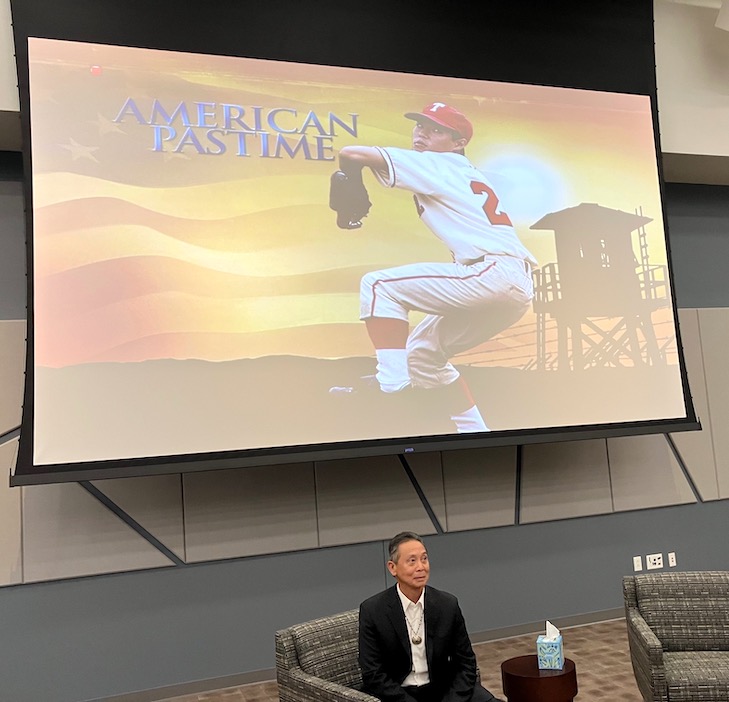
Kerry Yo Nakagawa during the “American Pastime” Q & A session following the film’s screening on March 29 photos: Courtesy of JACL St. Louis chapter
By Sherry Leitl, JACL St. Louis Chapter
The St. Louis chapter of the JACL co-sponsored a movie screening of “American Pastime” and a discussion with the movie’s associate producer, Kerry Yo Nakagawa, at the St. Louis Kaplan Feldman Holocaust Museum on March 29 in Creve Coeur, Mo.
Nakagawa, an author, historian and founder of the Nisei Baseball Research Project, told stories about Nisei baseball players, his family and how the movie has impacted viewers for nearly three decades.
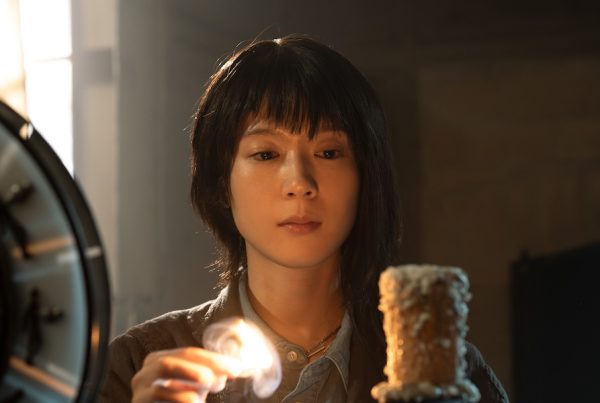
“American Pastime,” set in the 1940s, is a fictional film that portrays Japanese Americans as they were removed, assembled, relocated and forced to create new lives in the Topaz camp, behind barbed wire and armed guards.
The film was inspired by the real-life efforts of Kenichi Zenimura in creating a baseball league during the forced incarceration of people of Japanese ancestry during World War II. The film touches on one man volunteering and returning from war as part of the 442nd/Regimental Combat Team/100th Infantry Battalion, with their “Go for Broke” motto becoming an integral part of the movie’s climax.
In addition to showing baseball as a central theme of resilience, the movie presents themes of racism, love, coping, dignity and loyalty. For love of the game, men in the camp form a baseball team that ultimately competes against the local Caucasian team for a high-stakes prize.
“I could just see my parents going through all that. The movie brought it all close to home. To think your parents had to go through all that — it just breaks your heart,” said Anne Mitori, a JACL member who was incarcerated with her family at Tule Lake, of her reaction following the film’s screening. “I suspect young men enlisted to get out of that desolation.”
Said Ed Shimamoto, who was born in the Rohwer, Ark., incarceration camp: “I was very moved by the way they showed new character actors along with some old documentary videos. The racist scenes added a more graphic and personal effect, more impact than the documentary haircut story I had read about. It reinforced what [my father] said about not wanting to go back to California after camp because they weren’t treated very well. Indeed, the organization the Native Sons of the Golden West was as bad as the Ku Klux Klan with their violence and support of anti-Asian legislation efforts.”
Nakagawa’s family was incarcerated at Fresno, Calif., and then Jerome, Ark. In a Q & A-style discussion following the screening, Nakagawa said Asians and Negros played in separate leagues but were talented enough to play Major League Baseball in the 1920s and ’30s.
His uncle, Johnny Nakagawa, was the “Shohei Ohtani” of his time as a left-handed pitcher, homerun hitter and center fielder. Kerry Nakagawa brought photo prints of Japanese American all-star players Johnny Nakagawa, Harvey Iwata, Fred Yoshikawa and Zenimura with Lou Gehrig and Babe Ruth at a 1927 exhibition game at the Fresno Athletic Club.
Kerry Nakagawa also told stories about his family, including his godfather, actor Pat Morita, and about how the 2007 movie has impacted viewers.
“The St. Louis organizers did a great job making this, as well as other events, as part of the three-months-long ‘Resilience’ art exhibit,” said St. Louis Chapter JACL member Masao Nishi. “The partnership with the Holocaust Museum broadened the audience for the exhibit, and this wonderful movie was both educational and enjoyable. I’m very impressed with the event and its contribution to the community.”
The “American Pastime” event was the last in a series of events centered around the traveling art exhibit “Resilience: A Sansei Sense of Legacy.” The St. Louis Kaplan Feldman Holocaust Museum hosted the exhibit in partnership with the St. Louis Chapter JACL with support from the JA Community Foundation, the JACL Legacy Fund and the Regional Arts Commission of St. Louis. Ann and Alan Spector sponsored the “American Pastime” event.
The events were three years in the making for Mike Kimzey and Robin Hattori, who saw the exhibit in several cities before scouting for a location in St. Louis. Kimzey, along with Wendy Roll, board president, and Steve Mitori, vp of finance, worked with the Holocaust Museum’s education, events and logistics teams on the exhibit planning and implementation. Hattori obtained multiple grants to fund the exhibit project while the entire board planned related events in coordination with museum staff.
Events related to the “Resilience” exhibit included a Jan. 15 opening reception and a day dedicated to local JACL members and their friends. In conjunction with the opening, Kimzey and Hattori organized a bonsai exhibit, plus hands-on teaching and exhibits of ikebana, tea ceremony and origami.
The chapter also held a Feb. 22 Day of Remembrance presentation at the Holocaust Museum. The event included a presentation by Washington University Assistant Professor Kelley Van Dyck Murphy and students who created art projects based on their class research, as well as a trip to Manzanar.
The Day of Remembrance also featured a presentation and Q & A with author Tracey Slater, author of the book “Together in Manzanar.” The book is the true story about a Japanese Jewish family that fought to stay together during relocation. Hattori served as a moderator of the discussion.
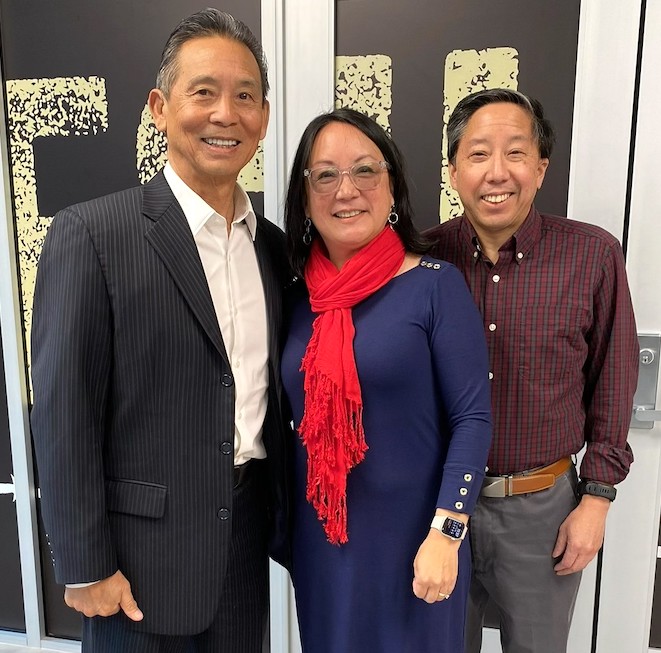
Kerry Yo Nakagawa (left) with St. Louis Chapter President Wendy Roll and Treasurer Steve Mitori
For more information about the Nisei Baseball Research Project and to see the famous 1927 exhibition game photo and film footage, visit niseibaseball.com.
For upcoming events, visit the JACL St. Louis chapter’s website at stlouisjacl.org.