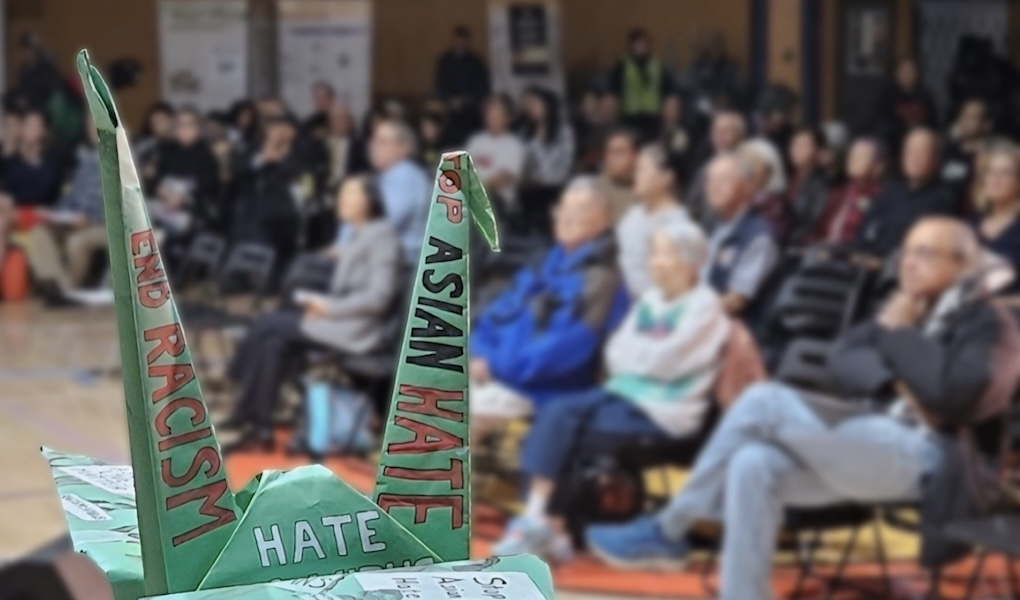
A folded crane with the words “End Racism” and “Stop Asian Hate” on display during the S.F. DOR observance event (Photo: Gil Asakawa)
Community members mark
Day of Remembrance in San Francisco, Denver
By Gil Asakawa, P.C. Contributor
Day of Remembrance is marked by Japanese Americans in events across the country around Feb. 19. This year was the 84th anniversary of President Franklin D. Roosevelt’s signing of Executive Order 9066, and the P.C. was on hand at two events in San Francisco on Feb. 13 and 15 and then in Denver on Feb. 22.
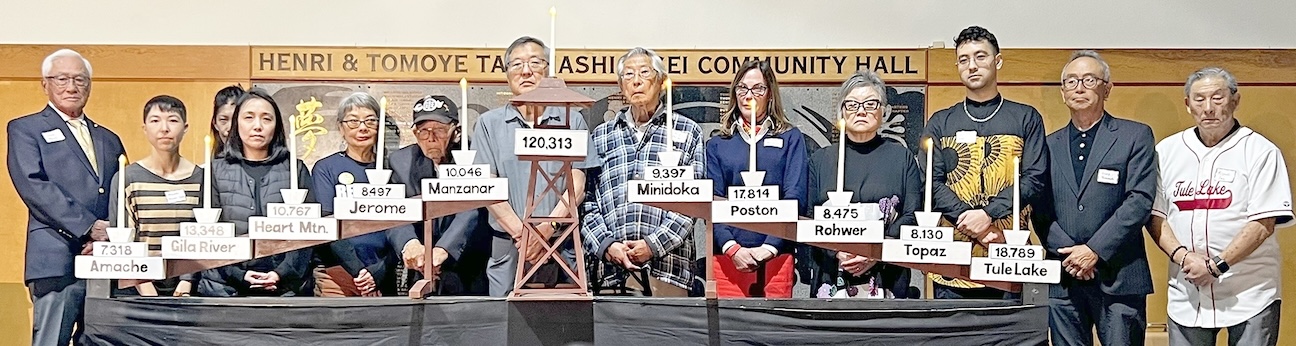
Candlelighting participants representing the 10 WRA incarceration camps at the S.F. Day of Remembrance event (Photos: Courtesy of Grace Morizawa)
The Bay Area Day of Remembrance Consortium, an organization that serves as an umbrella for 16 organizations including the San Francisco chapter of the JACL, started the weekend with a press conference on Feb. 13 at the KOHO community center in Japantown.
See related stories:
Boise Valley JACL Presents 25th DOR Observance
‘The Power of Action: Silence Today, Injustice Tomorrow’
The Government Made Them Neighbors, Their Connection Made Them Family
The event included an intimate discussion featuring moderator Jeremy Chan, a civil rights attorney, and panelists Chizu Omori, who fought for redress and then with sister Emiko made the award-winning 1999 film “Rabbit in the Moon” that focused on the Tule Lake resisters and criticized JACL’s role in the World War II incarceration of people of Japanese ancestry; Steve Okamoto, JACL legacy planning officer and vp of the Tanforan Memorial Project; Ruth Sasaki, editor of the Topaz Stories Project; and Grace Shimizu, whose father was kidnapped from Peru and who fights for Latin Japanese recognition and reparations.
The speakers were passionate and made clear-eyed connections between the JA wartime experience and the division and turmoil in the U.S. today.
Emiko Omori was in the audience and spoke up first when the question was asked of how Japanese Americans should apply the often-used phrases gaman (“endurance with dignity”) and shikata ga nai (“it cannot be helped”), which were used to guide the incarcerees during WWII, to the victims of mass arrests, incarceration and deportation today.
“It sounds like our grandparents or my grandparents,” Emiko Omori said. “Those words have been used to keep us quiet about what we need and what we endured, and that just makes me think those overused euphemisms just have to go.”
The Japanese prisoners had had a reputation as meek and nonconfrontational, she noted, but “I don’t know why we got stuck with those characterizations because there were plenty of people in the camp who objected to what was going on and fought for their rights.
“Even to the point where, you know, the government just labeled them all disloyal and deported or punished people in a lot of different ways,” she said.
“It’s our traditional values,” added Okamoto. He lightened the mood of the audience by noting, “I actually use (those terms) today, like if I’m stuck in traffic, it’s the only way that I can keep my sanity and my blood pressure under control. Those terms are kind of like survival responses. That’s what our grandparents and parents used to survive.”
Today though, Okamoto said, just accepting the situation isn’t enough. “I feel that as a survivor, I have an obligation to tell my story and inform the public that these things have happened and will continue to happen in our country unless we protest, and you know, the least you can do is vote, and then from there, get out in the streets.
“Asian Americans are kind of known as nonparticipants, in many political activities,” Okamoto continued. “But I feel that politics is everybody’s business. . . . And you should also certainly get out there and choose your leaders, which is to say, vote, elections and such because these things matter.”
San Francisco Dor Event
The Feb. 15 Day of Remembrance event, which drew a large crowd to the Japanese Cultural Community Center of Northern California, was a full program titled “Neighbors, Not Enemies: Stronger Together, Carrying the Light for Justice.”
The event was emceed by KPIX news anchor Ryan Yamamoto and opened with a taped video message from Sen. Mazie Hirono (D-Hawaii). The first part of the afternoon focused on a panel moderated by Kenji Taguma, editor-in-chief of the Nichi Bei News, with panelists San Francisco City Attorney David Chiu; Satsuki Ina, co-founder of Tsuru for Solidarity; and Grace Shimizu of the Campaign for Justice: Redress Now for Japanese Latin Americans.
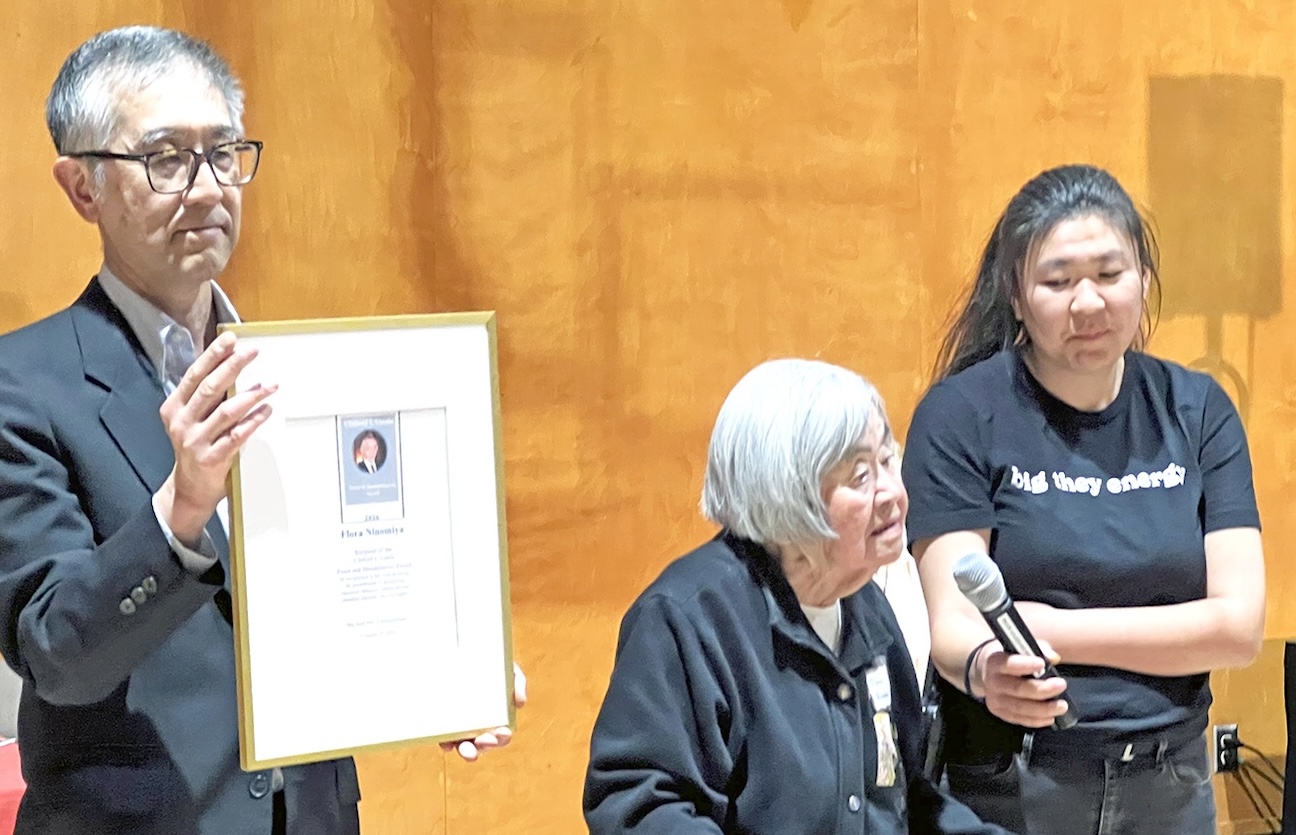
S.F. DOR honoree Flora Ninomiya
The program also included an update on Palestine by Rev. Michael Yoshii from the organization Friends of Wadi Foquin. Then, the Dr. Clifford I. Uyeda Peace and Humanitarian Award was given to Flora Ninomiya, a longtime member of the Contra Costa JACL chapter, who was forcibly incarcerated at Amache during WWII.
Ninomiya is still active in community organizing and once was a weekly speaker at the Rosie the Riveter WWII Home Front National Historical Park, where she advocated successfully for its speaker series to include the topic of wartime incarceration of Japanese Americans. Ina was the 2025 Uyeda Award honoree.
The afternoon closed with a powerful ceremony with leaders from various communities lighting candles representing all of the 10 War Relocation Authority concentration camps, as well as three candles symbolizing DOJ Camps.
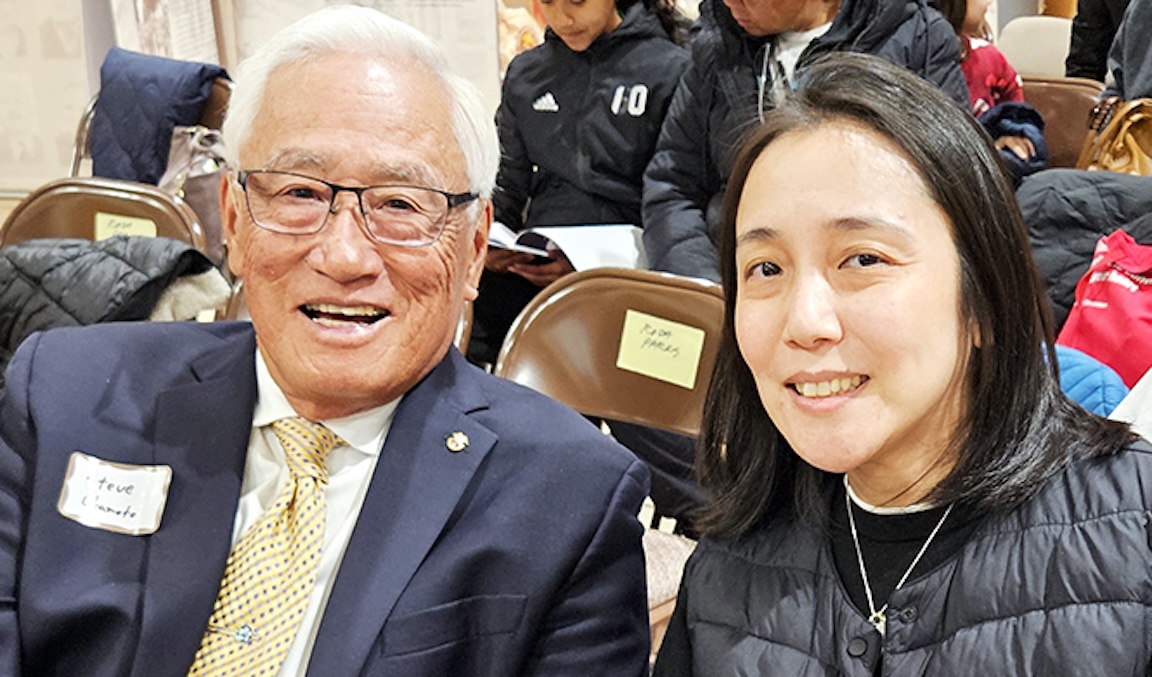
JACL Legacy Planning Officer Steve Okamoto with JACL interim Executive Director Saki Mori
Okamoto lit a candle for Amache, and JACL Interim Executive Director Saki Mori lit the candle for Manzanar.
Before the program, Ina was interviewed by a TV news crew and shared some thoughts about the importance of Day of Remembrance.
“The theme is neighbors, not enemies,” she noted. “I think what has happened is the criminalization of immigrants is so resonant for us in terms of our grandparents and also the legislation that’s been reactivated. So, today’s Day of Remembrance is to remember that the Alien Enemies Act of 1798 was invoked and cleared the way for the removal of American citizens. … These are crazy times, scary times.”
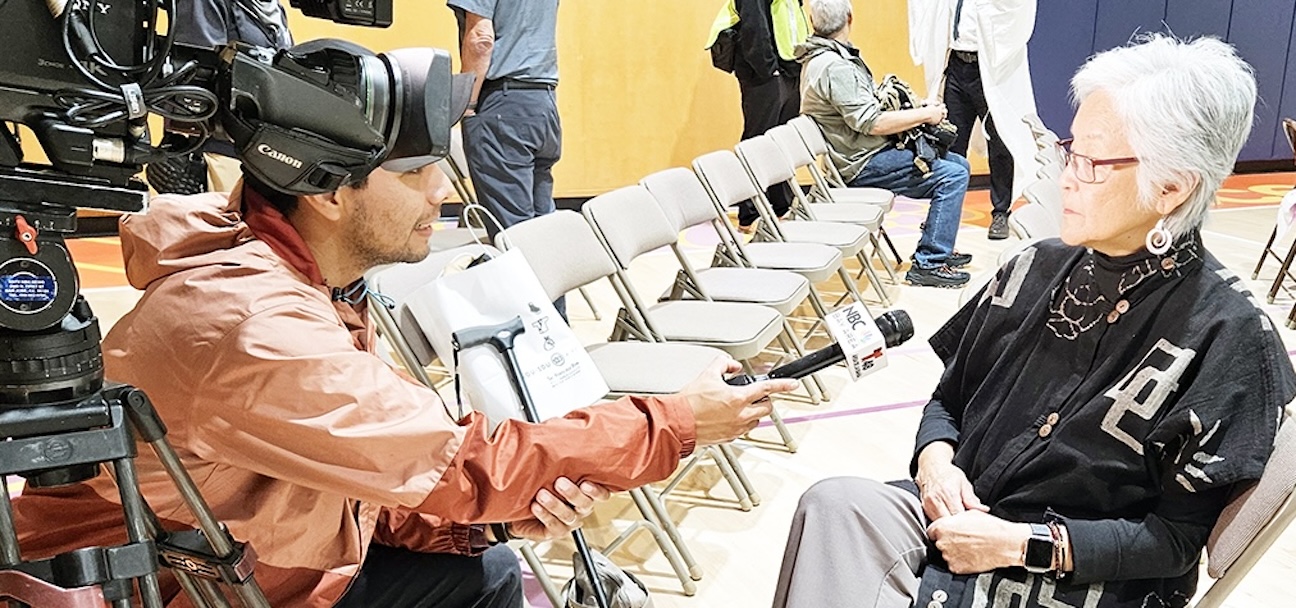
Satsuki Ina is interviewed by NBC Bay Area.
Ina continued, “And I think about the Immigration Customs Enforcement officers that have been trained to dehumanize the people that they’ve been tasked to capture. . . . I think a lot of it has got to be the numbers that they’re required to meet that makes them like that. ‘Doesn’t matter. They look different. Let’s just round them up.’”
Colorado DOR Observance
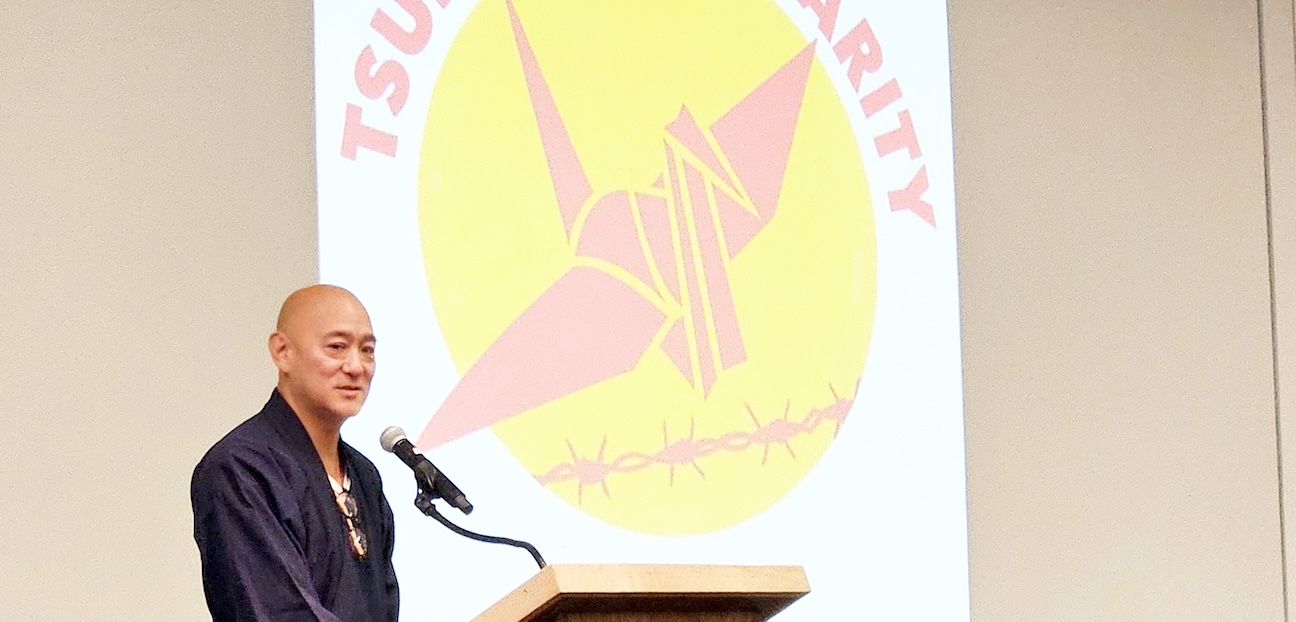
Tsuru for Solidarity’s Mike Ishii
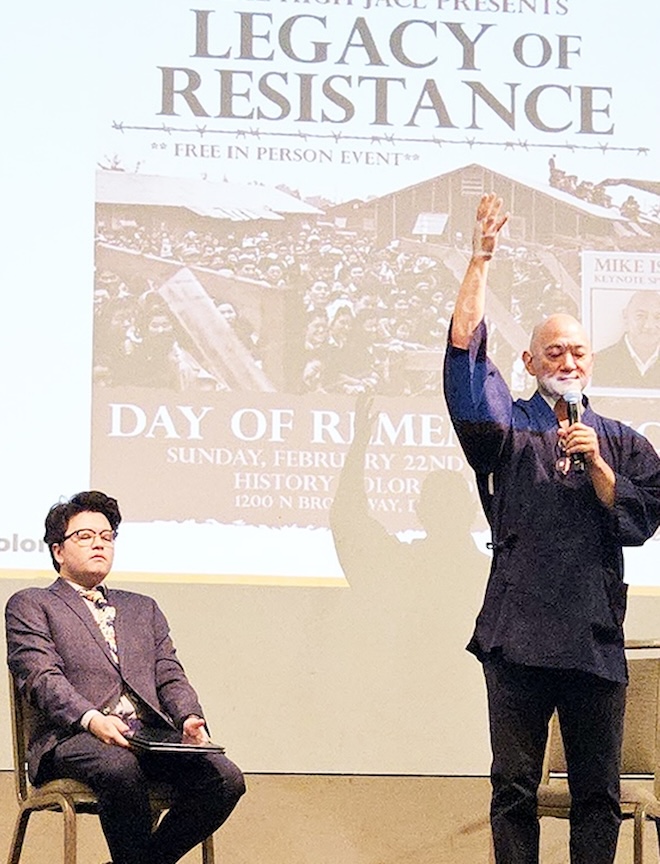
Mile High JACL President Dylan Mori (left) and Tsuru for Solidarity’s Mike Ishii
Mile High JACL has sponsored the annual DOR for two decades, starting out with intimate discussions at the Tri-State Denver Buddhist Temple (the first guest speaker was Satsuki Ina, who spoke about her 1999 first film “Children of the Camps”), then held at the University of Denver, and since 2014, the History Colorado Center.
The featured speaker this year for the 155 audience members assembled was Mike Ishii, co-founder with Ina of Tsuru for Solidarity, who spoke about the history of his family’s incarceration and the work of Tsuru for Solidarity by showing photos of the organization’s work, beginning with protests in Texas against family separation and the incarceration of refugees and undocumented immigrants.
The program ended with a reading by Brandon Shimoda, an assistant professor of English at Colorado College in Colorado Springs.
Shimoda wrote the powerful poem the day before the event as a tribute to his aunt, who had been incarcerated and is now suffering from dementia in a memory care center.
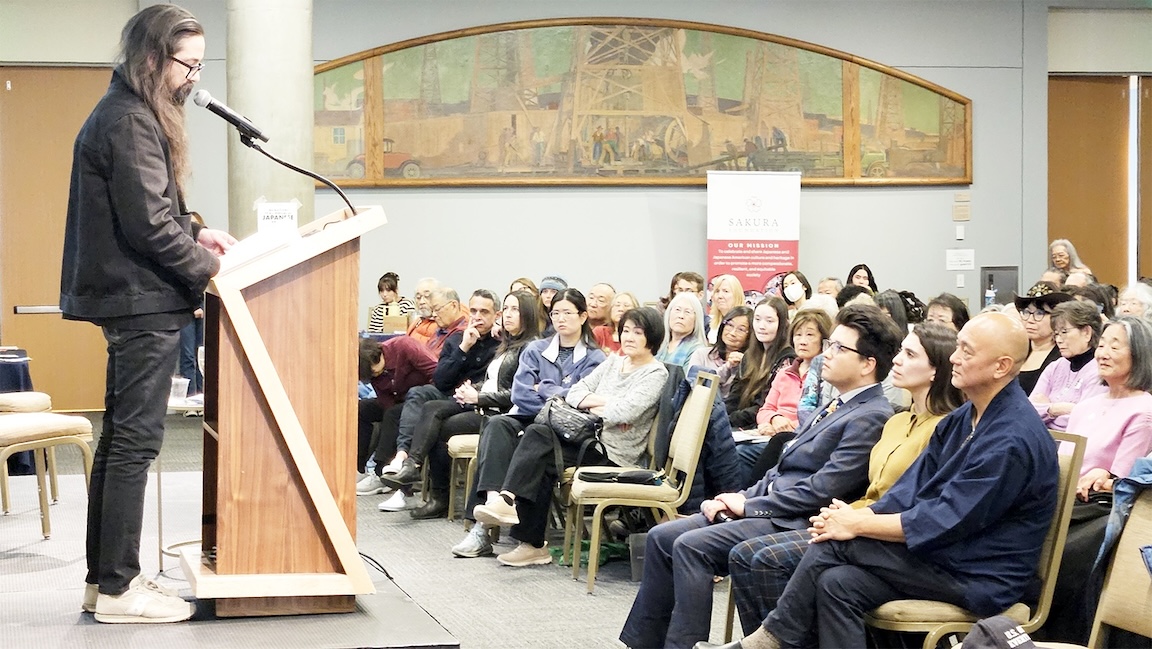
Poet Brandon Shimoda recites his poetry at the Mile High event.