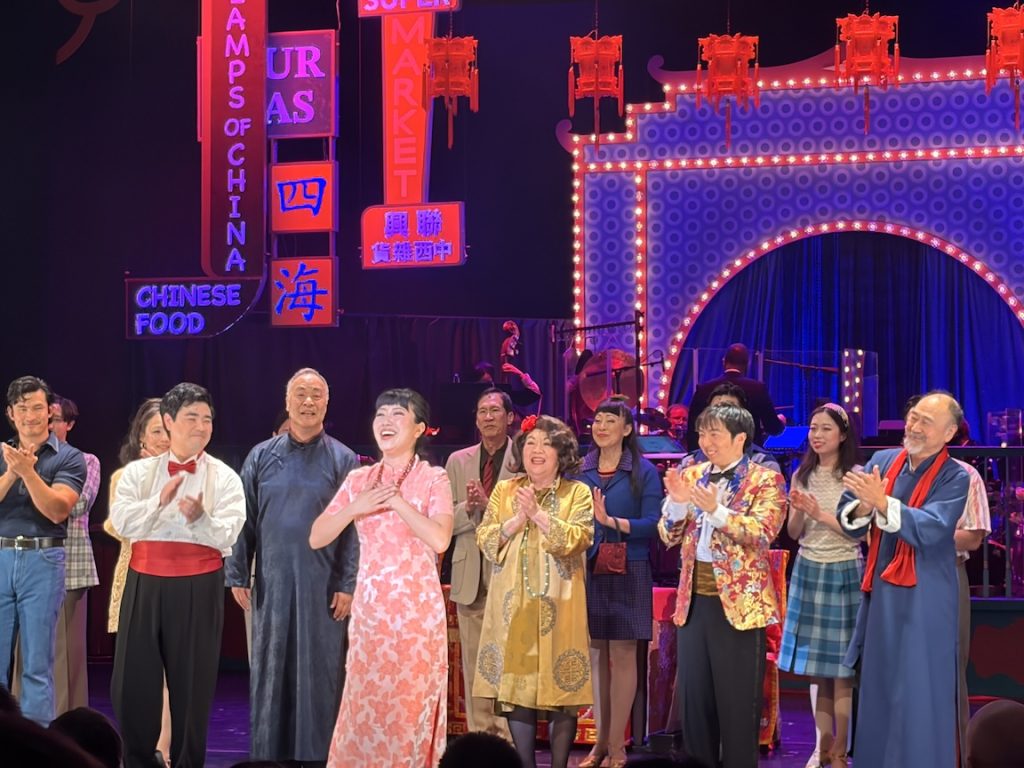
The cast of East West Players’ “Flower Drum Song” takes a bow after their performance at the Aratani Theatre in Little Tokyo. (Photo: Cindy Yee)
The new production ‘allows Asian Americans
to reclaim this cherished story in a meaningful way.’
By Cindy Yee
The latest version of Tony winner David Henry Hwang’s Broadway rewrite of Rodgers and Hammerstein’s musical “Flower Drum Song,” directed by East West Players’ Artistic Director Lily Tung Crystal, should have tweaked its title.
For those who know the 1961 movie, one definitely cannot compare the storyline because it would be comparing apples to oranges. However, for pure entertainment, this 2026 iteration is a must-watch performance with funny, clever jokes mixed in with the seriousness of racism that the majority of us have faced our entire lives, along with actual facts about Chinese American history that educate the masses in a light comedy and musical, cleverly woven into Hwang’s second rewrite.
The production, currently playing at the Aratani Theatre in Los Angeles’ Little Tokyo, is the “grand finale” for EWP’s Diamond Legacy season and features Cooper Bennett, Kenton Chen, Emily Kuroda, Mark Oka, Scott Keiji Takeda, Gedde Watanabe, Grace Yoo and Krista Marie Yu.
The performance of the character Mei-Li is brilliantly sung by Yoo, who has a voice like a singing sparrow. The choreographers also created clever and entertaining skits featuring Linda Low’s character, performed by the lovely Yu, who was born in Oakland, Calif., and followed in the footsteps of her great-aunt, Dorothy Toy (real name Shigeko Takahashi).
In the years leading up to World War II, Toy and her husband, Tony Jew, were known as the Asian Fred Astaire and Ginger Rogers-type duo Toy & Wing, performing at the Forbidden City nightclubs in the chop suey circuits in San Francisco and New York.
Yu’s lead performance in “I Enjoy Being a Girl,” complete with the show’s talented chorus line portraying the three-mirror scene made famous by legendary actress Nancy Kwan, is beautifully executed and doubled across the entire Aratani stage along with young, gorgeous dancers who also performed the “Fan Tan Fannie” song and dance.
The show also features a new, never-heard-before song titled “My Best Love,” which comes to life and is beautifully performed by veteran actor Watanabe. Hwang located this title in the Rodgers and Hammerstein archives and brought it to its debut in “FDS.” It pays tribute to those who have endured a long marriage!
The entire stage, with the orchestra behind the set, is aesthetically beautiful. The pioneering talents of Watanabe, along with Oka, who in his role as Wang has a hilarious song-and-dance scene in “I Am a Vagabond Sailor,” and especially Kuroda, whose character was transformed from Madame Liang in the movie to a talent agent for Asian American entertainers, all shine.
Hwang cleverly pays tribute to Jadin Wong, a pioneering Chinese American entertainer and agent, who was often noted for her work in the 1940s and ’50s entertainment circuit in the Forbidden City nightclubs of San Francisco.
He remembers Wong as a brassy, brilliant ex-actress-turned-agent for “Oriental” talent and as the quintessential Broadway dame. For those of us who lived in the Los Angeles area during that time period and worked at Universal Studios in the movie industry, we remember talent agent Bessie Loo.
A very surprising and highly enjoyable part of the new musical features the LGBTQ community, performed by the extremely gifted Chen. Audience, watch out for some very surprising scenes and enjoyable skits!
To celebrate the 60th Anniversary of East West Players Theatre, and the first woman director at EWP, we must congratulate Crystal for her courage and fortitude in directing the latest production of the most-beloved Asian American musical of our time. Crystal is so diverse and multitalented that she was able to substitute for Kuroda during a performance my husband and I attended.
During intermission and after the show, there was much buzz, excitement and happiness among patrons who were highly motivated to obtain the DVD of the original 1961 movie from Universal Studios, including my 10-year-old granddaughter, having enjoyed this 2026 version of “FDS” immensely.
After all, the first Chinese American movie offering a small glimpse of our lives here in America has been lost for at least two generations of Asian Americans trying to live the American Dream.
In 2008, the Library of Congress placed “FDS” on the National Film Registry for its cultural and historical significance to American film.
As a member of the National Film Preservation Board that oversees selections for the registry, Arthur Dong wrote in his nomination for “FDS”: “This film has represented an unparalleled and unprecedented milestone for both the film industry and the Asian American community.”
For those that don’t know, Dong is an Oscar-nominated, triple Sundance Award-winning American filmmaker, author and curator whose body of work and documentary collection explores Asian American experiences and LGBTQ history.
“Flower Drum Song” is now playing at the Aratani Theatre at the Japanese American Cultural and Community Center until May 31. For tickets, visit https://www.eastwestplayers.org/flower.
This article was made possible by the Harry K. Honda Memorial Journalism Fund, which was established by JACL Redress Strategist Grant Ujifusa. To make a donation to this fund, email busmgr@pacificcitizen.org and put Honda Memorial Journalism Fund in the subject line.