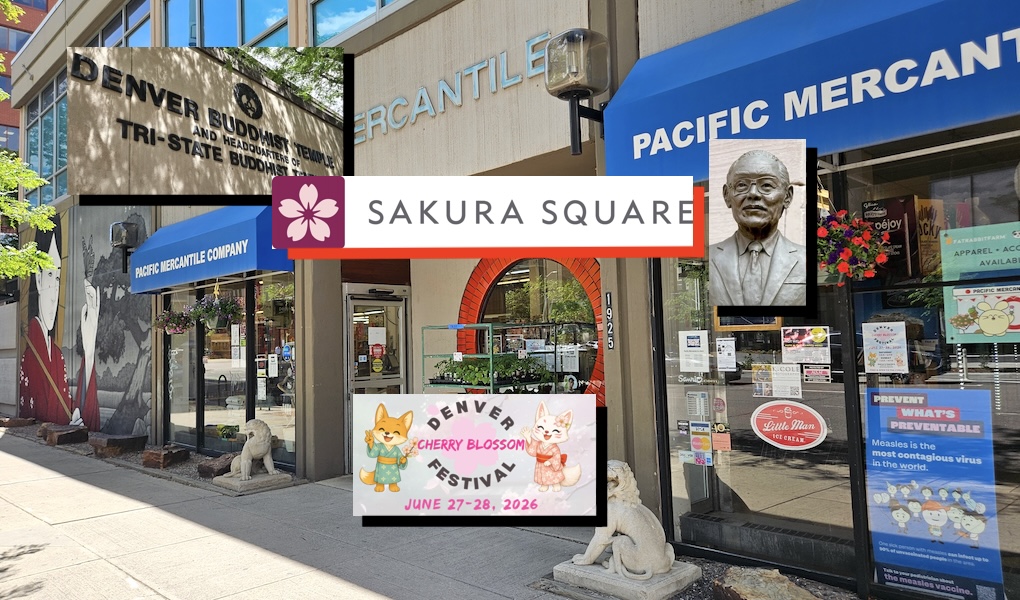
A mixed-use site with residences, a Japanese grocer and a Buddhist temple, Sakura Square is the hub of Denver’s Japanese American community.
Denver’s historic Sakura Square is looking to the future.
By Gil Asakawa, P.C. Contributor
DENVER — San Francisco has Japantown. So does San Jose, albeit a smaller Nihonmachi. And Los Angeles has Little Tokyo, which is not so little. But Denver? Denver, Colo., has its “Tiny Tokyo,” Sakura Square, which takes up exactly one block of the city’s downtown, a stone’s throw from Coors Field where Major League Baseball’s Colorado Rockies play.
But recent local news reports have sounded an alarm that Sakura Square may be in danger of collapsing or going away, after 53 years as the center of Denver’s Japanese community.
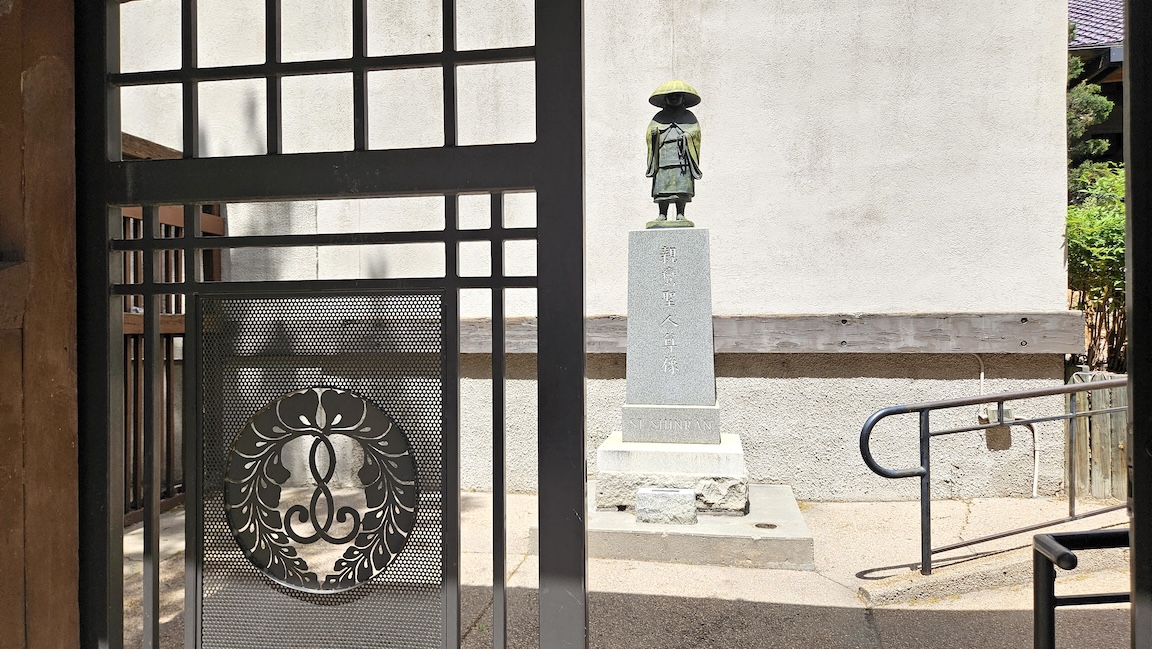
The entrance to the Tri-State Buddhist Temple (Photos: Gil Asakawa)
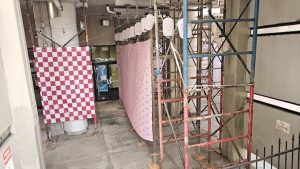
Scaffolding at Sakura Square
The news coverage has been unnecessarily dire. Sakura Square is showing its age and for more than a year has had scaffolding shore up its second level. But, says Tim Higashide, the CEO of Sakura Square LLC, the company that manages the property, the structure is safe and not about to collapse and crumble to the ground.
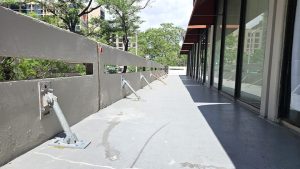
Braces upstairs at Sakura Square
As wear and tear appears, Sakura Square gets fixed. Safety, Higashide says, is primary. And, he adds, “It is critical to get this project done. I mean, every year that our buildings are getting older, it’s critical.”
Higashide is also pragmatic — a very Japanese trait. “But I think we need to hang on as long as we need to get this project done, and the people are the most important thing,” he said.
That includes the residents in the 19-story Tamai Tower apartments and the throngs who shop at Pacific Mercantile, the oldest Asian grocery store in Colorado, as well as the people who worship and attend events at the Tri-State Denver Buddhist Temple.
Those are the anchors at three of the block’s corners, with the fourth taken up with a Japanese garden and small park.
Tim Higashide, CEO of Sakura Square LLC
“The most important is taking care of the people, but it’s also a reality that in terms of renovation, keeping up with the properties’ repairs has to be a priority,” Higashide continued. “Like the financing is going to be challenging.”
And, though redevelopment is necessary because of the block’s older infrastructure, that work has been discussed and planned for 15 years. It’s not a sudden crisis, as some reports have portrayed it.
Partly, the spark for the fire alarm has been a Downtown Denver Development Agency loan for $30 million to help fund a rebuild for the block that Sakura Square applied for improvements.
The city has approved some other funding for projects to revitalize the moribund 16th Street Mall that crosses downtown, and a nearby mall that has been largely empty for some years. But Sakura Square hasn’t heard yet about its funding.
Then again, the community has been discussing funding for redevelopment for years, so that’s not new, either. Grants, loans, donations — all have been part of the planning for more than a decade. If this loan doesn’t come through, the Square will turn to the other fundraising, which has been part of the equation anyway even if it gets the DDDA money.
How It Became ‘Tiny’
Denver’s Japanese community came together in the early 20th century near downtown and was already formed before World War II, with businesses like restaurants and a newspaper along Larimer, the street made famous at one point after Jack Kerouac wrote about it in his 1957 novel “On the Road” (without references to its many Japanese American shops).
At its post-war peak, 15 blocks and more on neighboring blocks were lined by dozens of Japanese American-owned shops.
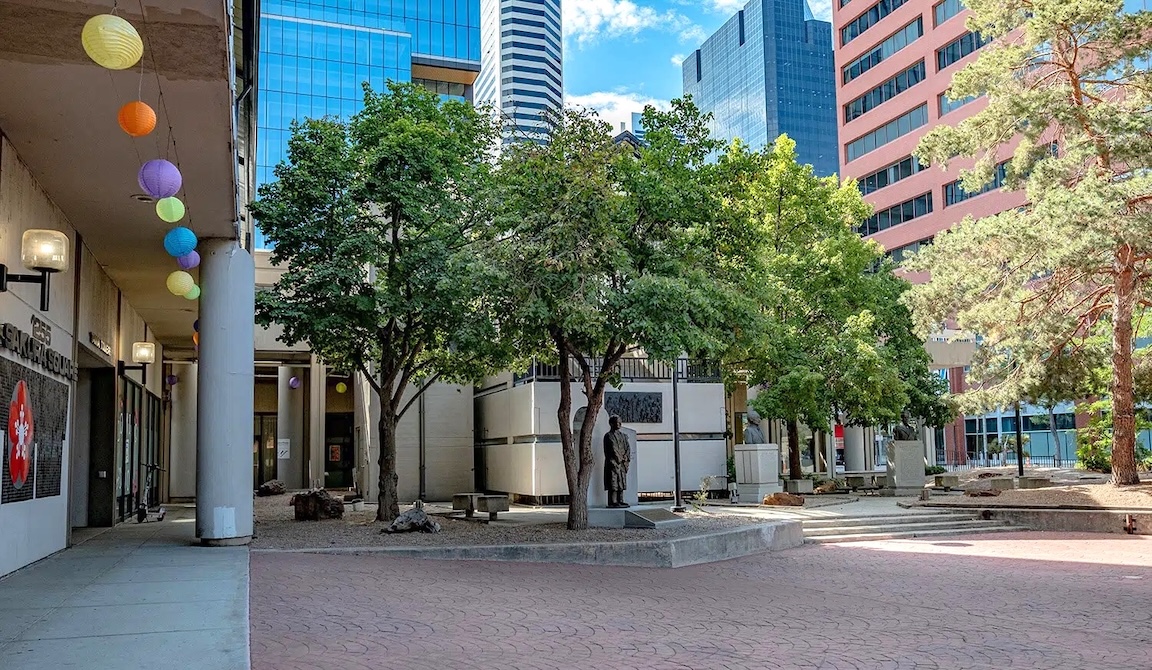
The courtyard and garden located in front of Tamai Tower (Photo: SakuraSquare.com)
But by the late 1960s, as a wave of “urban renewal” spread across the U.S. to take what big cities designated as blighted areas — ethnic enclaves, mostly — and raze them or redevelop them into fancy pricey residential structures or construct new office buildings, Denver was hit by the movement.
A Latino neighborhood just west of downtown was demolished except for a few historic buildings, including a Spanish church, and was turned into a multicollege campus development.
And the Japantown stretch was taken over — much of it with businesses not much newer or fancier, just not Japanese — except for one block, between Larimer and Lawrence streets and 19th and 20th streets. That was the block that included the Tri-State Denver Buddhist Temple, which had moved to its building on the block in 1948, and Pacific Mercantile, the grocery store that opened in 1946.
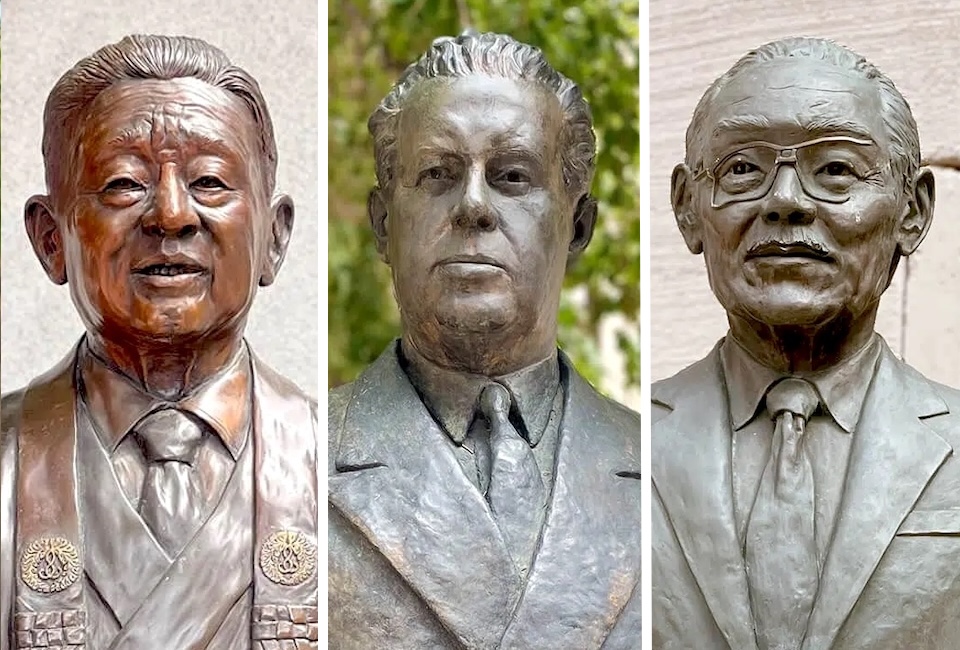
Busts featuring Sakura Square heroes Rev. Yoshitaka Tamai, Gov. Ralph L. Carr and Minoru Yasui (Photos: Courtesy of Sakura Square)
A group of leaders organized and worked with the city to purchase the block to protect the temple and the store, as well as build a legacy for the JA community that included the park and the apartment building, which was built as a place for the community’s elders to live. The land was purchased from the Denver Urban Renewal Authority for $188,800.
Construction began at the turn of the decade, and Sakura Square opened with much fanfare in 1973.
Sakura Square was hailed at the time for its clean, modern design — it was designed by Bertram A. Bruton, one of the first African American architects to practice in Colorado. It’s a modern design that feels Japanese without being obvious about it. Bonsai trees and the garden give off Japanese vibes.
Back to the Future
The redevelopment of the block has been on a tortuously slow path, in large part because of the Covid pandemic and the economic crash to downtown Denver. Many office buildings are half-empty today because of the cutbacks and remote work that have changed downtown’s energy.
Where once there were 10 cranes jutting up against the Denver skyline to show how vibrant construction was booming, now there are none. Property values downtown have dropped, so original plans had to be reassessed to align with current realities.
Sakura Square sign (Courtesy of Sakura Foundation)
Higashide hopes the downturn won’t force Sakura Square to downsize its vision for redevelopment.
“We certainly hope that we don’t have to downscale it,” he said. “I truly do think that the vision that we have is still based upon the many community discussions and workgroups going back a decade or more. It really depends on how do we create it? How do we build it? How do we get funding for this project, whether through public private partnership or through community donations?”
Higashide adds, “I think obviously the legacy, like, how do we continue the legacy? And then there’s so much when you talk about the legacy; there is so much history in this area of downtown.”
Mayor Mike Johnston’s priority has been to revitalize downtown’s economy and bring people back to the city’s core, and Sakura Square is hoping to be a part of that revitalization.

The 52nd Cherry Blossom Festival, which will be held at Sakura Square on June 27-28, will bring back tens of thousands of people to the block to enjoy Japanese cultural performances, gift and food vendors for the weekend.
The festival was first held in 1973 as a way to celebrate the completion of Sakura Square. It was sponsored by the Tri-State Buddhist Temple until 2016 when the Temple leadership asked Sakura Foundation to become the co-presenter of the event.
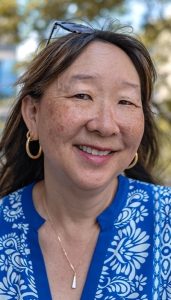
Stacey Shigaya, executive director of the Sakura Foundation
“Some people think that we took it over,” says Stacey Shigaya, executive director of the Sakura Foundation, the parent organization of the LLC that manages Sakura Square. “But it’s a partnership. We were asked to help support them. The two big reasons are, you know, we have paid staff, so that’s what we do. But the other reason is because since we’re a 501(c)3, we’re able to go out and get grants and sponsorship support, whereas [the Tri-State Buddhist Temple] couldn’t because they’re a church.”
The festival is the temple’s biggest fundraiser of the year, and Shigaya and her staff are deep in preparations for the weekend event.
She understands the role the festival — and Sakura Square — represents for Denver’s Japanese American community and the city’s hopes for an economic revival. The festival has attracted more people the past few years post-Covid, and this year, there were so many vendor applications that organizers had to place applicants on a waitlist.
Shigaya is also aware that attendees will need to navigate the maze of scaffolding in some parts of Sakura Square for this year’s festival, but she’s hopeful that won’t keep away the crowds. Like Higashide, she emphasizes the square is safe and not about to come down.
Instead, Shigaya says, “In this decadelong process of working on this redevelopment, I think one of the most heartwarming things we’ve realized is how many people really care about Sakara Square, about the Japanese American community, about our culture and about the importance of people from different backgrounds learning about each other, respecting each other and wanting to see each other succeed.
“Because we haven’t only heard from fellow JAs,” Shigaya continued. “We’ve heard from people from all different types of backgrounds about how they want us to succeed. So, I think that’s the biggest takeaway from this whole process.”
For more information about the 52nd Cherry Blossom Festival, visit https://cherryblossomdenver.org. And to learn more about Sakura Square, visit www.sakurasquare.com.
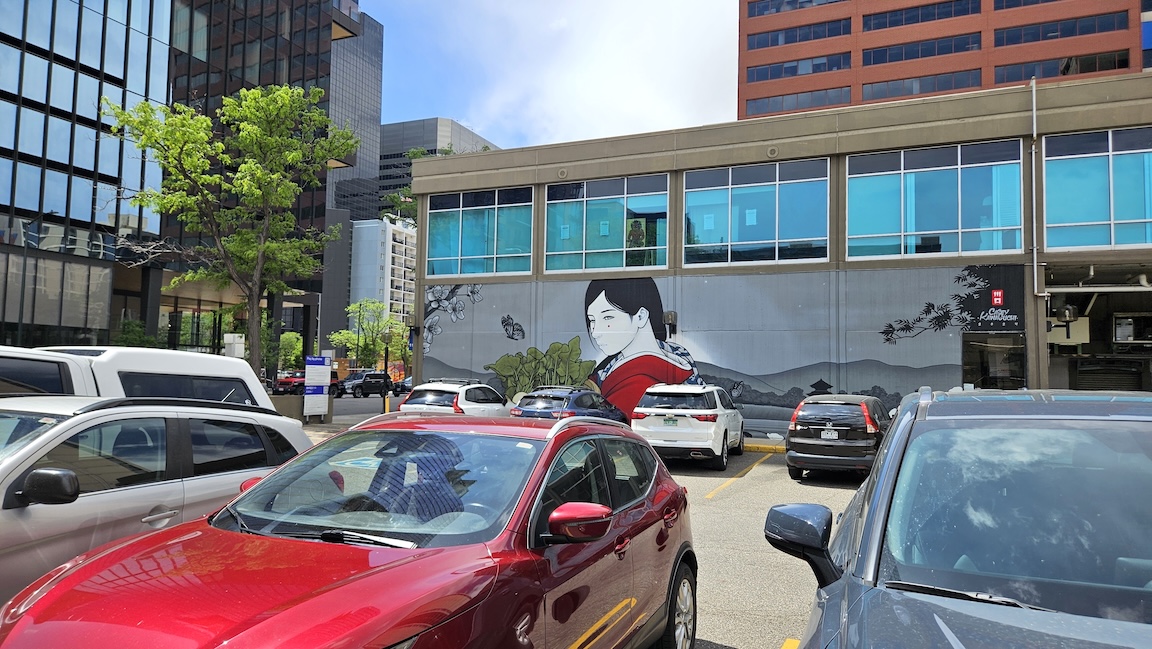
The Sakura Square parking lot