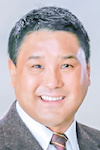
Judd Matsunaga
Anti-Japanese sentiment against Japanese American citizens in the U.S. would peak during World War II, after the surprise attack on Pearl Harbor. An example of this was the so-called “Jap hunting license,” a faux official document, button or medallion that purported to authorize “open season” on “hunting” the Japanese, despite the fact that over a quarter-million Americans at that time were of Japanese origin. These “licenses” often characterized Japanese people as subhuman (Boggs, Jeremy. Open Season. 06 Mar. 2004. 15 Oct. 2007).
In 1942, with the Japanese incarcerated in 10 American concentration camps, California Attorney General Earl Warren saw his chance and approved the state takeover of 20 parcels of land held in the name of American children of Japanese parents, in absentia. In 1943, Gov. Warren signed a bill that expanded the Alien Land Law by denying Japanese the opportunity to farm as they had before WWII. In 1945, he followed up by signing two bills that facilitated the seizure of land owned by American descendants of the Japanese.
In a Dec. 19, 1944, opinion poll, it was found that 13 percent of the U.S. public was in favor of the extermination of all Japanese, as well as 50 percent of American GIs. U.S. professor of Japanese History, John Dower, suggests the racial hatred of the front-lines in the war rubbed off onto the American public through media representation of Japanese and propaganda (Feraru, A. N. (1950), “Public Opinion Polls on Japan” Far Eastern Survey, 19(10), 101–103).
Dower, in his essay about the Second World War, introduces his “War Hates and War Crimes” by quoting American Historian Allan Nevins that “no foe has been so detested as were the Japanese.” Dower highlights how the Japanese were more despised than the Germans by the American public, and he claims that it was a result of racial hatred.
There’s a well-known Japanese saying, “The nail that sticks out gets hammered down.” Meaning, don’t rock the boat or make waves, or you will pay a price. Not surprisingly, Japanese Americans had to lay low and avoid drawing attention, even if that meant getting “stepped on.”
After the war, Hollywood, i.e., the movies and media, would stereotype Japanese men as physically unattractive, sexless, nerdy and lacking social skills. In contrast, Hollywood perceived Japanese woman as highly desirable, e.g., exceptionally feminine and delicate. In the 1960s, James Yoshio Yoda played “Fuji,” a prisoner of war in the sitcom “McHale’s Navy” (1962). In the ’70s, Pat Morita, a Japanese American actor and comedian, played Arnold Takahashi on “Happy Days.”
Major movie and TV roles of Asian men were given to non-Asian actors. In the 1940s, Swedish American actor Warner Oland was the first actor to portray Charlie Chan. David Carradine was cast in the 1972 TV series “Kung Fu.” Although Bruce Lee originated the concept and was considered for the role, his audition was rejected.
Fast forward to more recent times. Since the Civil Liberties Act of 1988 (i.e., “Redress”), a significant evolutionary change has occurred in the self-perception and collective identity of Japanese Americans. The Sansei, their parents, grandparents and children are changing the way they look at themselves and their pattern of accommodation to the non-Japanese majority. Redress and the subsequent educational campaigns have facilitated a community-wide healing process that continues today.
The younger generations (Sansei, Yonsei, Gosei) are changing the way they look at themselves as individuals of Japanese descent in their respective nations. A real Hollywood change in the portrayal of Japanese men came when Morita earned an Academy Award nomination for Best Supporting Actor for his portrayal of Mr. Miyagi in the 1984 film “The Karate Kid.”
In the sports world, baseball has changed the way the American mainstream views the Japanese male. On May 2, 1995, Hideo Nomo made his MLB debut with the Los Angeles Dodgers and became the first Japanese-born player in Major League Baseball. Nomo’s success created a path for subsequent Japanese players.
As of the 2025 season, the Dodgers have three Japanese players: Shohei Ohtani, Yoshinobu Yamamoto and Roki Sasaki. They have all played a significant role in the Dodgers’ success, including consecutive World Series titles in 2024 and ’25.
On Dec. 11, 2023, Ohtani signed a 10-year, $700 million contract with the Dodgers, the largest contract in professional sports history at the time. Ohtani also is the first player in Major League history to win multiple MVPs in both leagues and only the second player to win four MVP Awards after Barry Bonds. TV commentators would call him the best player in baseball history!!!
But it was his teammate, Yamamoto, that made the biggest impression on me. Yamamoto received a standing ovation after the Dodgers’ World Series win in November and was named the MVP, recording three wins in the series and a 1.02 ERA. It was as if America, i.e., “Voices of the People,” were saying that the time has come when the dream of the Japanese American Nisei WWII soldiers is coming true — Japanese Americans are good Americans.
Judd Matsunaga is the founding attorney of Elder Law Services of California, a law firm that specializes in Medi-Cal Planning, Estate Planning and Probate. He can be contacted at (310) 348-2995 or. The opinions expressed in this article are the author’s own and do not necessarily reflect the view of the Pacific Citizen or constitute legal or tax advice and should not be treated as such.