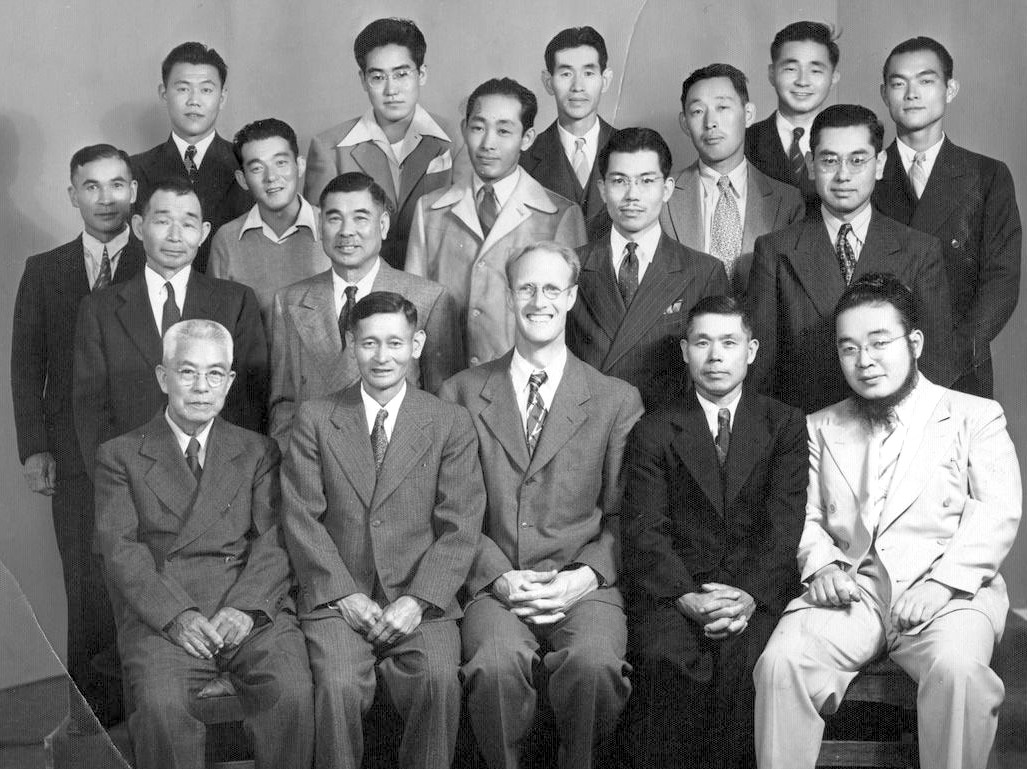
The Manzanar Guayule Project team was led by California Institute of Technology scientist Robert A. Emerson (seated at center) and was comprised of Japanese incarcerees. (Photo: Courtesy of Cory Shiozaki)
‘Little Guayule’ to screen May 31 with ‘Manzanar Fishing Club’ at Gardena Cinema.
By George Toshio Johnston, P.C. Senior Editor
What’s better than one movie?
Try two movies for the price of one.
And what’s better than two movies for the price of one?
Try when one of the movies is being screened publicly for the first time.
Yes, squeaking in just under the wire to be a part of Asian American and Pacific Islander Heritage Month is a double-bill beginning at noon on May 31 at the Gardena Cinema featuring the award-winning 2012 documentary “The Manzanar Fishing Club” and the new documentary “Little Guayule: The Lost Manzanar Rubber Project,” both directed by filmmaker Cory Shiozaki.
At one hour, 14 minutes, “The Manzanar Fishing Club” is, of course, the true story of Japanese Americans incarcerated at the Manzanar War Relocation Authority Center who caught fish, according to Shiozaki, first at Bears Creek inside the camp and later by sneaking out to fish at the high-elevation streams and lakes of the Sierra Nevada Mountains, the only places in the world where the California Golden Trout can be found.
At about 65 minutes, “Little Guayule” (pronounced wy-OO-lee), meantime, presents another subchapter of the Manzanar experience, one that involved incarcerees with farming experience and scientific backgrounds who were enlisted to help cultivate the guayule plant (Parthenium argentatum) as an alternative source for natural latex, from which natural rubber is made, to help in the war effort.
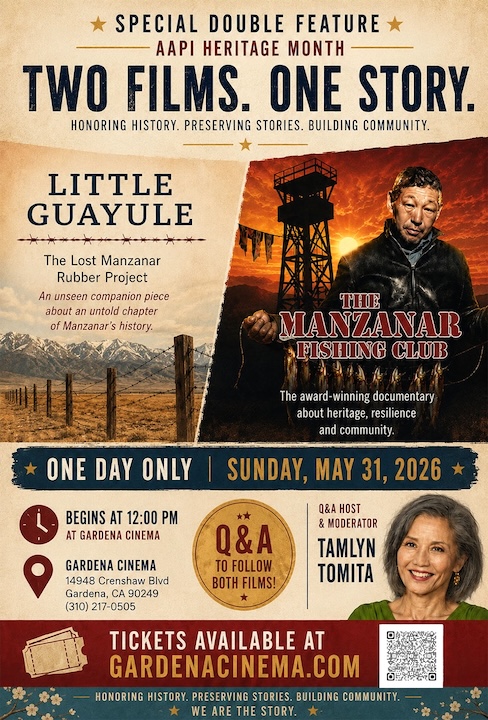
Flyer for the double-feature screening of “Little Guayule” and “The Manzanar Fishing Club”
At the time, before synthetic rubber made from petroleum was invented, rubber was of great strategic importance — and remains so today, for reasons both somewhat ordinary (guayule rubber, unlike rubber tree rubber, is hypoallergenic), as well as for national security and industrial reasons. (It turns out that Japan-based Bridgestone Americas has been funding guayule research and cultivation for several years.) (See tinyurl.com/vt4jumu8.)
The problem many decades ago was that the plantations where the natural rubber made from the rubber tree (Hevea brasiliensis) were located in tropical Southeast Asia, which were under Japanese control. For the U.S., rubber was required for medical supplies and automobile tires, not to mention such military needs such as for boots, gas masks, jeeps, aircraft, etc.
Like rare earth minerals or high-end microprocessor chips today, natural rubber was critical to the economy — and the war.
Enter the federal government’s $37 million Salinas, Calif.-based Emergency Rubber Project and guayule, a different plant — a desert shrub — that also produces latex but grows in nontropical, semi-arid parts of North America. It had never, however, been cultivated at scale. But just because no one had tried it before didn’t mean it couldn’t be done.
So, if the Salinas-based ERP was “big guayule,” it makes sense that the smaller, rival Manzanar Guayule Project was “little guayule.” But as Shiozaki’s documentary conveys, “little” is open to interpretation.
Despite the challenges that faced the Manzanar guayule project, like being comparatively underfunded, the “little guayule” team, which received its sponsorship from the California Institute of Technology, punched above its weight. According to the Manzanar Committee, the Manzanar Project “produced a higher yield of plant and a higher quality of rubber than the Salinas Project or tree rubber” (see tinyurl.com/yrmsthxn).
Thus, “Little Guayule” is also the story of a Cal Tech scientist named Robert A. Emerson, who happened to be a pacifistic Quaker sympathetic to the plight of incarcerated Japanese Americans.
Emerson insisted on using the high-level Japanese American talent he knew was within the camp for the guayule project. Again, according the Manzanar Committee, that team included such names as Dr. Shimpe Nishimura, Dr. Kenji Nozaki, Dr. Masuo Kodani, Frank Hirasawa, Homer Kimura, Frank Kageyama and Tomoichi Hata. And this is where the documentary’s importance lies: It turns out that the “little” Manzanar guayule project was actually more successful than the better-funded Salinas project.
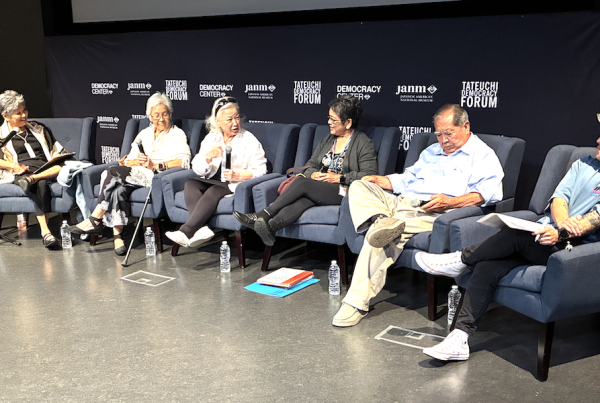
In addition to the double-feature screening of Manzanar-related movies, Shiozaki told the Pacific Citizen that “there’s going to be a Q & A for both films that are going to be moderated by Tamlyn Tomita because her Uncle Sets is one surviving fisherman who is still alive, and he’s on the panel, as well as Mas Okui.”
Thanks to Shiozaki, the screenings offer another perspective on Manzanar and, by extension, the Japanese American incarceration narrative that is as important as those telling the story of the abrogation of civil liberties and civil rights that occurred.
There are two ticket tiers: a $20 admission and a $30 ticket that includes an eight-piece sushi bento. Either way, the motivation is not to make a buck but to make the films available and cover the costs involved, Shiozaki says.
“We want to do this for the community. We don’t do it for the money. We don’t do it for the fame. . . . We do it because we’re giving back to a community that gives us so much,” said Shiozaki.
In addition to the May 31 double-bill, on May 23, Shiozaki is also involved with the noon screening of a 29-minute version of “MFC” that takes place at the West Theater at the Manzanar National Historic Site (5001 Highway 395) in Independence, Calif., which also includes a guided driving and walking tour to “key sites in Manzanar’s fishing history.”
 Back to the double-feature of “The Manzanar Fishing Club,” to preorder tickets, visit GardenaCinema.com or use the QR code in this article.
To view a trailer for the double-bill of “The Manzanar Fishing Club” and “Little Guayule: The Lost Manzanar Rubber Project,” visit tinyurl.com/mmx5tkcz.
The Gardena Cinema is located at 14948 Crenshaw Blvd. in Gardena, Calif.