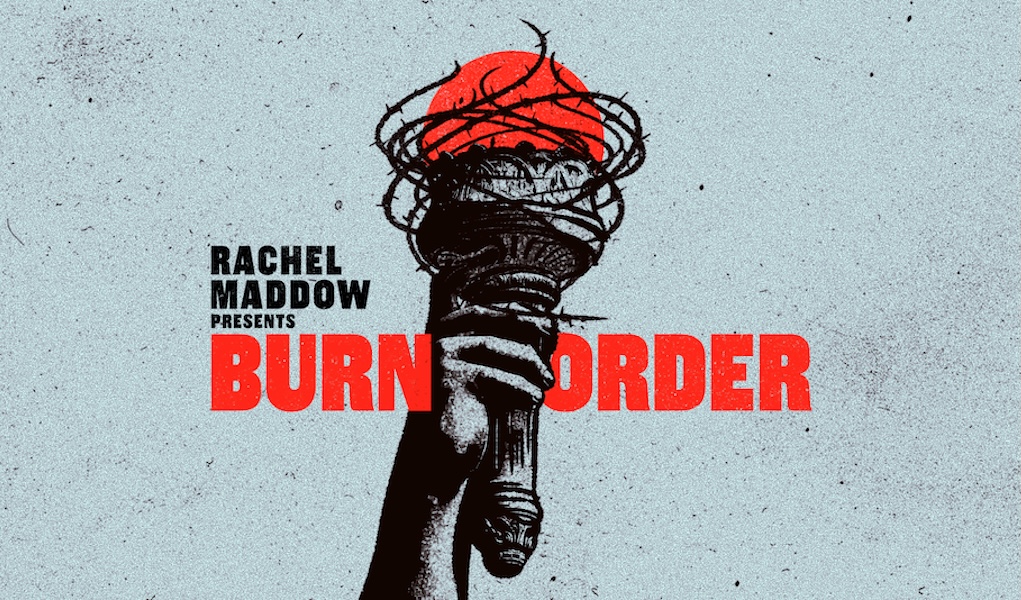
MN NOW’s six-part podcast “Burn Order” explores the parallels between today and last century’s
mass incarceration of ethnic Japanese, including U.S. citizens, during World War II. (Image: Courtesy of MS NOW)
MS NOW’s ‘Burn Order,’ ‘History for the Reckoning’ Revisit a Timely Tale.
By George Toshio Johnston, P.C. Senior Editor
Can that which is created to educate also entertain and do so without diluting, whitewashing, bowdlerizing it?
That is an essential question teachers, historians, authors, journalists, screenwriters, movie directors and others with a story to tell must grapple with when they go about writing books and scripts, reporting news stories, directing movies and the like because even if you may have the most amazing, important, uplifting or inspirational hunk of knowledge to share, if it is unengaging and unentertaining and you have no audience, then what was the point of doing the work?
Read related story here.
The word “edutainment” was coined for this approach, and while it might seem like it has the potential to diminish or mock a subject (think “Drunk History”), when it works, it can be quite effective.
“Burn Order” may be listened to via the podcast app of any up-to-date smartphone.
Consider “Rachel Maddow Presents: Burn Order” (see related story, April 3, 2026, Pacific Citizen, tinyurl.com/4f848vje). Released late last year, the six-part podcast managed to tell an important, ever-timely story in an engaging, compelling and, yes, entertaining manner.
With its Dec. 1. 2025, launch, the series — produced by cable news outlet MS NOW with many, if not most, of the same behind-the-scenes folks who, back when it was MSNBC, worked on the podcasts “Bag Man,” “Prequel” (both also books) and “Ultra” — conveys to a mass audience a history well-known (and experienced directly and indirectly) by many Pacific Citizen readers and JACL members: the forced removal from the West Coast and subsequent mass incarceration of thousands of people of Japanese heritage — U.S. citizens and legal residents then-ineligible for naturalization alike — thanks to something that became ubiquitous over the past year and several months, an executive order.
It is a saga that, important as it is to America’s historical record, has been given comparatively little attention over the decades by mainstream news outlets and entertainment companies. “Burn Order” takes a huge step toward rectifying that situation, and the timing could not be more apropos to the status quo.
❖❖❖
That story, of course, is the “race prejudice, war hysteria and failure of political leadership,” thanks to an executive order, that led to the abrogation of constitutional and civil rights of an unpopular minority group during World War II.
That story is of the government and military cooperating to degrade and punish a group of people held in low-esteem by the biased, the fanatical and the powerful.
If the preceding sounds like an old song that is today echoing off purple mountain majesties where instead freedom should be ringing, well, that’s the point of “Burn Order” — that what has happened since January 2025 from sea to shining sea is not a new tune but a mashup, a remix for the masses that failed to learn from the mistakes of the past.
The six sprawling episodes of the eminently listenable “Burn Order” are “Safecracker,” “The Jitters,” “One Drop,” “Like an Ordinary American,” “Sheep and Goats” and “A Reckoning.”
Co-written mostly and co-executive produced by Maddow and Michael Yarvitz, “Burn Order” uses several techniques to tell the overarching story. With Maddow as narrator, the installments can sometimes seem akin to a compelling police or legal procedural, as well as a twisty whodunit.
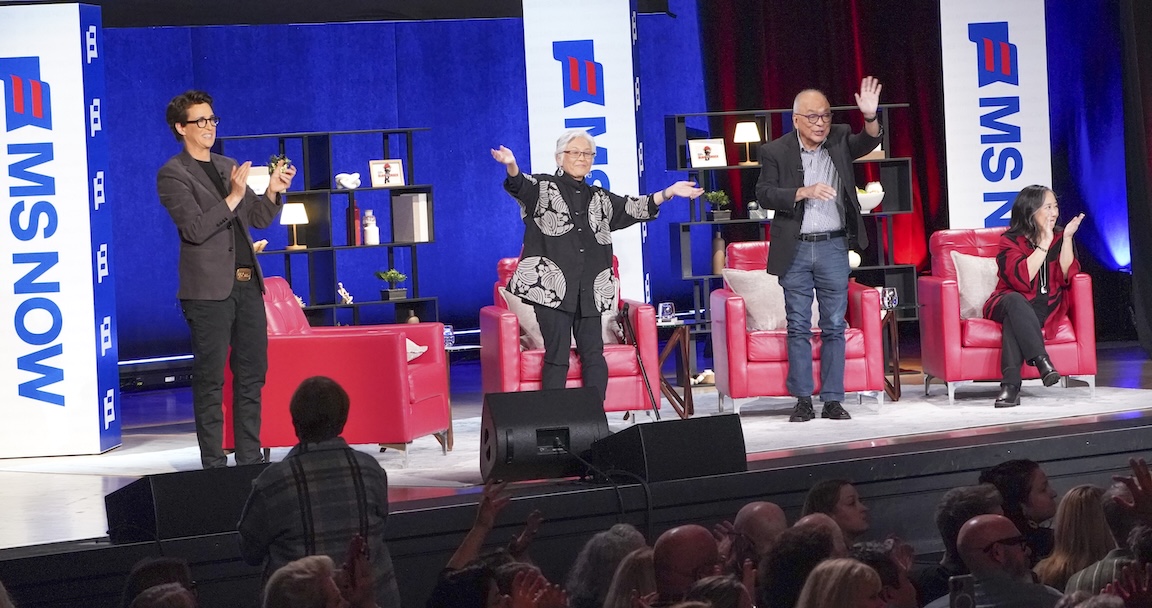
Pictured (from left) are Rachel Maddow, Satsuki Ina, Frank Abe and Lorraine Bannai onstage at the Orpheum Theatre on Dec. 14. (Photo: MS NOW and Monty Brinton)
❖❖❖
With its high-quality production values, “Burn Order” integrates with Maddow’s narration subtle background music, the spoken word via audio clips (many culled from the oral histories compiled by Densho) of people, some long-deceased, whose names are a part of the remarkable experiences of those Japanese Americans and others who had key roles in the story, not the least of whom is the late Aiko Herzig-Yoshinaga (see Aug. 3, 2018, Pacific Citizen, tinyurl.com/yk8wr7hk).
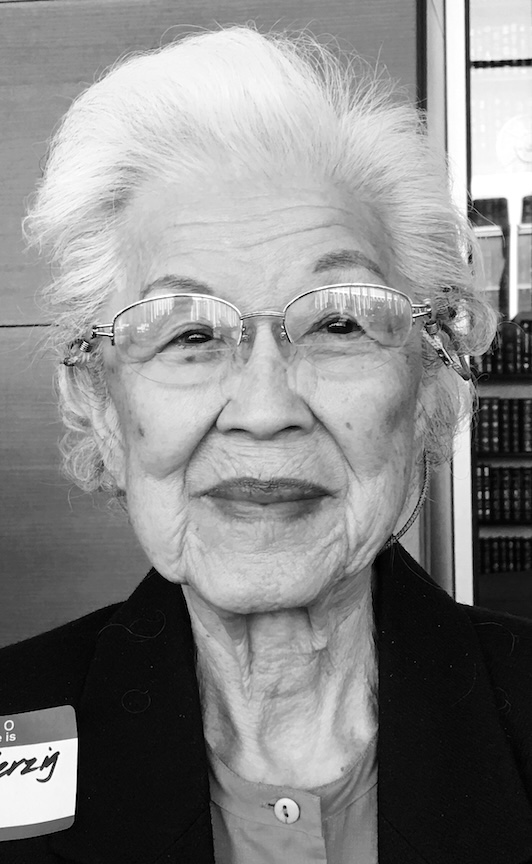
Aiko Herzig-Yoshinaga (Photo: George Toshio Johnston)
The name of the podcast is, in fact, derived from the “smoking gun” artifact that Herzig-Yoshinaga uncovered decades ago as a private citizen who spent an inordinate amount of her own time researching what the National Archives held with regard to the Japanese American incarceration.
In what could be described as a fluke, serendipity, dumb luck or even divine providence, she happened to notice something at the Archives during a search one day that had been mislabeled: the only surviving copy of the original “Final Report on Japanese Evacuation From the West Coast.”
As “Burn Order” relates, it was not supposed to exist. What Herzig-Yoshinaga found was not the revised version of the report, which attributed the mass incarceration to military necessity.
This original version, the contents of which were so damning that all 10 copies had been ordered incinerated, essentially admitted that the basis for the removal and incarceration of ethnic Japanese had nothing to do with ginned up but possibly plausible “military necessity” and everything to do with racism.
❖❖❖
Herzig-Yoshinaga’s story is just one of the many threads woven into the story told in “Burn Order.” The story of Colorado Gov. Ralph Carr is part of the mix, as well as that of Naval Intelligence officer Ken Ringle, who knew firsthand that Japanese Americans were not the disloyal, duplicitous and dangerous bogeymen that some politicians, pundits and newspapers portrayed them as.
Other threads: The four Supreme Court cases of Mitsue Endo, Gordon Hirabayashi, Fred Korematsu and Minoru Yasui that challenged different aspects of the evacuation order. Included are the voices of some of the attorneys who in the 1980s revisited three of those failed cases via an arcane legal gambit suggested by legal historian Peter Irons: writ of error coram nobis. Iron’s voice is also part of the story.
Every good story needs a good antagonist, of course. In “Burn Order,” those roles go to the Western Defense Command’s Gen. John DeWitt and his incarceration architect, Col. Karl Bendetsen.
One episode even includes (spoiler alert!) audio of Bendetsen himself, recorded in the early 1980s, a few years before he died in 1989. And, without saying it explicitly, the podcast lets the listener make the connection that the roles played by these two then are being reprised now by a different devious duo that has applied not-dissimilar tactics to immigrants of this era.
Other prominent voices that appear in the podcast belong to Norman Mineta (see May 3, 2022, Pacific Citizen, tinyurl.com/yz7j7kuy); his son, David Mineta; Kenneth Ringle (son of Ken Ringle); Hirabayashi, Korematsu and Yasui; Justice Department lawyer Edward Ennis; former Justice Department official Chuck Rosenberg; Carr; journalist-turned-historian Frank Abe (tinyurl.com/2vyey82s); Tsuru for Solidarity doyenne Dr. Satsuki Ina (tinyurl.com/474v45hw); attorney Lorraine Bannai (tinyurl.com/34cj39rh); and others. (One name that comes up only once in the six episodes: Japanese American Citizens League.)
❖❖❖
The saying “great minds think alike” might explain why MS NOW was not alone in its reasoning to explore something from the previous century that the U.S. is grappling with today.
 The inaugural season of another multiepisode podcast, “History for the Reckoning,” has also decided to examine the Japanese American incarceration experience of WWII. It’s a worthy companion piece to that other podcast.
Its creator and host, Utah-based Spencer Ford, told Pacific Citizen that “History for the Reckoning” is “about diving into uncomfortable history” so that society learns to “not repeat the wrongs of the past” that are “resonating today.” The Japanese American incarceration saga certainly checks that box for Season 1.
Released just weeks ago on Feb. 19, Episode 0 (the first installment) features a conversation with actor George Takei. Interviewed in subsequent episodes that have been released every two weeks are Susan Kamei (see Sept. 10, 2021, Pacific Citizen, tinyurl.com/yur6mnkt), Chizu Omori, Emily Inouye Huey and Claudia Katayanagi. Upcoming episodes, meantime, include many of the same people who appeared in “Burn Order.”
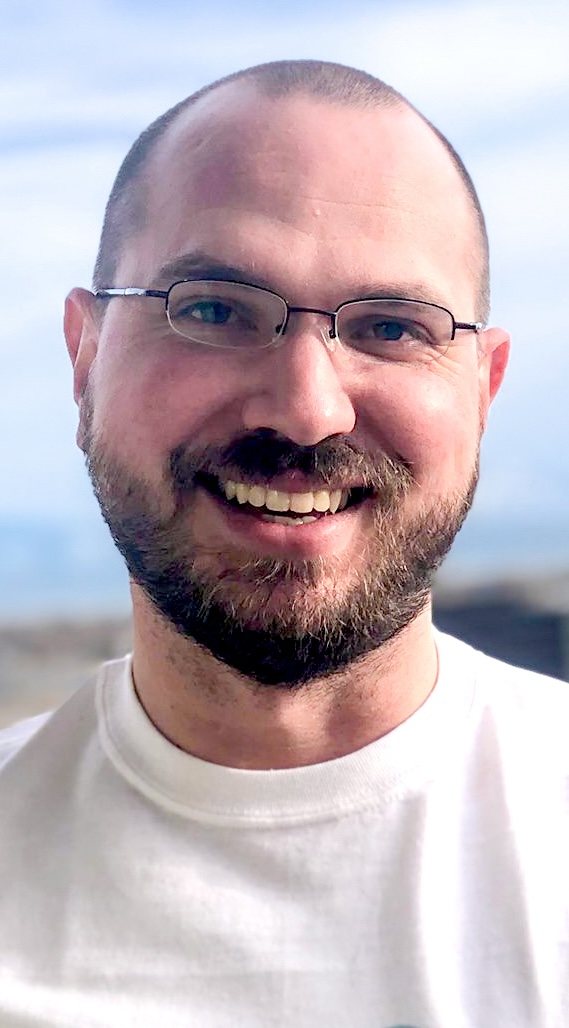
Spencer Ford (Photo: Courtesy of Spencer Ford)
“Everyone has been incredibly gracious with their time,” Ford said. Although he had no familial ties to the incarceration, as a self-described history buff with a strong sense of social justice, his initial research focused on the leader of the Fair Play Committee of the Heart Mountain War Relocation Authority Center, Frank Emi.
“From researching his story, you learn all about the JACL, and you learn about all the people who are involved in many other organizations, just incredible things,” Ford said. “And from then, it just kind of started an obsession with me.”
To feed Ford’s obsession, Japanese American friends in Salt Lake City suggested that he attend one of the camp pilgrimages. As he dug deeper, he realized that there was the makings of the first season of his podcast.
Fortunately, because he had a background in theater and music, as in producing and recording bands in a studio, he also had the necessary technical skills to turn the idea into a show.
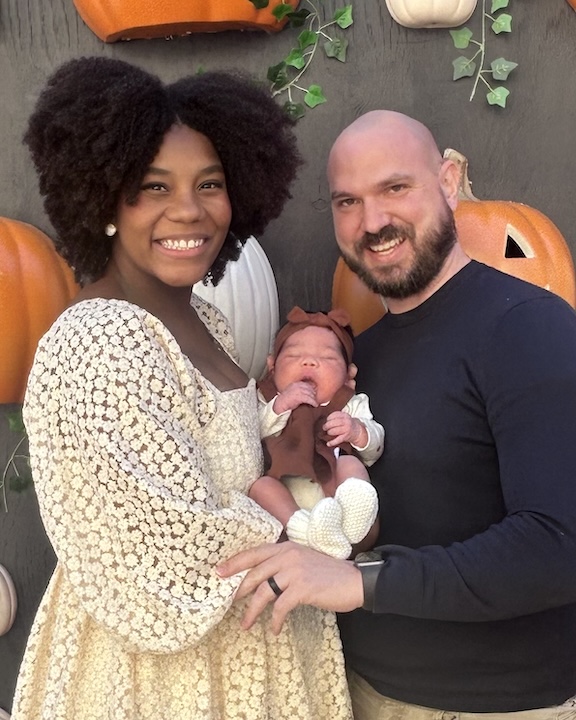
Spencer Ford with his wife, Kaushay, and their daughter (Photo: Courtesy of Spencer Ford)
Add to that funds and grants from the Mount Olympus JACL chapter, the Takahashi Family Foundation, the Japanese American Community Foundation and the like, and “History for the Reckoning” began.
In Season 1, it will be adding episodes through most of the remaining months of the year. Topics addressed in episodes so far: prewar life for Japanese Americans, from Pearl Harbor to the camps, life in camp and the Department of Justice camps; future episodes will address the draft resistance, the legal justification for the incarceration, the Supreme Courts cases and the later coram nobis cases, the redress movement, intergenerational trauma and more.
To listen, there are several options, including visiting the website historyforthereckoning.com; the Substack link historyforthereckoning.substack.com/; using the following link (tinyurl.com/2wt738ww) for Apple Podcasts; and searching on YouTube or in the podcast app of a personal smartphone or tablet.
❖❖❖
After the release of the last episode of “Burn Order,” Maddow and the MS NOW team held a live event last Dec. 14 at the Orpheum Theatre in downtown Los Angeles and it aired Dec. 29.
With Maddow as host/moderator, it was a 90-minute culmination of the podcast that featured her onstage with three of the people whose voices were integral to the six episodes: Abe, Bannai and Ina. Joining Maddow in the evening’s second section were Pasadena Mayor Victor Gordo, Rep. Mark Takano (D-Calif.) and Amy Oba of Nikkei Progressives. (It can be auditioned on YouTube at tinyurl.com/522kdw43.)
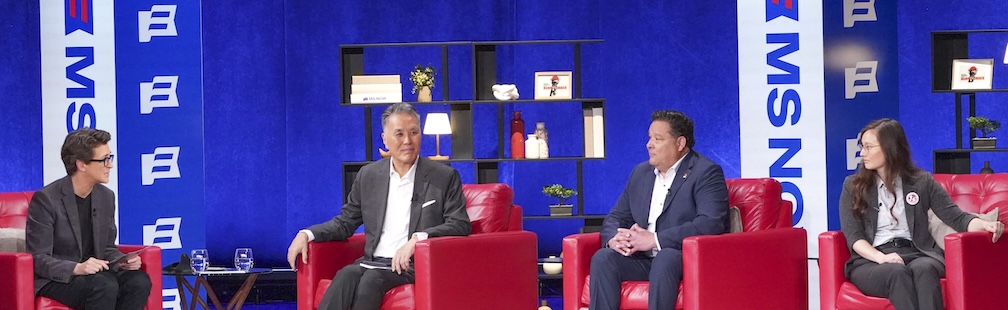
MS Now’s Rachel Maddow (far left) interacts with Rep. Mark Takano, Pasadena Mayor Victor Gordo and Amy Oba of Nikkei Progressives during the second panel of the “Burn Order” live event held at the Orpheum Theatre in Los Angeles. (Photo: MS NOW and Monty Brinton)
Despite the gravity of the subject matter conveyed in the series, the mood at the Orpheum was celebratory, and it had cause to be so. “Burn Order” had presented to a wide audience an important, truthful examination of events that was not only perfect for the podcast medium, but it also was a story that was perfect for the present and, realistically, one that had not received the treatment and resources that a professional, mainstream news outlet could bring.
That said, a cursory internet search will yield criticism of “Burn Order.” Even with six episodes, it is not comprehensive. Some might see it as an oversimplification of a far more complex story. The editorial choices and dramatic devices made on how to frame and tell the story, just as it is with any such endeavor, are certainly open to debate.
But, as was noted, “Burn Order” can be classified as edutainment and judged from that perspective, its strengths surely outweigh its weaknesses. For those to whom the Japanese American WWII incarceration story is new, “Burn Order” can be seen as an introduction to further investigation of other extant studies, research and books, and that is noteworthy when taking into account that there are still people in this country who consider themselves educated and knowledgeable, yet have never heard much of about what happened in this country to people who are still alive.
With the podcast medium now a Golden Globe category, it remains to be seen what, if any, accolades “Burn Order” might be nominated for later this year when awards season begins. (At the very least, it deserves some sort of recognition from that organization that received but one mention in six episodes when it holds its national convention this summer in Las Vegas.)
Also worth considering: After “Ultra,” another MS NOW podcast (back when it was still MSNBC) ended its run, filmmaker Steven Spielberg’s Amblin Entertainment optioned it to possibly become a feature film. Might that be in the future of “Burn Order,” too?
If not, that is OK. “Burn Order” is a perfectly fine standalone work in a medium of its own, the podcast. In a time when the nation has demonstrably slid backward from hard-won advances, maybe, just maybe, the timely arrival of it and “History for the Reckoning” will serve as a caution and reminder that sometimes, the past isn’t as far away as it seems.
Odd as it is, perhaps one of the rare upsides of the trauma of the Japanese American experience of decades ago is that, as conveyed by something like “Burn Order, it can serve as an immune-system response to the stirring of an ever-present bug buried deeply in the fundament of this nation, lying in wait like a cicada for the right time to emerge yet again.
“Rachel Maddow Presents: Burn Order” and “History for the Reckoning” can be heard by searching the podcast app on smartphones and tablets. To view an interview by Karen Korematsu of Michael Yarvitz, visit tinyurl.com/5ejxbube.
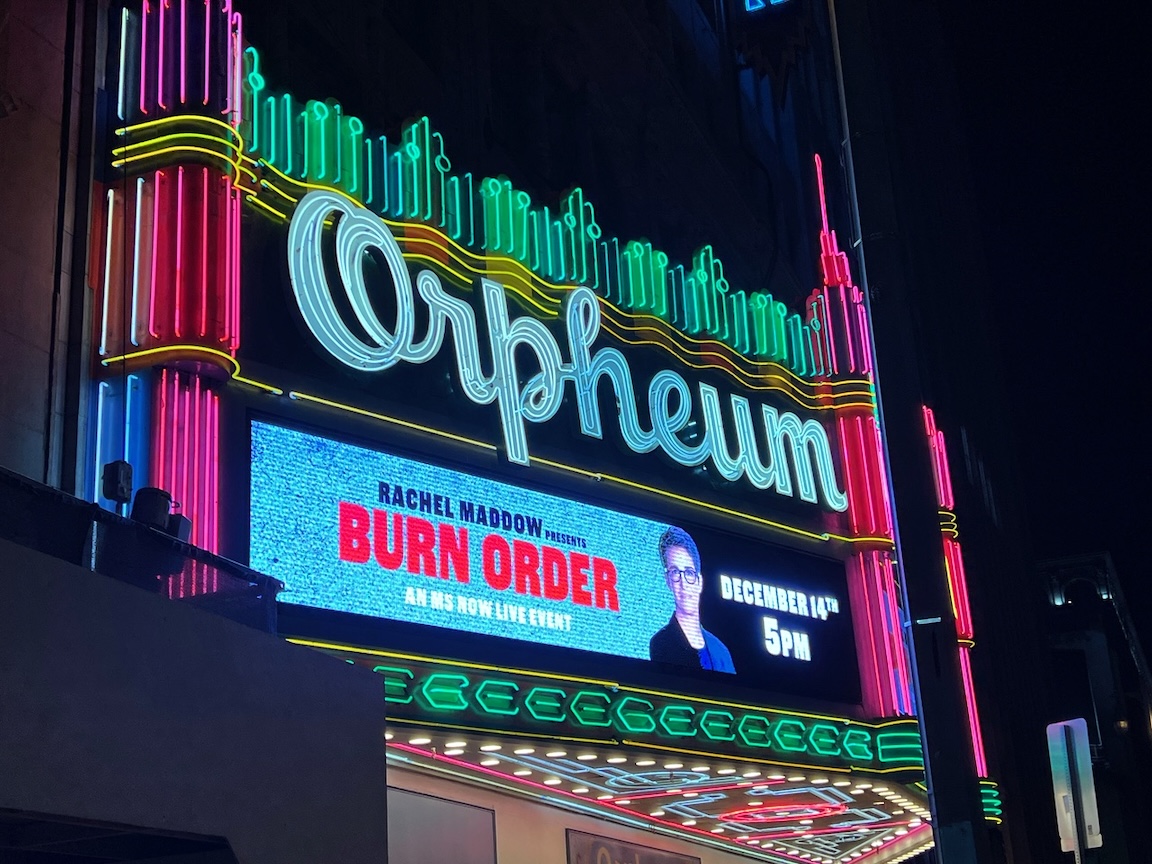
The Orpheum Theatre’s marquee on Dec. 14, 2025 (Photo: George Toshio Johnston)