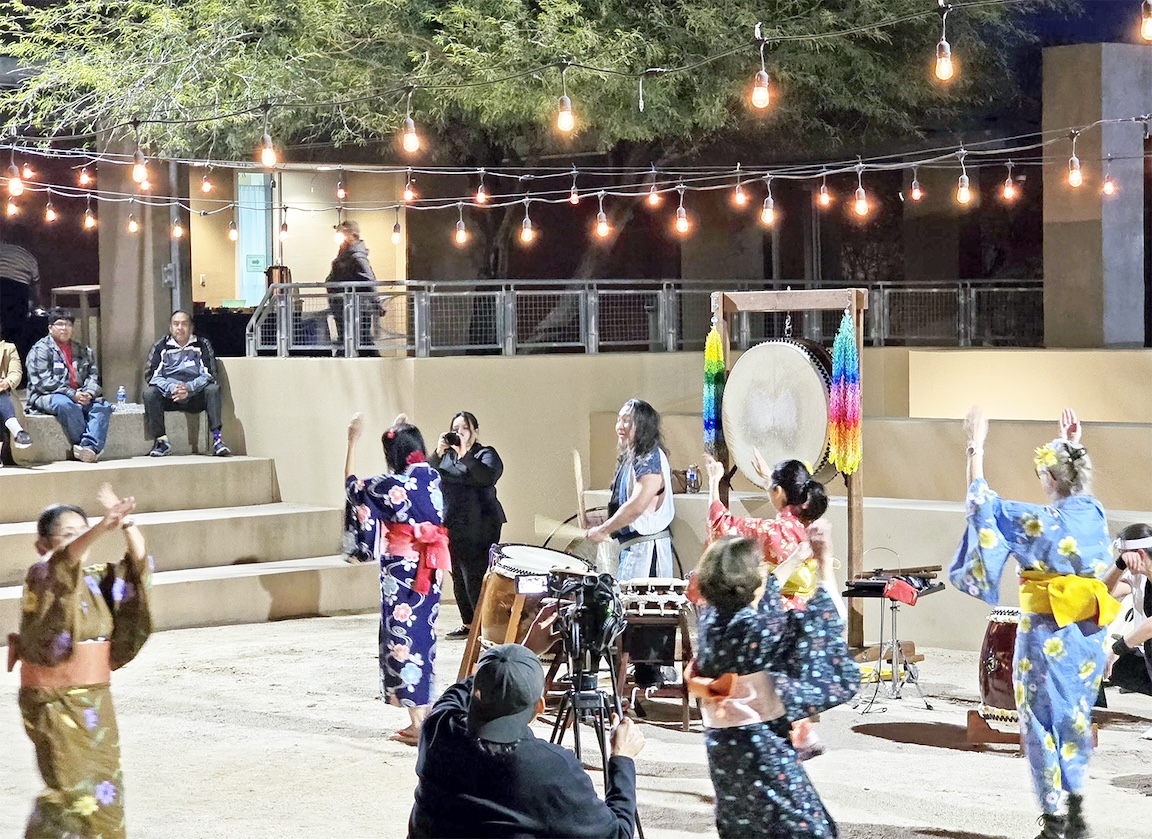
A taiko performance led by Ken Koshio (center) and Bon dance led by Marilyn Tang (front, center right) at the Huhugam Cultural Center. (Photos: Matt Marumoto)
The shared memories of the Gila River Indian Community and Japanese Americans
By Matthew Marumoto, JACL Daniel K. Inouye Fellow
Just south of the Phoenix metropolitan area, approximately 372,000 acres of land are home to the Keli Akimel O’otham, or the Gila River People. In this vast expanse of the Sonoran Desert, there lie large piles of broken ceramic shards in dry irrigation ditches, abandoned ponds and the foundations of more than 1,000 buildings, all seemingly forgotten.
See related stories:
Boise Valley JACL Presents 25th DOR Observance
‘The Power of Action: Silence Today, Injustice Tomorrow’
Contrary to their initial appearance, these remnants and their associated memories are remembered and protected by the Gila River Indian Community. Scattered across the land are traces left behind by the more than 13,000 Japanese Americans who were incarcerated at the Gila River War Relocation Center from July 1942-November 1945, a camp that was only constructed after the U.S. government strong-armed the Gila River Indian Community into accepting it. What was built on Gila River land was, in the eyes of many, an incarceration camp inside of an incarceration camp.
The “Gila River Connections: A Celebration of Shared History” was held on Feb. 19 at the Huhugam Cultural Center on the Gila River Indian Community land. Incarceration survivors, their descendants, Gila River elders, tribal government officials and members of the wider Arizona Asian American community all gathered to commemorate the Day of Remembrance and explore their connections further.
Koji Lau-Ozawa, an assistant professor in the Department of Anthropology at the University of California, Los Angeles, discussed his work at Gila River and described how the land remembers the presence of Japanese Americans at the site.
Drone mapping and archaeological surveys of the site revealed the remains of 400-plus features that were constructed by incarcerated Japanese Americans. Most commonly, the features are what remains of gardens and decorative ponds that were just outside many of the barracks.
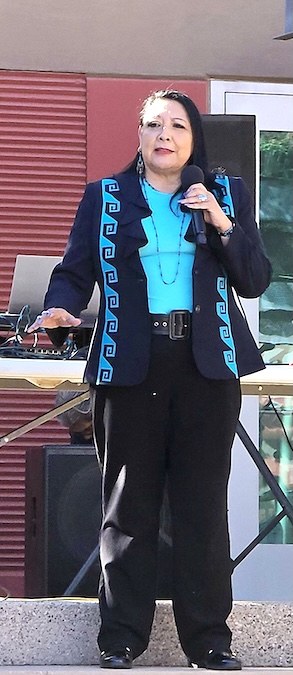
Regina Antone, lieutenant governor of the Gila River Indian Community, delivers closing remarks.
Lau-Ozawa also worked to analyze the piles of discarded ceramics, which are largely composed of serving dishes used in the mess hall, but also included decorative porcelain that could be traced back to California and Japan.
These findings demonstrate a stark contrast between what the government had built, a prison to contain people, and what Japanese Americans built and brought with them while incarcerated, things to remind them that they were still human.
The land carries fragments of memories from the incarceration, and so do the people who still call Gila River home. Community elders of the Gila River recall that they initially thought Japanese Americans were wealthy. As Japanese Americans arrived at Gila River, the War Relocation Authority would begin massive infrastructure projects on the land. These projects would bring running water, electricity and a medical facility to the reservation for the first time.
Despite the government advising members of the Gila River Indian Community not to interact with the Japanese Americans, it was only a matter of time before children began making friends, and Gila River residents would sell clothing and food through the barbed-wire fence.
Community elders further recalled that as Japanese Americans were released from Gila River, Gila River community members began to move into the barracks. However, this was only the case for the barracks in the worst condition.
The “best” barracks were removed from the site and sold when the camp began to close. This situation would often place a Gila River family on one side of the barracks and a soon-to-be-released Japanese American family on the other. When the Gila River War Relocation Center closed, the WRA would remove all barracks and the infrastructure that provided electricity and running water to the site. Just as the federal government had done in the late 1800s when it diverted the water of the Gila River from the very people it was named for, the Gila River Indian Community was left to survive on its own.
After the federal government had taken everything that it had built, except for the concrete foundations upon which the barracks once sat, the Gila River Indian Community made use of what the incarcerees had left behind.
Abandoned furniture and cookware that still bore the names of their original Japanese American owners found new homes within the Gila River Indian Community. Trees originally planted by incarcerated Japanese Americans were removed and planted closer to the homes of the Gila River people. However, it would not be long until Japanese Americans would return to the Gila River Indian Community.
While incarcerated at Gila River, Masaji “Mas” Inoshita volunteered to serve as a translator in the Military Intelligence Service. When Inoshita returned to Arizona, he became involved with the local American Legion post. Every Veterans Day, he would post the colors at the Ira Hayes Memorial Park and host meals at his home for members of the Gila River Indian Community and Japanese Americans.
Inoshita dedicated the rest of his life to maintaining the Gila River Monument and educating others on what had occurred on the land. He is remembered fondly as being a bridge between the Gila River and Japanese American communities.
Yolanda Hart Stevens, an artist, community activist and resident of the Gila River Indian Community, recalled that traditional songs sung by the community detail journeys through the land, and common waypoints to help guide the way, a sort of map through song.
Just as in the songs, the Gila River Indian Community and the Japanese American community can point to shared points of interest in each of their journeys: the sacred land of the Gila River Community, the betrayal by the federal government, the struggle to survive in the face of impossible circumstances and the desire for connection between the communities.
This shared song of collective trauma and resilience will forever bind the two communities as one. Stevens also explained that what both communities have suffered and celebrated on Gila River land has made them family forever.
As a testament to this connection, leaders of the local Japanese American community and the Gila River Indian Community publicly discussed a proposed formal partnership, the Rivers Community Alliance, intended to preserve the site, share the multicultural history of Gila River, honor the legacies of those who lived at Gila River and continue intergenerational storytelling. Our shared song is far from over. What will we write together?