The Shokudo team of (from left) Luke Uyeda, Jon Kenzo Okeya and Michael Murata
began filming their cooking videos during Covid and are now preparing a return this summer featuring all-new episodes. (Photos: The Shokudo)
The culturally-rich cooking show plans to debut all-new episodes this summer.
By Athena Asklipiadis, P.C. Contributor
During the Covid-19 pandemic, the Grateful Crane Ensemble was searching for a creative way to engage the community virtually. Michael Murata, former board chair of the nonprofit theater organization, was also a part of “The Grateful 4,” a Yonsei acapella group, when he was tasked with the assignment of creating new programming for its YouTube channel.
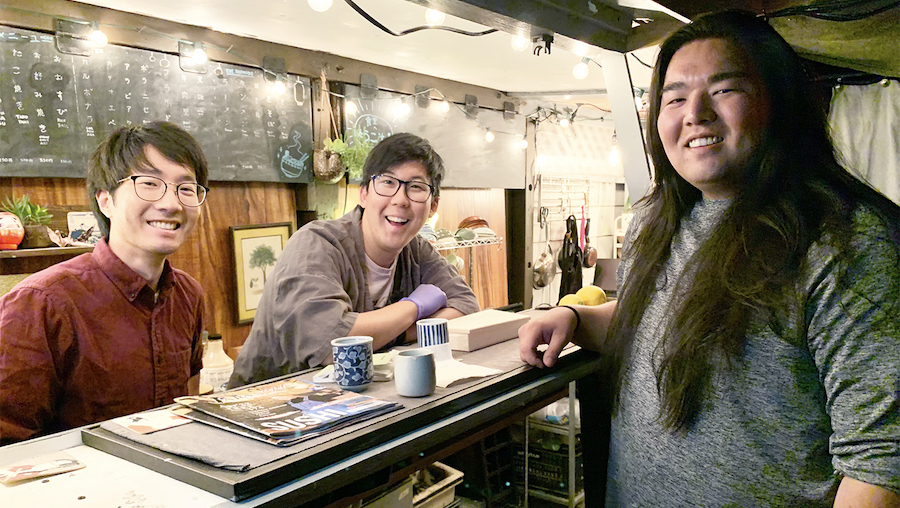
The Shokudo team’s (from left) producer and co-host Michael Murata, chef and host Jon Kenzo Okeya and videographer Luke Uyeda
Murata, who would serve as the show’s co-producer and co-host, recruited the talents of videographer and director Luke Uyeda and co-producer and co-host Jon Kenzo Okeya to embark on a culturally rich adventure through community stories and recipes.
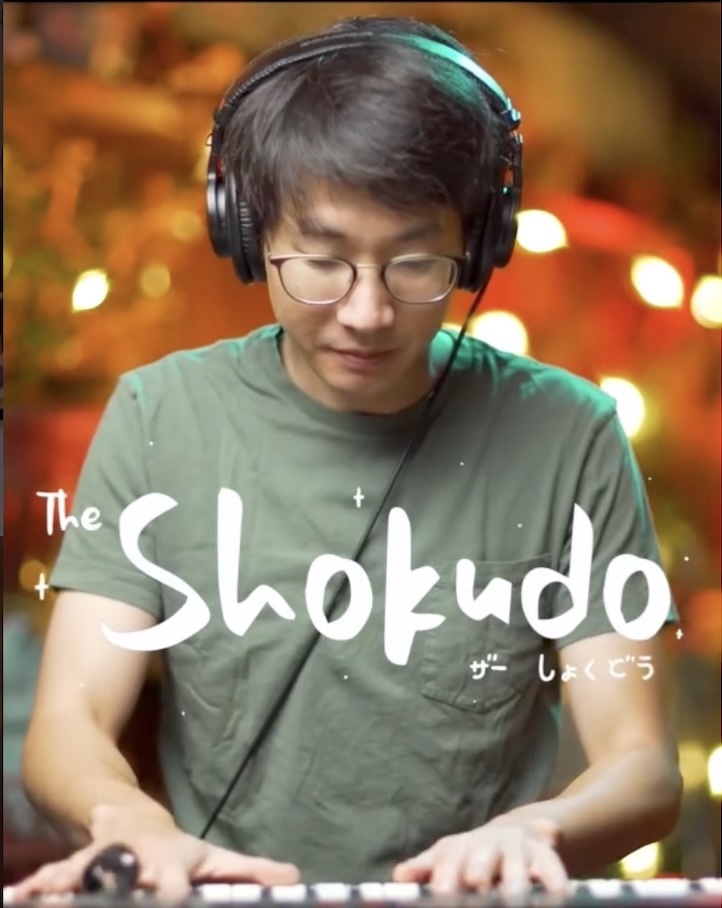
Michael Murata (below) performed and composed the opening theme song.
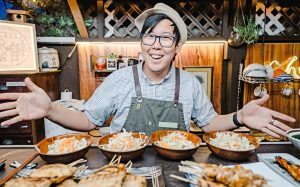
Chef Jon Kenzo Okeya presents his delicious offerings.
Together, they named the new cooking show “The Shokudo,” which debuted in February 2022. For the last few months, the series has been on pause, but it is set to return with new episodes this summer.
Shokudo (食堂, shokudō) are diners or small casual eateries in Japan that serve a variety of dishes. Inspired by Netflix’s “Midnight Diner” (Shinya Shokudō), Okeya sought to replicate the cozy atmosphere, warm conversations and comfort foods with his backyard kitchen.
Each episode begins with an intro monologue from Okeya over whimsically pleasant music produced, composed and performed by Murata on a keyboard.
“I’m no different than any other Japanese American person here in Los Angeles. I work as an artist, run errands and I pay my bills just like everyone else. But sometimes, when the day is done, and the opportunity arises, I open my secret little restaurant. It’s there where I discover who I truly am, one dish at a time. I call that place ‘The Shokudo,’” said Okeya.
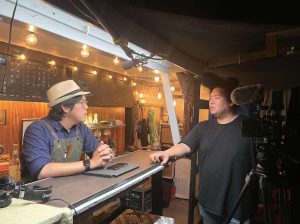
Jon Kenzo Okeya (left) and Luke Uyeda discuss filming.
Murata shares that his goal for filming the series was to “document and preserve culture,” as well as “learn more about ourselves and our own community, meeting new people and learning more stories.”
With Okeya and Uyeda, the three friends are committed to helping their community record and share valuable traditions that might otherwise be on the brink of being lost or forgotten.
Okeya, who lives in a full house with his wife, parents, sister, brother-in-law and two nephews, provides the setting for capturing this unique show.
Formerly his father’s 10-by-12-foot tool shed in the family’s backyard, the quaint space was transformed into a mini-secret kitchen complete with decorative string lights and a chalkboard-style menu for episode filming.
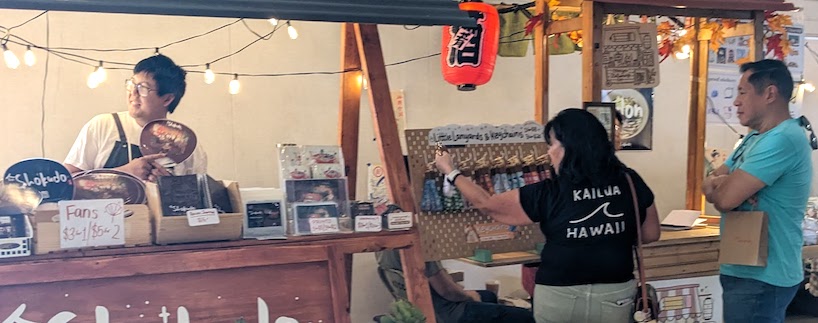
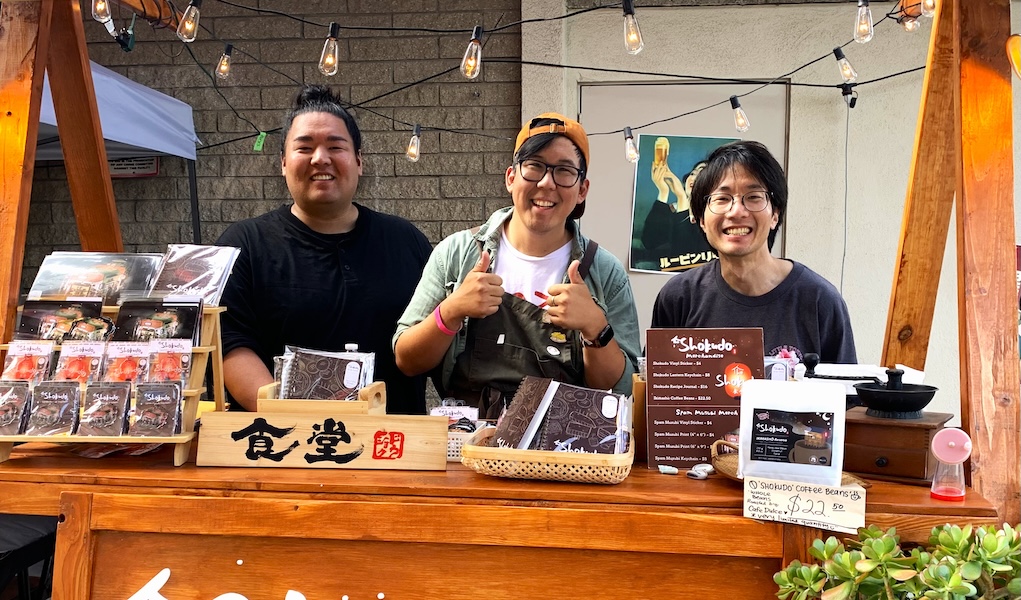
At the GVJCI/Grateful Crane “Showa Alley” by Shokudo benefit event, Jon Kenzo Okeya is pictured at the Shokudo booth alongside his Okeya Stationary offerings.
By day, Okeya is actually a full-time artist who creates stationary, cards and an illustrated series for his company Okeya Stationary Co., which he co-owns and operates with his wife, Audrey.
But his creativity goes beyond his pen and pad through his love of cooking and enthusiasm for Japanese American culture, which made Okeya the perfect fit for co-hosting such a show with Murata.
Having a Chinese mother from the Philippines and a Japanese father made Okeya’s experience growing up a bit different than Murata’s and Uyeda’s, who are both Yonsei, each with two Japanese American parents.
It is also Okeya’s excitement and introduction to a lot of things he did not grow up with that really draws the audience into each YouTube episode. Kind of like a Huell Howser, if you will, who enthusiastically listens, learns and speaks with various JA SoCal locals, Okeya’s jovial personality really makes each episode engaging.
Murata, who co-hosts some of the episodes, provides banter and heartfelt conversations that really balance out the sometimes comedic situations of the show.
Murata, like Okeya, has a career unrelated to entertainment and very much on the opposite end of the spectrum from his passion for music. Murata, a self-proclaimed “scientist and musician,” actually works in medicine in the surgery department at Cedars-Sinai Medical Center in Los Angeles and is also a husband and new father to an 18-month old. Surprisingly, he somehow manages to still find time to produce music, perform and film “The Shokudo.”
Currently, the trio are reconstructing the entire set of “The Shokudo,” which endured weather and termite damage in the past year. They hope to complete construction in the next few months and resume filming new episodes this summer.
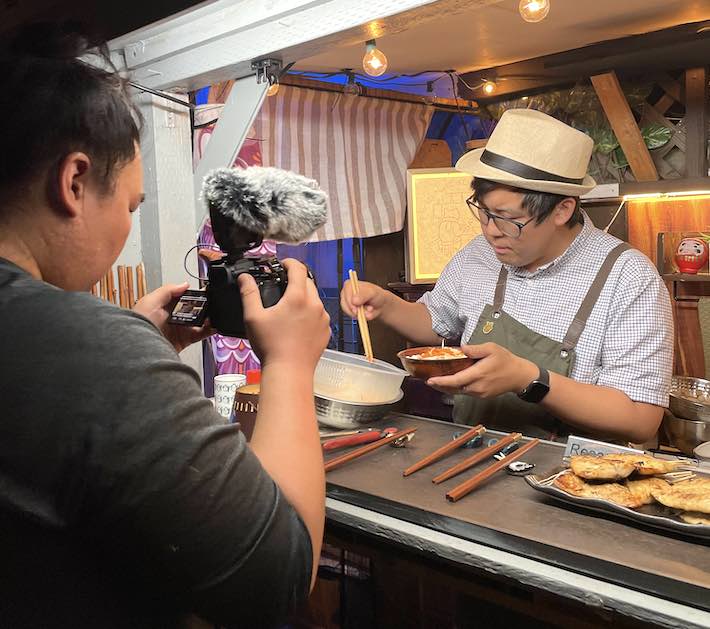
Luke Uyeda films Jon Kenzo Okeya cooking in an episode of “The Shokudo” series.
Uyeda, Okeya’s childhood friend and the third part of show’s trio, is a talented photographer and videographer who works in plumbing with his family’s longtime company, Jo-Mi Plumbing & Solar.
Although the frame of the new build was started by contractors, the rest of the renovation will be completed by these three multitalented young men during their free time on evenings, after work and on weekends.
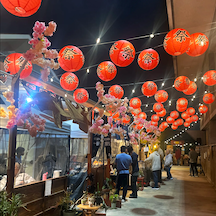
The Shokudo team transformed the GVJCI into a yokocho, immersing visitors into the sights, sounds and tastes of a bustling Japanese alleyway.
Uyeda shares that they are currently determining electricity and plumbing options to make it safer than the previous set up.
While they rebuild the show’s set, the trio have a lot of show ideas in mind. Shared Murata: “With Luke and Jon, there’s no shortage of ideas; it’s just tough to find willing participants to be on camera and join episodes.” He went on to say that they need more folks from the community to be a part of their series.
The trio’s most successful past episodes have featured favorite tasty staples of the JA community — spam musubi, rainbow jello and chili rice, with various guest cooks sharing their cooking skills and family stories.
During the “The Shokudo” series episode “On the Level With Rainbow Jello,” Okeya jokes that the audience will be “learning the mendokusai (めんどくさい) art of rainbow jello.”
The tedious process of making what most in the JA community know as rainbow or ribbon jello takes the viewer on a journey of creating the seven-layer dessert along with guest mother-and-daughter duo Dina and Regina Furumoto.
The Furumoto’s share a family favorite recipe from the Orange County Buddhist Church recipe book. Okeya and Murata decide to take the dessert a step further by challenging themselves to create a 15-layer rainbow jello tower, opting for a beer stein as the container due to its height.
This episode is a great example of why the series is so popular, and why we should all be excited to see what more is in store in the future from these three multitalented individuals.
Blending comic relief of trying to out-do the original recipe, Okeya and Murata also get deep while talking about something many would see as such an insignificant dish. This JA staple, as random as it is to our community, is something comforting and nostalgic that many of us remember our grandmas and aunties making.
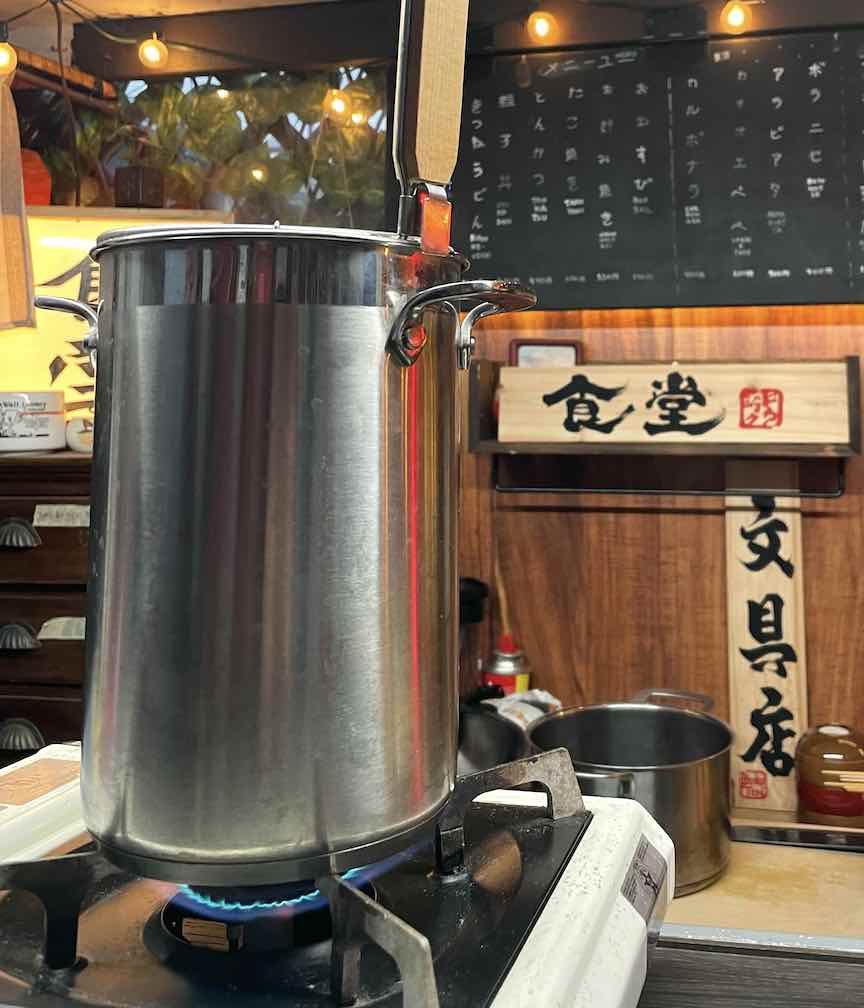
A hot pot warms up noodles, just one of the many Japanese comfort foods featured on “The Shokudo” series show.
It was something welcomed at potlucks and gatherings where the patience and hard work in making such a dessert was appreciated. Memories of peeling each layer apart as children and eating each one by one is also a common experience of which we all can relate.
These sweet little recollections we might take for granted is what makes “The Shokudo” so special and so specifically Japanese American.
Another must-see episode is the “The Culture Around Kaki (Persimmon).” Not only is a kaki/persimmon bread recipe shared by guest Mike Okamura, but the show really does a great job at capturing the essence of the fruit and its place in our community.
Okamura shares his recipe from a Japanese American National Museum Volunteers recipe book “Cooking With Love” while recalling the importance of having kaki trees amongst our community members and the culture of giving, in this case, sharing fruit.
Murata even makes a visit to his own family members’ home, where a tree his grandparents planted still provides fruit to generations of family after their passings.
The Murata family has created a new tradition for everyone in the family, young and old, to come together to all pick kaki as a yearly event.
With appreciation, Okamura addresses Okeya and Murata at the end of the episode’s filming, saying, “It makes me happy that you wanted to learn, wanted to participate, both of you, in something that brings me joy every year. It brings me hope that at least with me doing this tradition, I can pass that along. Whether you use that knowledge or not, I planted the seeds.”
Murata sums up his feelings in the episode by saying that being Japanese American is a feeling, not something we can quantify or have to prove in an obvious way.
“For us, as Japanese Americans, our Japanese American culture is no longer rooted in the language . . . it’s rooted in these underlying values like giving each other kaki . . . that’s how we preserve our culture.
“Younger and younger generations,” Murata continued, “being less and less Japanese by blood, they’ll have this culture in them that isn’t just based on being able to speak [Japanese] or even having a Japanese name.”
Murata makes a point that as much as our community is changing and growing, it is not diluting — the next generation is still finding the importance in preserving and sharing our nuanced traditions.
Back in the day, many churches and organizations gathered recipes and made printed and bound cookbooks. Today, we are digitally archiving our culture through brilliant shows like “The Shokudo” and through social media.
The community can support “The Shokudo” and the amazing work its creators, Murata, Okeya and Uyeda, are doing through supporting the Grateful Crane Ensemble, who funds the series, or by attending the series’ next fundraiser event, which is currently in the works. (In 2024, “Showa Alley by the Shokudo” benefit was held at the Gardena Valley Japanese Cultural Institute, which featured a replica yokocho, very much like the alleyways in Japan that feature tiny eateries and giftshops.)
You can stay up-to-date with the “The Shokudo” series by following @the_shokudo_series on Instagram and YouTube. You can also catch an in-person screening of the episode “On the Level With Rainbow Jello” at Nikkei Movie Night at the Venice Japanese Community Center on May 23. This event, co-presented by Murata, will give you a literal taste of “The Shokudo,” as refreshments will made by Okeya.
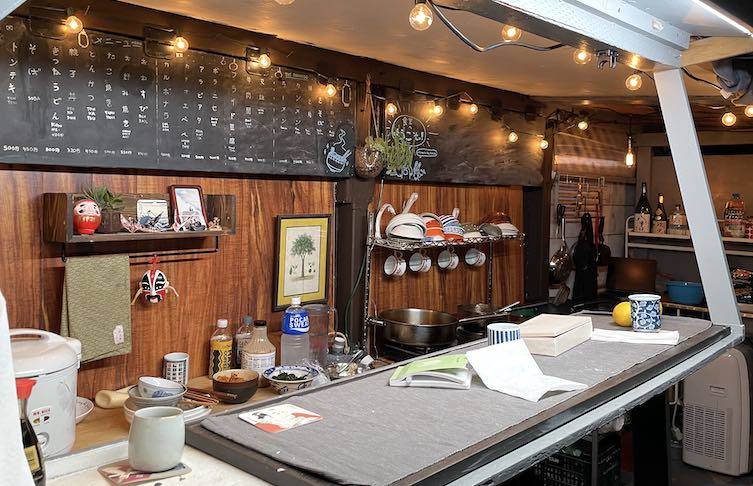
The Shokudo was once an architecture tool shed owned by Jon Kenzo Okeya’s father before it was converted into a kitchen.