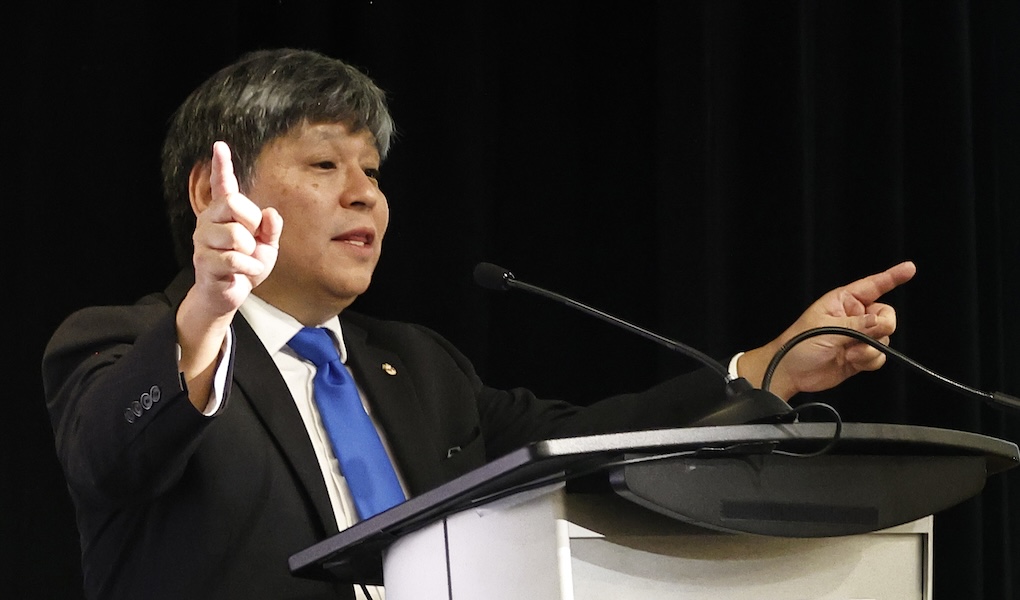
Sheldon Arakaki addresses the audience at the 2026 National JACL Convention’s Sayonara Gala, one of his first duties after being elected the organization’s national president. (Photos: Darrell Miho)
The newly elected JACL president
stays mum on specifics for the new biennium.
By George Toshio Johnston, P.C. Senior Editor
Following his election as JACL National Board president on Aug. 1 at the JACL’s 2026 National Convention, Sheldon Arakaki spoke with the Pacific Citizen to discuss his vision for the organization during his new biennial term.
A JACLer for more than 20 years, the Seattle-born, Hawaii-raised Yonsei, who returned to live and work near the place of his birth as an adult, ascended to JACL’s top leadership position as the storied organization faces several long-running challenges — membership decline, financial pressures, JACL’s raison d’être, staffing issues, competition from other community organizations for a person’s time and commitment — as it approaches not only its 2029 centennial but also a 2027 with no National Convention and a 2028 with plans for a virtual-only confab (see aforementioned financial pressures).
Following is a conversation between Pacific Citizen Senior Editor George Toshio Johnston and Arakaki, edited for conciseness and clarity.
THE PACIFIC CITIZEN: You’ve been a JACL member for, according to your speech at the Candidates’ Forum at the JACL National Convention, 22 years, and you’ve received the Ruby Pin. Congratulations for that. That also means you’ve seen how the organization has evolved and changed since going back to about 2004.
SHELDON ARAKAKI: I think I joined December of 2003.
THE P.C.: That would include Larry Oda’s first back-to-back terms from 2006-10 and several different executive directors and national presidents. With that perspective and seeing how the organization has had to deal with fiscal belt tightening in the past few years, not to mention declining membership, when and where do you think JACL, in quotes, “lost its way” and how will a Sheldon Arakaki administration set the stage for a return to growth and relevance for JACL?
ARAKAKI: Reading the P.C. archives, I can see the financial issues have been there for decades (see ‘Reality of JACL’s Dire Financial Situation Hits Personnel,’ June 6, 2003, Pacific Citizen, tinyurl.com/5en2u7ue). Before I joined in December of 2003, apparently there was some gala in L.A. with Rep. Bob Matsui and [Sen.] Dan Inouye and I think maybe Norm Mineta in the fall of 2003 to raise money for the JACL because it was having financial issues (see ‘Reflections on 9/11 as Honorees Gather for JACL Gala Dinner Tribute,’ Sept. 19, 2003, Pacific Citizen, tinyurl.com/rfwhvsn7).
The 1994 convention, one of the big issues apparently was JACL’s financial condition. There were a couple board meetings in December of ’94, and they took a vote to reduce the budget and align the expenses with expected revenues, which resulted in a bunch of headcount reduction (see ‘President Explains Board Decision to Downsize Staff,’ Jan. 6, 1995, Pacific Citizen, tinyurl.com/3ns9p89m). If you think about the ’92-’94 period, this is just four years after redress, so we should be on a total high and everything, but you could see we’re even struggling back then. . . . It’s nothing new.
So, the question is, how do we really slow things down and reposition the organization — and maybe even reposition it isn’t even the right term for it. The world has changed. The community has changed a lot, and I think it’s about adapting and recognizing it. Let’s just say there’s more choices out there. We’re more distant from the World War II generation. I’m a Yonsei, right? We’re just much further away from this than our immigrant history. So, it’s about adapting to a different time, different demographics. I think for me, it’s about adapting. What I had campaigned on is a focus and return back to policy. Focusing on policy work and then advocacy. Education. We’re an advocacy organization.
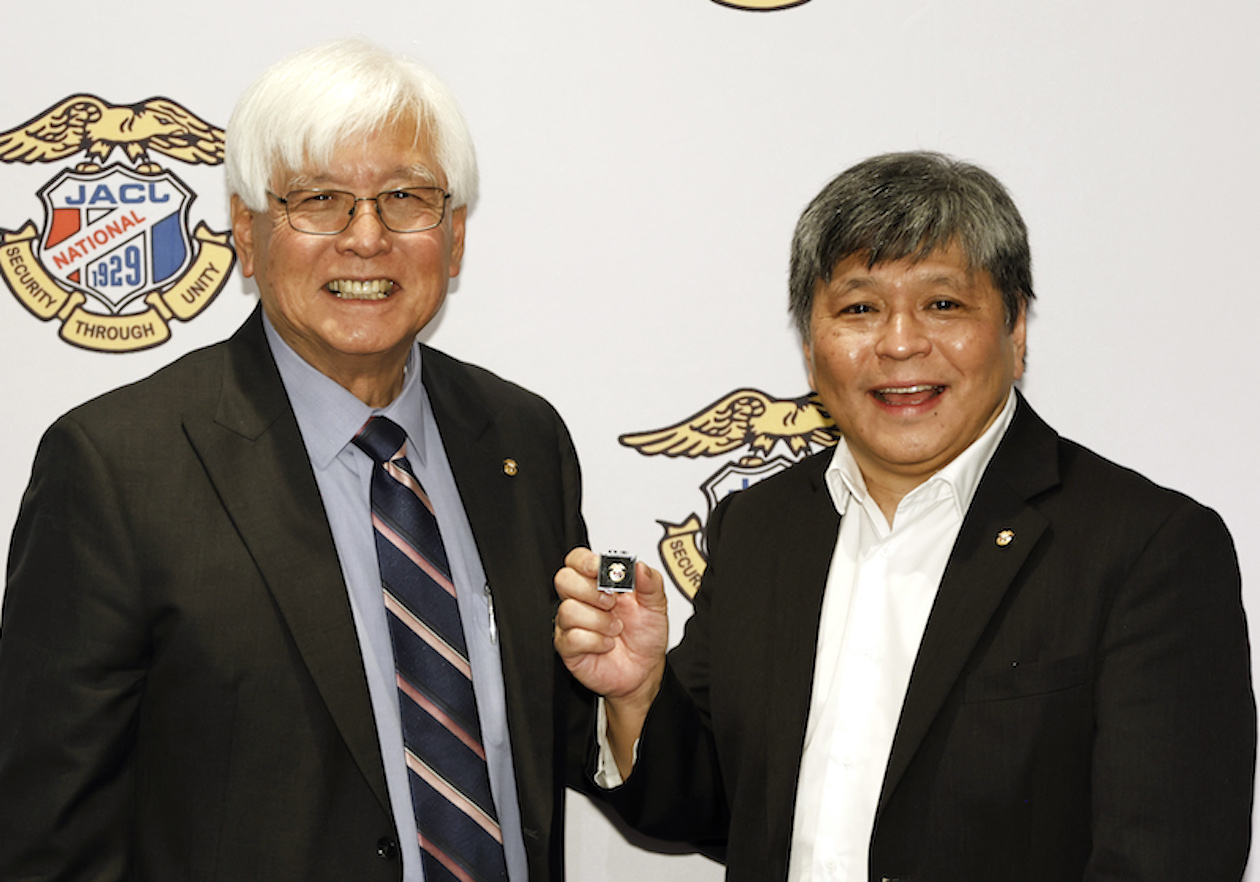
Larry Oda (left) in one of his last acts as JACL national president, presents Sheldon Arakaki with the JACL’s Ruby Pin, the organization’s highest honor for service.
THE P.C.: In your Candidates’ Forum speech, you said: ‘As far as my basic platform, three things: policy focus, advocacy and education, and connecting people and communities.’ I’m quoting Sheldon Arakaki there. So, how does this tie into the Sheldon Arakaki era and helping JACL grow and put it back in the forefront, if that’s possible? Is there a path forward, getting back to my initial question?
ARAKAKI: This is what I try to get to. So, you have to have an actual focus and a direction first, right? Because this is how you’re going to attract people or get people involved. For me, it’s about member engagement. What do you do with the existing members? So, if we’re saying we’re going to focus on policy, you know, we have to actually have a program built around policy work, the advocacy that goes with it and, of course, education, and then making an effort to build a community.
THE P.C.: Let’s switch gears a little bit, getting more into your cabinet. What is your timeline for filling any remaining vacancies, such as vp of general operations?
ARAKAKI: I am hoping in the next 30, maybe 60 days.
THE P.C.: How does your vision for JACL align with Executive Director Lily Simmering’s vision (see ‘Simmering Presents Priorities,’ Aug. 14, 2026, tinyurl.com/bdfzd4ku), for JACL, especially in the next couple of years?
ARAKAKI: I think we’re pretty much aligned. We really seem to speak the same language. We both talk in terms of key performance indicators. We should be publishing them. I’ve asked for the last few years about a public policy platform because you can build around a policy platform.
THE P.C.: With the decision at the National Convention that there will be no convention in 2027, what about the possibility, then, of a bidistrict or tridistrict conference instead?
ARAKAKI: I think at least one governor has brought it up. There’s been some light discussion on that. There are other things that have been brought up. Apparently, Omaha is having a big birthday party next summer. There’s also been some thoughts on if we want to focus on policy, we should have some sort of policy forum gathering, maybe in ’27. I think that’s more of a TBD right now because in all these ideas, you have to pay for it.
THE P.C.: The past few conventions, and I think probably including this latest one, have been moneylosers as opposed to moneymakers. Should National Conventions strive to be moneymakers?
ARAKAKI: Oh, my God! Break-even minimum, moneymakers, yes.
THE P.C.: Back to your basic platform, you said three things: policy, focus, advocacy and education, and then you also added connecting people and community. The one word I didn’t hear was membership, and it’s been on the decline, according to your predecessor, for 25 years. Why didn’t you mention membership growth as a priority for you in your basic platform? And what will happen during the Sheldon Arakaki biennium that will help JACL grow its membership base. What are the broad strokes of what you’d like to do?
ARAKAKI: Well, first of all, membership hasn’t been declining for 25 years. It’s been declining for decades, right? Going back to the P.C. archive, there was a story about ‘We have 30,000 members, and we’re declining,’ and it showed a year-over-year change from 31,000, and by the end of it, was like down to 28,000. So, the question is, are we asking the right question? What I am focusing on, though, is what I’ve been talking about: What about member engagement? If you want to retain the members, you have to engage them. We have thousands of lapsed memberships. You haven’t heard anybody talk about, ‘What about all the lapsed members?’ . . . We’ve got thousands of them. There should be more of a concerted effort to bring them back in. What I’m hoping for again is by having more of a direction on the policy work and the advocacy work and the education work, we can bring back some of the lapsed members. Lapsed members are the low-hanging fruit. You have an issue about the chapters really not engaging their members. So, this is where I think you’re going to have to go back to what can National do to help the chapters to engage their members, or what do the chapters want from National to engage the members? And this is where, of course, the vp for membership comes into play.
THE P.C.: Tell me if I’m encapsulating this correctly, then, because you said lapsed members are low-hanging fruit. So, is that going to be part of your focus, bringing back lapsed members?
ARAKAKI: I think we should try. We haven’t made a concerted effort to try to go after lapsed members.
THE P.C.: What is the value proposition, especially if I’m, say, under 30, to becoming a JACL member?
ARAKAKI: I think that’s what we have to formulate a new message around, right? You asked me about how I’m aligned with the executive director. We both talk about service. There are those of us who talk about service to the greater good, to the organization, recruiting around service, and then you talk, and then you’ll see this other theme about benefits. What can we give? What can you consume as a member, as far as experiences? I think Lilly and I are in alignment on that. We talk about service. We’re looking for members to serve, to contribute, to give back.
THE P.C.: My question had to do with value proposition, like being a Sam’s Club member, a Costco member, AAA or Auto Club member or AARP member. I think right now, if you’re a JACL member, you can get free admission into the Japanese American National Museum, which is great if you happen to be in Los Angeles County. But for you in Bellevue, Wash., unless you happen to be in L.A., it’s basically worthless. So, getting back to the question, what would compel me, especially if I’m under 30 and it costs me $65 to become a member, what do I get?
ARAKAKI: And that’s why I was telling you earlier, we have to come up with a new position, a new message. And that has to be developed. I’m not revealing anything right now. You’re not going to hear anything first that I haven’t worked throughout the board level. When the board level works things out, and the vp for membership works out and we’re all simpatico, then we will do a rollout. You’re not going to hear anything first that the board hasn’t agreed to as a whole and moves in one direction. That, and then we’re in alignment with the executive director on.
THE P.C.: But you are the national president, and that carries a lot of weight. You might say, ‘Well, I like Plan A,’ or, ‘I like this particular thing,’ and as national president, you’re charged with leading. So, I was just wondering if you had any particular, specific thing that you could mention. But it sounds like you don’t want to reveal at this time.
ARAKAKI: Exactly. But what’s important here is you have a board president who recognizes that we need one. That’s the important thing. You cannot change things or fix things unless there’s recognition that it needs to be changed or it needs to be fixed. We have known that the value proposition has needed change for years. This is not new either, right? But you would need board leadership to also recognize it, too, to drive the conversation. This is what I said in the campaign trail. The board president has to drive the conversation. I have to drive the conversation on a strategic plan, on the direction, get the board to agree on what the North Star is, etc., etc.
THE P.C.: What are your thoughts regarding JACL becoming more than just the Japanese American Citizens League, emphasis on Japanese American, and more pan-AANHPI, such that JACL becomes just letters like AARP. The YMCA used to stand for Young Men’s Christian Assn., then it became YMCA only, and now it’s just the Y. Any thoughts on JACL going down a path similar to that?
ARAKAKI: Why would you think we already haven’t gone down that path?
THE P.C.: We’re still Japanese American Citizens League.
ARAKAKI: That’s how we present ourselves.
THE P.C.: But if you look at the membership, it’s still primarily Japanese American.
ARAKAKI: It’s still primarily, but you have had other Asian Americans involved.
THE P.C.: Oh, absolutely. David Lin was a prime example. Lilly herself is a prime example. So, what you’re saying is, even though it hasn’t been formally done, it’s already happening.
ARAKAKI: It’s been maybe slowly happening. Maybe it doesn’t get as much attention, but it’s already happening. I don’t think we become like OCA – Asian Pacific American Advocates. A big part of our community history is around what happened in 1942. I think what you would have are people who are non-JAs would get involved because of overall work on various different issues over time, but because of that story and the reparations work, because we are the only group that has actually been able to do that.
THE P.C.: That’s a good segue to my next question. We have a couple of rare convergences ahead. One is the 40th anniversary of redress in 2028 because that was Aug. 10th, 1988, and then in 2029, JACL’s Centennial. What do you intend to do to take advantage of both of these occurrences that are coming up from a purely marketing point of view?
ARAKAKI: We can’t reveal marketing plans, right? We need the whole agreement first on what the plan is. But yes, you have a board president who recognizes all of it that. It’s out there, and we have to figure out how to take advantage of it, right, whether it’s in the membership, whether it’s membership engagement, how do we take advantage of this? How do we use this as part of our asks in the campaign, doing letters and everything, right? It’s a recognition that it’s all out there, and we can add more on it.
THE P.C.: You’re the president of the Japanese American Citizens League. If you had, and maybe you’re keeping this close to the vest, did you have any kinds of —
ARAKAKI: I’m not revealing anything in this until you get everybody bought-in this and in alignment with the executive director. I’ve already had conversations about this with some people about, ‘What do you want to focus on?’ ‘What do we want to emphasize?’ ‘What sort of reflection direction do you want to take?’ But there has to be more of a formal conversation, and proposals have to be put together.
THE P.C.: OK, so nothing specific.
ARAKAKI: I can’t give you anything specific. Although, again, as one governor speaking to other governors, I did say to other governors, ‘Your chapters, your district should already be planning at the local level.’ But yes, you’re right. The National level, we should be doing, we should be focusing on, too. And I agree with you about the marketing.
THE P.C.: Last question, you mentioned early on in our conversation going back to the Pacific Citizen’s archives, which I think is a fantastic resource. What is the role and the future of the Pacific Citizen under a Sheldon Arakaki administration?
ARAKAKI: Oh, my God, it’s our media platform, right? One of the things that’s defined in the constitution and bylaws is it’s our public relations vehicle. How many times did I reference the archives to you in this conversation? It’s our history, man. This is what’s capturing JACL’s history. You are writing about JACL history.
THE P.C.: But we’re also there to report news for our membership, and sometimes those two missions can bump heads.
Arakaki: Yes, yes.
THE P.C.: So, it’s safe to say that the future and the role of Pacific Citizen under the Sheldon Arakaki administration will continue in some way, shape or form.
ARAKAKI: Some way, shape or form, right. We have to get our news.