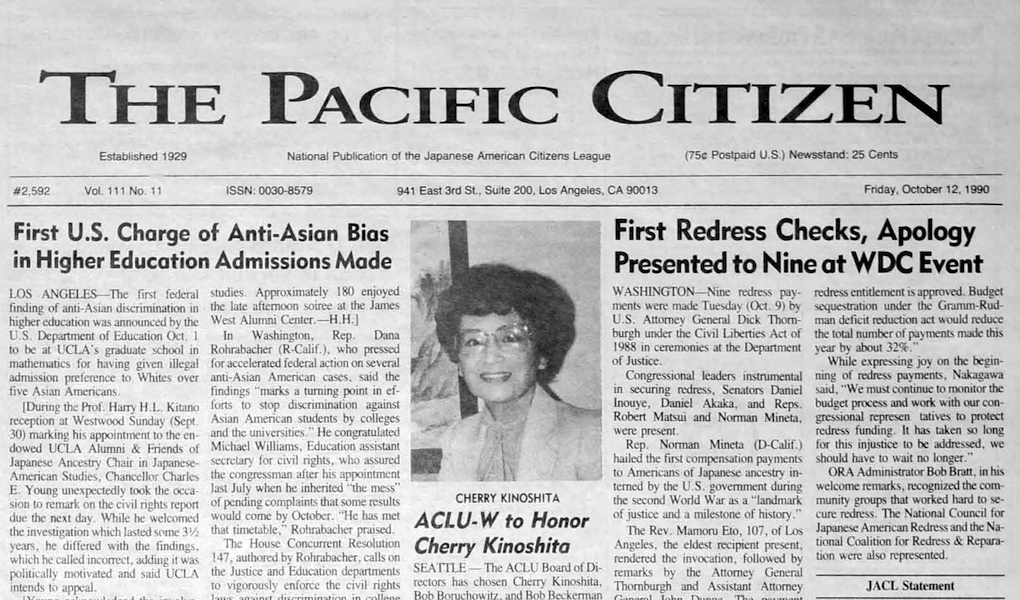
The front page of the Oct. 12, 1990, Pacific Citizen reported on the Oct. 9 ceremony at which the first nine Japanese Americans eligible for redress compensation received checks and letters of apology. (Photo: Pacific Citizen)
In 1990, first redress funds were
disbursed to living incarceration survivors.
By P.C. Staff
Exactly 36 years after the United States government first delivered $20,000 in monetary compensation in the form of checks to nine elderly persons of Japanese ancestry decades after having their constitutional right violated (see Oct. 12, 1990 Pacific Citizen), the Japanese American Citizens League issued a statement today to mark the occasion.
In its news release, the JACL stated: “Today, the legacy of redress and lessons learned continue to shape and inspire our work. We are committed to advocating for modern-day redress and a formal apology for Japanese Latin Americans interned and incarcerated during World War II and reparations efforts for the Black community … ”
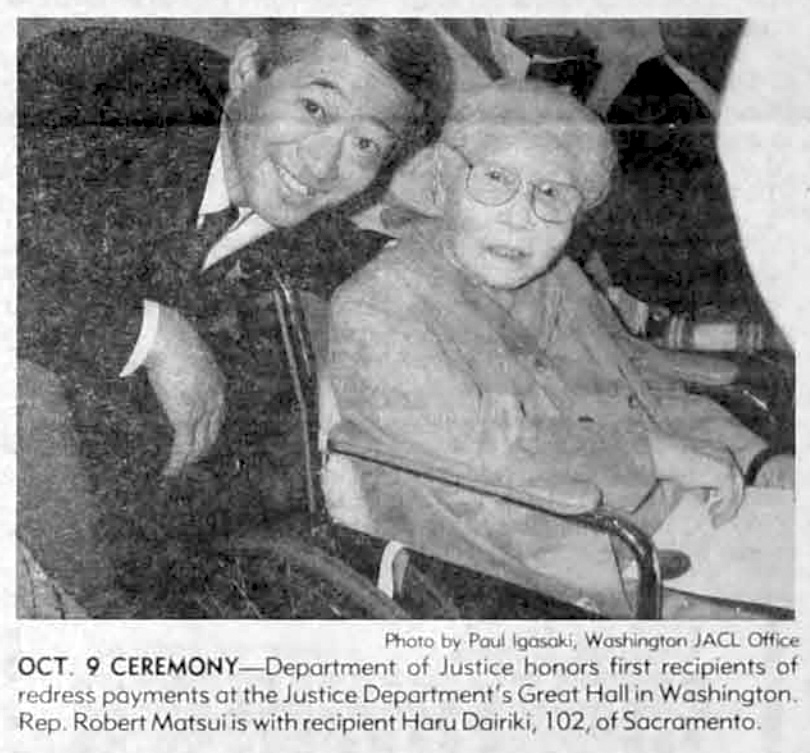
In this archival image from the Aug. 19, 1990 Pacific Citizen, Rep. Robert Matsui shares a smile with 102-year-old Haru Dairiki, one of the first former incarcerees to receive a redress check and apology from the U.S. government. (Photo: Pacific Citizen)
The JACL’s statement also included reflections from Peggy Nagae, Martha Watanabe and Kathy Masaoka, all of whom made contributions to the success of the 10-year-long Japanese American redress campaign that began in Seattle at the 1978 JACL National Convention and culminated with President Ronald Reagan’s Aug. 10, 1988 signing of the redress bill, officially known as the Civil Liberties Act of 1988, aka HR 442.
In addition to authorizing monetary compensation of $20,000 to still-living individuals who were affected by what the Commission on Wartime Relocation and Internment of Civilians concluded was “race prejudice, war hysteria and a failure of political leadership,” the 1988 law also included with redress checks a letter of apology that was signed by President George H.W. Bush.
A day after Imperial Japan’s Dec. 7, 1941 attack on American naval assets at Pearl Harbor in the territory of Hawaii, the U.S. declared war on Japan and entered World War II. On Feb. 19, 1942, President Franklin Roosevelt issued Executive Order 9066, which would authorize the removal of more than 125,000 ethnic Japanese — mostly U.S. citizens and Japanese nationals then-barred from becoming American citizens — from the West Coast to incarceration centers operated by several governmental agencies, mainly the War Relocation Authority.
To read the JACL’s entire statement, visit here.