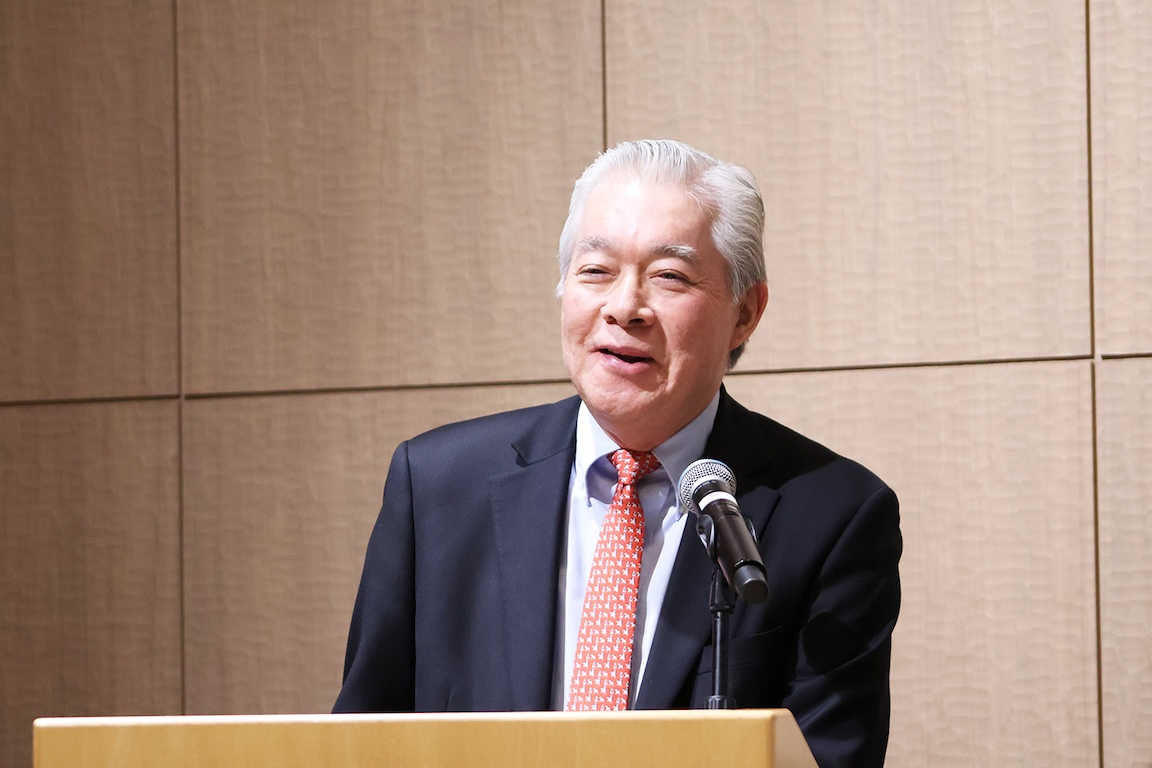
Glen Fukushima speaks at Japan House in a lecture entitled “U.S.-Japan Relations in a Shifting Global Landscape.” (Photo: George Toshio Johnston)
The noted éminence grise of U.S.-Japan relations holds court in a shifting global landscape.
By George Toshio Johnston, P.C. Senior Editor
Underscoring an unstable present, Glen Fukushima’s timely March 2 lecture titled “U.S.-Japan Relations in a Shifting Global Landscape” was bookended by events of the distant and recent past, as well as a future that had seemingly begun to alter even before the “living legend,” as he was described by Consul General of Japan in Los Angeles Kosei Murota, ended his address at Japan House Los Angeles.
Occurring just two days after the United States, along with Israel, launched a globally destabilizing attack on Iran, Fukushima (see Dec. 20, 2024, Pacific Citizen, tinyurl.com/yz4edz6n), nevertheless shared his decades-long observations, perspective and historical knowledge of the dynamics and status of the longstanding, vital and mutually beneficial military, economic, technological and social relationship between the global superpower and regional “middle power,” the latter a label put forth by Japanese law professor Yoshihide Soeya.
“I’m interested to know from Consul Murota to what extent Japan considers itself to be ‘middle power’ because I actually think that perhaps Japan doesn’t think of itself as a middle power,” Fukushima said, later noting that “Japan has one of the largest militaries in the world.”
In his first visit to Japan House Los Angeles, Fukushima was preceded by an introduction and remarks from Japan House President and CEO Yuko Kaifu, who was followed by Murota and Christopher Patay, chairman of the board of directors of Japan-America Society of Southern California, which co-sponsored the lecture.
“He brings rare, practical perspective granted in decades of experience working at the intersection of policy, business and the U.S.-Japan relationship,” Patay said of Fukushima, a visiting fellow, Stanford University; senior fellow, Center for American Progress; former deputy assistant U.S. trade representative for Japan and China; former president of the American Chamber of Commerce in Japan; and current vice chair of the Securities Investor Protection Corp.
Fukushima began by heaping praise on Kaifu. “She’s done a fantastic job over the last 27 years promoting U.S.-Japan relations and also [being] very active with the community, the business community, as well as Japanese American community,” he said. “I recognize all of her contributions and thank her for inviting me today.”
Regarding the past, Fukushima alluded to a remark made by Murota, how in 1989 Business Week magazine had published a poll asking Americans which was the bigger threat, Japan as an economic rival or the Soviet Union as a military rival, with 68 percent of respondents believing that Japan was the bigger concern.
“It’s quite difficult to believe now,” Fukushima said before revealing the subject of his upcoming book on the evolution of U.S.-Japan relations, with a focus on the current relationship between America’s Silicon Valley and Japan in the area of technology.
Noting that there has been so much of a focus on the past, Fukushima said that in his book, he wants to “focus on the future” because “there’s been a clear evolution and a clear change in the two countries being rivals to being partners.”
That relationship was, of course, in the news just days later with Prime Minister Sanae Takaichi’s visit to the White House. Whether the following will be included in Fukushima’s book remains to be seen, but in an awkward incident, with Takaichi at his side on March 19, President Donald Trump was asked why the U.S. had not informed allies such as Japan, which depends on oil coming through the Strait of Hormuz, in advance of the attack on Iran.
“We didn’t tell anybody about it because we wanted surprise. Who knows better about surprise than Japan? Why didn’t you tell me about Pearl Harbor, OK?” Trump asked jokingly, getting some laughs in the room but that otherwise fell flat, with Takaichi sitting stoically by.
That Trump is again in the White House in 2026 was something that Fukushima addressed. “I’m often asked in Japan, because I’ve lived in Japan, ‘How could this have happened?’” he said. “One of the things I try to explain is — and I believe this — I say, ‘It’s not that Donald Trump was so strong and popular in the United States, it’s that Joe Biden and Kamala Harris were so weak.
“One of the reasons I felt that the election of 2024 ended up the way it did — if, for instance, President Biden had announced, as many people had hoped and expected, that he would step aside after one term, then there would have been a primary among the Democrats. At least 10 people I know who would run, and it’s quite likely that we would have different outcomes in the general election of 2024.”
On the topic of stepping aside, Fukushima turned his focus on recent political events in Japan that saw former Prime Minister Shigeru Ishiba announce last September that he would resign following a defeat months earlier in July’s parliamentary election.
That would later, of course, open the door to Japan electing Takaichi, a protégé of former Prime Minister Shinzo Abe, who was assassinated on July 8, 2022, in Nara while speaking at a political event. Fukushima noted that Abe had served twice as PM and was “the longest-serving prime minister in Japanese history.”
“When I visited Japan in September of last year, I would say 95 percent of the people I spoke with, and these are people who are really in the know, they told me that they felt that Mr. Shinjiro Koizumi, the son of the former prime minister (Junichiro Koizumi) and agricultural minister at the time, that he was the most likely person to become the president of the LDP (Liberal Democratic Party) and therefore prime minister of Japan.”
However, that did not happen. “It surprised a lot of people,” said Fukushima. “Ms. Takaichi ended up becoming the president of the LDP and then elected prime minister of Japan, the first woman to be prime minister.” (Editor’s note: Takaichi later tapped Koizumi for minister of defense.)
Takaichi’s popularity in Japan soared — and soured in China — after she stated last November that Japan might intervene militarily if Taiwan faced an attack from the PRC. More surprising to the Takaichi doubters: In early February, the LDP won a two-thirds supermajority in the lower house of parliament, giving her even greater sway over Japan’s direction in the coming months and years.
Although he does not know her well, Fukushima recalled meeting her years ago and how she had spent nine months as a congressional fellow “in the office of Patricia Schroeder, ironically, a pretty liberal member of the House of Representatives from Colorado.”
As an aside, Fukushima opined that much credit for the strong relationship Takaichi (as well as Ishiba and in Trump’s first term, Abe) subsequently developed with Trump must go to interpreter Sunao Takao, who he called “outstanding.”
The “shifting global landscape” would, of course, change one of the events that Fukushima alluded to, namely Trump’s planned visit to China, which in the aftermath of the Iran war was rescheduled to May 14-15.
But other planned events — the G7 summit set for France in June, the November APEC (Asia-Pacific Economic Cooperation) meeting in Shenzhen, China, in September and the December G20 summit in Florida — are all still intact, for now at least.
On a smaller scale, one thing new in Fukushima’s life is becoming an executive producer of motion pictures. Known for his institutional philanthropy with regard to entities like Deep Spring College, the Stanford-administered Inter-University Center for Japanese Language Studies, Harvard University’s Master’s Program in Regional Studies — East Asia and the creation of the Glen S. & Sakie T. Fukushima JASC Alumni Fellowship Fund, it seems that helping filmmakers is now something for him. But it wasn’t something he sought. When the Trump administration killed funding for a documentary titled “Diamond Diplomacy,” Fukushima stepped in to fill the breach.
With decades of promoting U.S.-Japan relations, it was an action that conveniently fulfilled an aspect of Fukushima’s life’s work, since the film’s subject is 150 years of baseball relations between the U.S. and Japan. In a world where U.S.-Japan relations exist in a shifting global landscape, baseball appears to be the most-enduring connection between the two nations.
Underscoring an unstable present, Glen Fukushima’s timely March 2 lecture titled “U.S.-Japan Relations in a Shifting Global Landscape” was bookended by events of the distant and recent past, as well as a future that had seemingly begun to alter even before the “living legend,” as he was described by Consul General of Japan in Los Angeles Kosei Murota, ended his address at Japan House Los Angeles.
Occurring just two days after the United States, along with Israel, launched a globally destabilizing attack on Iran, Fukushima (see Dec. 20, 2024, Pacific Citizen, tinyurl.com/yz4edz6n), nevertheless shared his decades-long observations, perspective and historical knowledge of the dynamics and status of the longstanding, vital and mutually beneficial military, economic, technological and social relationship between the global superpower and regional “middle power,” the latter a label put forth by Japanese law professor Yoshihide Soeya.
“I’m interested to know from Consul Murota to what extent Japan considers itself to be ‘middle power’ because I actually think that perhaps Japan doesn’t think of itself as a middle power,” Fukushima said, later noting that “Japan has one of the largest militaries in the world.”
In his first visit to Japan House Los Angeles, Fukushima was preceded by an introduction and remarks from Japan House President and CEO Yuko Kaifu, who was followed by Murota and Christopher Patay, chairman of the board of directors of Japan-America Society of Southern California, which co-sponsored the lecture.
“He brings rare, practical perspective granted in decades of experience working at the intersection of policy, business and the U.S.-Japan relationship,” Patay said of Fukushima, a visiting fellow, Stanford University; senior fellow, Center for American Progress; former deputy assistant U.S. trade representative for Japan and China; former president of the American Chamber of Commerce in Japan; and current vice chair of the Securities Investor Protection Corp.
Fukushima began by heaping praise on Kaifu. “She’s done a fantastic job over the last 27 years promoting U.S.-Japan relations and also [being] very active with the community, the business community, as well as Japanese American community,” he said. “I recognize all of her contributions and thank her for inviting me today.”
Regarding the past, Fukushima alluded to a remark made by Murota, how in 1989 Business Week magazine had published a poll asking Americans which was the bigger threat, Japan as an economic rival or the Soviet Union as a military rival, with 68 percent of respondents believing that Japan was the bigger concern.
“It’s quite difficult to believe now,” Fukushima said before revealing the subject of his upcoming book on the evolution of U.S.-Japan relations, with a focus on the current relationship between America’s Silicon Valley and Japan in the area of technology.
Noting that there has been so much of a focus on the past, Fukushima said that in his book, he wants to “focus on the future” because “there’s been a clear evolution and a clear change in the two countries being rivals to being partners.”
That relationship was, of course, in the news just days later with Prime Minister Sanae Takaichi’s visit to the White House. Whether the following will be included in Fukushima’s book remains to be seen, but in an awkward incident, with Takaichi at his side on March 19, President Donald Trump was asked why the U.S. had not informed allies such as Japan, which depends on oil coming through the Strait of Hormuz, in advance of the attack on Iran.
“We didn’t tell anybody about it because we wanted surprise. Who knows better about surprise than Japan? Why didn’t you tell me about Pearl Harbor, OK?” Trump asked jokingly, getting some laughs in the room but that otherwise falling flat, with Takaichi sitting stoically by.
That Trump is again in the White House in 2026 was something that Fukushima addressed. “I’m often asked in Japan, because I’ve lived in Japan, ‘How could this have happened?’” he said. “One of the things I try to explain is — and I believe this — I say, ‘It’s not that Donald Trump was so strong and popular in the United States, it’s that Joe Biden and Kamala Harris were so weak.
“One of the reasons I felt that the election of 2024 ended up the way it did — if, for instance, President Biden had announced, as many people had hoped and expected, that he would step aside after one term, then there would have been a primary among the Democrats. At least 10 people I know who would run, and it’s quite likely that we would have different outcomes in the general election of 2024.”
On the topic of stepping aside, Fukushima turned his focus on recent political events in Japan that saw former Prime Minister Shigeru Ishiba announce last September that he would resign following a defeat months earlier in July’s parliamentary election.
That would later, of course, open the door to Japan electing Takaichi, a protégé of former Prime Minister Shinzo Abe, who was assassinated on July 8, 2022, in Nara while speaking at a political event. Fukushima noted that Abe had served twice as PM and was “the longest-serving prime minister in Japanese history.”
“When I visited Japan in September of last year, I would say 95 percent of the people I spoke with, and these are people who are really in the know, they told me that they felt that Mr. Shinjiro Koizumi, the son of the former prime minister (Junichiro Koizumi) and agricultural minister at the time, that he was the most likely person to become the president of the LDP (Liberal Democratic Party) and therefore prime minister of Japan.”
However, that did not happen. “It surprised a lot of people,” said Fukushima. “Ms. Takaichi ended up becoming the president of the LDP and then elected prime minister of Japan, the first woman to be prime minister.” (Editor’s note: Takaichi later tapped Koizumi for minister of defense.)
Takaichi’s popularity in Japan soared — and soured in China — after she stated last November that Japan might intervene militarily if Taiwan faced an attack from the PRC. More surprising to the Takaichi doubters: In early February, the LDP won a two-thirds supermajority in the lower house of parliament, giving her even greater sway over Japan’s direction in the coming months and years.
Although he does not know her well, Fukushima recalled meeting her years ago and how she had spent nine months as a congressional fellow “in the office of Patricia Schroeder, ironically, a pretty liberal member of the House of Representatives from Colorado.”
As an aside, Fukushima opined that much credit for the strong relationship Takaichi (as well as Ishiba and in Trump’s first term, Abe) subsequently developed with Trump must go to interpreter Sunao Takao, who he called “outstanding.”
The “shifting global landscape” would, of course, change one of the events that Fukushima alluded to, namely Trump’s planned visit to China, which in the aftermath of the Iran war was rescheduled to May 14-15.
But other planned events — the G7 summit set for France in June, the November APEC (Asia-Pacific Economic Cooperation) meeting in Shenzhen, China, in September and the December G20 summit in Florida — are all still intact, for now at least.
On a smaller scale, one thing new in Fukushima’s life is becoming an executive producer of motion pictures. Known for his institutional philanthropy with regard to entities like Deep Springs College, the Stanford-administered Inter-University Center for Japanese Language Studies, Harvard University’s Master’s Program in Regional Studies — East Asia and the creation of the Glen S. & Sakie T. Fukushima JASC Alumni Fellowship Fund, it seems that helping filmmakers is now something for him. But it wasn’t something he sought. When the Trump administration killed funding for a documentary titled “Diamond Diplomacy,” Fukushima stepped in to fill the breach.
With decades of promoting U.S.-Japan relations, it was an action that conveniently fulfilled an aspect of Fukushima’s life’s work, since the film’s subject is 150 years of baseball relations between the U.S. and Japan. In a world where U.S.-Japan relations exist in a shifting global landscape, baseball appears to be the most-enduring connection between the two nations.