Participating in the plenary session at the JACL National Convention were (from left) Ana Tanaka, Naomi Kawamura, Dan Sakura and moderator Katie Masano Hill. (Photos: Darrell Miho)
The National Convention plenary session covered how
preserving JA incarceration sites brought on 50 years of healing.
By Gil Asakawa, P.C. Editorial Board Co-Chair
Ever since the first organized pilgrimages to the Japanese American concentration camps began throughout the U.S. with the 1969 visits to Manzanar and Tule Lake, the 10 War Relocation Authority sites have been preserved to various extents, including some receiving National Historical Landmark, Memorial or Site designations, becoming under the protection of the National Park Service.
The 2026 JACL National Convention’s plenary session on July 31 at the Paris Hotel & Casino in Las Vegas that kicked off a full day of panels and presentations, “Preserving Incarceration Sites — Fifty Years of Healing (1976-2026),” offered an historical overview of how the camps have been preserved for posterity.
The panelists included moderator Katie Masano Hill, JACL’s Norman Y. Mineta Policy Fellow; Naomi Kawamura, executive director of Densho; Dan Sakura, principal of Sakura Conservation Strategies; and Ana Tanaka, a member of the Minidoka Pilgrimage Planning Committee.
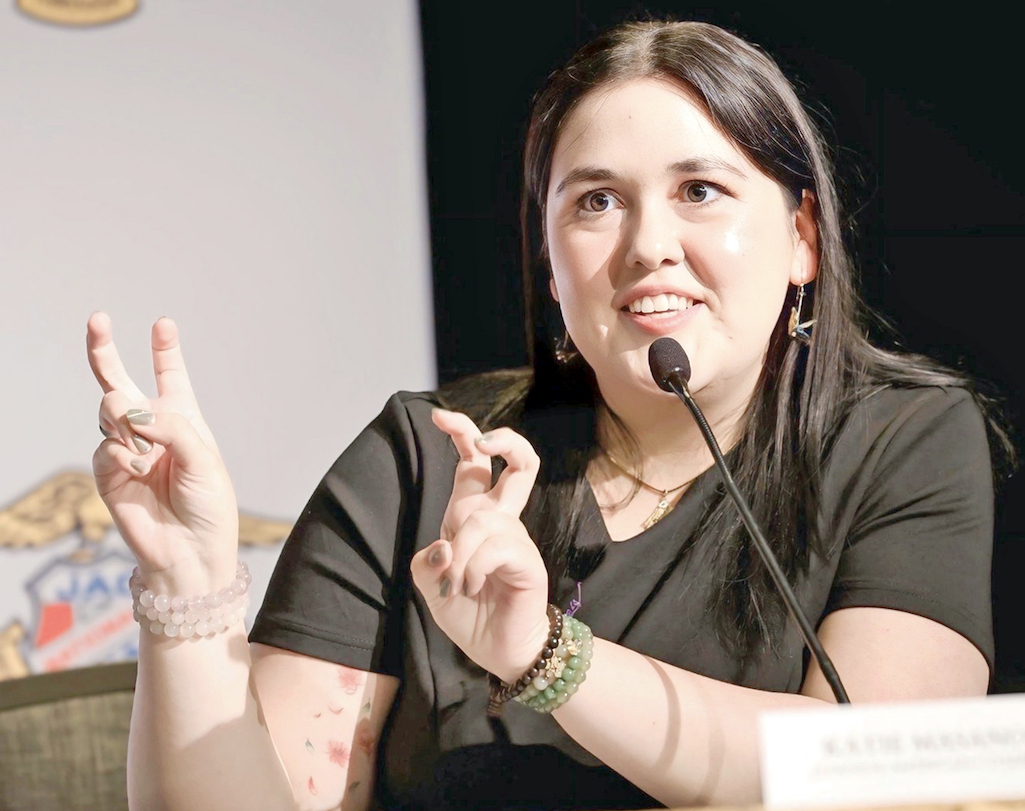
JACL Norman Y. Mineta Policy Fellow Katie Masano Hill
Hill kicked off the discussion by asking Sakura, who advises clients including the Tule Lake Committee, the Minidoka Government Planning Committee, the Japanese American Confinement Sites Consortium and also the Asian Pacific Islanders and American Historic Preservation or APIAHiP, which has a four-day forum coming up in Denver in September, for a historical overview.
Sakura acknowledged that he hasn’t witnessed the past 50 years of JA site preservation and noted that he grew up in Lexington, Mass., “and it really inspired in me the love of history and also instilled in me the significance of what I call commemorative energy.”
He said community efforts that have rallied to provide “all of the hard work from California from Manzanar until Amache (in Colorado, the most recent National Park site), is something to be celebrated.”
Sakura also noted that in 1976 when Manzanar was the first camp listed on the National Register of Historic Places, it was a milestone that opened the doors for other camps, as well as the Bicentennial of the United States.
“And it was an incredible moment for our nation,” he remembered. “Unfortunately, this year, the 250th, there really has not been that pride and willingness to admit it was wrong.” So, the revocation of Executive Order 9066 was a critical step forward toward redress, but today, some of the camp preservation efforts and official acknowledgement that the incarceration was wrong are facing an anti-DEI backlash from the administration.
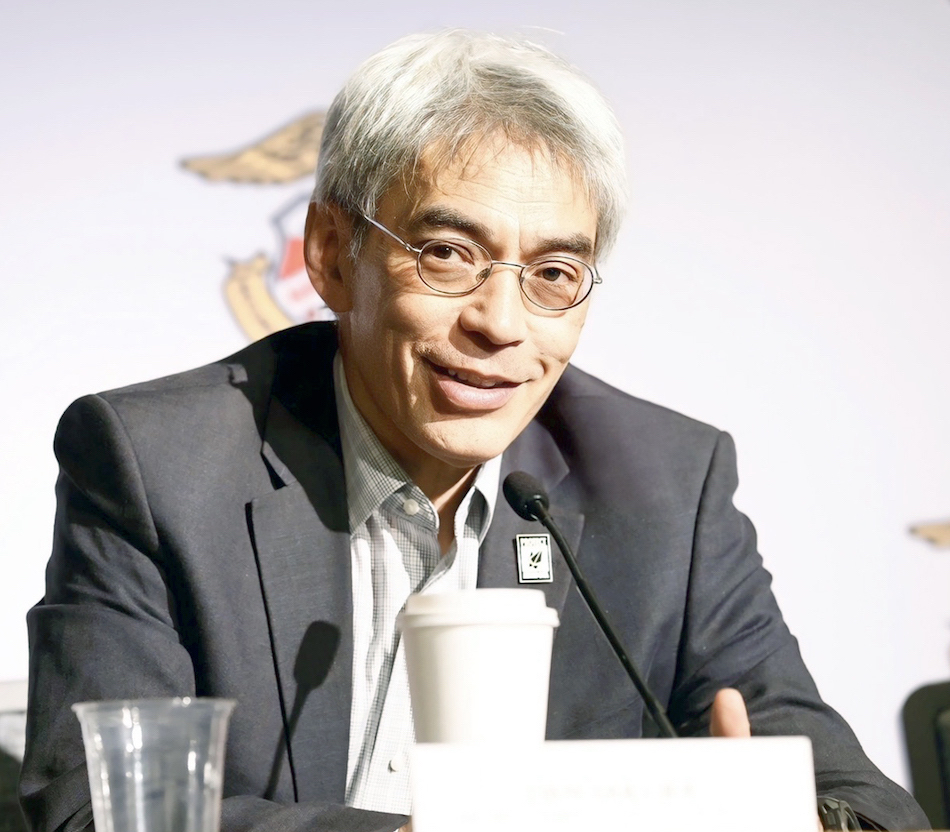
Sakura Conservation Strategies’ Dan Sakura
Sakura emphasized the importance of the JA descendants and local community’s role in preserving and protecting incarceration sites, even in the face of national challenges.
“The four-legged chair for successful camp preservation includes Japanese American community leaders and includes the local community,” he said. “We’ve been incredibly fortunate to have the National Park Service as a partner and then bipartisan congressional support. And so, a four-legged chair is better than a three-legged stool.”
He explained the timeline that led to the National Park Service recommending that Manzanar be designated as a national park, then the legislation that passed in 1992 to authorize the Manzanar National Historic Site.
Then, he recalled his involvement in Arkansas’ two sites, Jerome and Rohwer. “I was working at the Interior Department, and this nomination package came through, and I was like, ‘Wait a minute, this is pretty cool. Preserving a Japanese American site!’ I kept that in mind going forward when I was later serving in the White House. In 2000, I was working at the Council on Environmental Quality in the White House, and we were working on putting together a budget initiative. And we were like, ‘Well, how do we put together something meaningful?’ And so, we were able to move funding for the Manzanar Visitor Center above the line and into the president’s budget request. We were incredibly fortunate to have support from bipartisan leaders in California, and this actually planted the seeds for the Japanese American Confinement Sites grant program.”
He continued to outline the work being conducted at Bainbridge Island and Minidoka, as well as current efforts at confinement sites beyond the concentration camps.
However, Sakura warned, “We do face a very significant threat with regard to the Section 106 National Historic Preservation Act regulations that affect all historic properties. With the threats to the archives, the closures, and we are looking at permitting reform.”
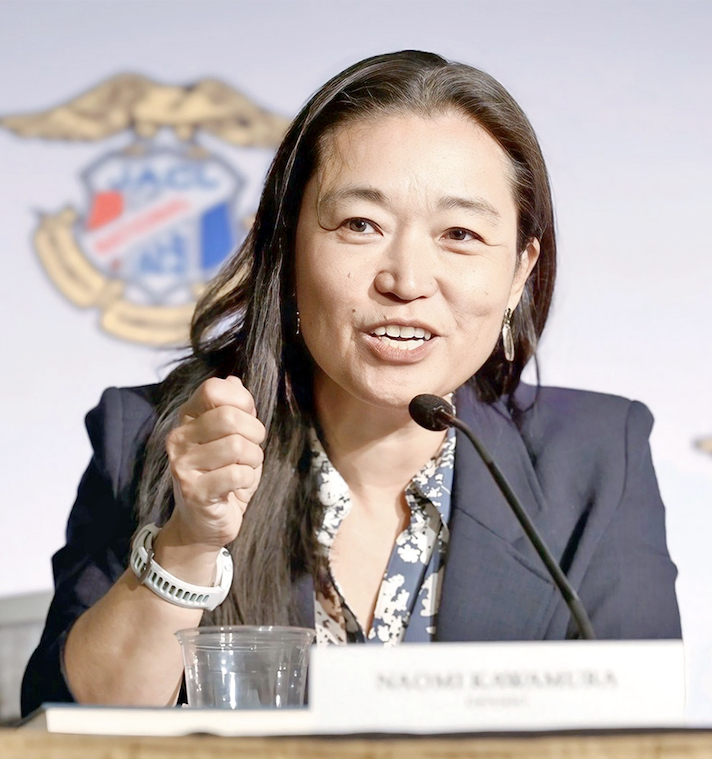
Densho’s Naomi Kawamura
Kawamura then introduced herself and outlined her passion. “I’m the executive director at Densho, and I also am a scholar of cultural memory. My Ph.D. research looked at how memory travels in Japanese American and Japanese Canadian communities, what it does in those communities, the collective identities that are formed and shaped by wartime incarceration history, and that continues to inform my work within.”
Densho serves an important role in this community effort because, as Kawamura pointed out, history isn’t just preserved in a place or its buildings and artifacts. It’s kept in peoples’ memories, and those memories can be preserved and handed on to future generations digitally, with technology capturing the stories that might otherwise be lost in the past.
“For many years, memories of the wartime incarcerations were preserved primarily in families or through community,” she said. “But then, many different projects started to arise to document that history, including Densho, so our founding Executive Director Tom Ikeda is the child of Minidoka incarcerees, and he helped to found the organization in 1996 because there were many other children of former incarcerees who started to recognize their parents were aging, that their stories were not being recorded or documented, and that their experiences might become lost to time. So, they recognized also that it might be difficult for everyone to go to the actual sites themselves. It might actually be difficult for everyone to go to the National Archives, or go to JANM, or go to any of these sort of museums that we have in our community, and so making these materials and stories accessible online was already the sort of foundational philosophy of our organization.
“We want to ensure that future generations can have access to and know and learn about this particular past,” Kawamura continued. “We now have over 1,200 oral histories. Our Oral History Program is still active. Earlier this week, I met with two former incarcerees at our Densho office as potential narrators, and so this is still very much an active part of the work that we do. We do this to ensure that this history isn’t lost or forgotten, but also to promote equity and justice today.
“As an organization of archivists and historians, we think of the physical historic sites like Minidoka, Amache, that Dan spoke to as some of the most important primary sources to this history that we have. These sites show us where events unfolded, and they preserve physical evidence that no document can fully capture.
“So, this morning,” she continued, “I thought I might talk about the complementary work of preservation, what I think of as like memory work, not just of the physical sites themselves, but understanding how do places become part of collective memory. What is the work of memory? What does that entail? And so, the preservation of the past requires more than preserving the sites because places do not remember, people do, communities do, and then institutions help communities and people to remember.”

Minidoka Pilgrimage Planning Committee’s Ana Tanaka
The final panelist, Ana Tanaka, shared a story about her flight from Seattle to Las Vegas. “I ended up talking to this man about I’d say my age, and he was from Florida, and he asked why I was coming to Vegas,” she recalled. “I mentioned this convention and this panel, and he mentioned how he hadn’t learned about the Japanese American incarceration until his 20s, which honestly is more than I would expect from someone from Florida.
“But we got into a whole conversation,” she continued, “Which led to him talking about the blatant racism that he has recently experienced as a Mexican and Jamaican man from Oran, El Salvador, and how he has recently been going through a lot, and so we ended up talking for the entire plane ride.
“But my point is that there’s no part of history that exists in a vacuum, and there is an inherent connection between his experiences and my own, and also between Japanese American families being forced out of their homes and into barracks. And an interaction that he had with a random man recently, who told him that he looked like he was ready to be picked up by ICE and that he should go back to his country.
“They’re not the same thing, but there are parallels between those two,” Tanaka concluded. “And so, Japanese American incarceration history is an essential chapter of American history because it represents the entire book. It’s an iteration of a pattern that has been the basis of our country. I think Japanese American history is not just the incarceration; it goes beyond that. There’s redress. There’s rebuilding. There’s resettlement. There’s everything that came after and before, and so that also means that it includes us and it includes tomorrow. And tomorrow it will include today.”
The audience left the plenary session moved and hopefully, inspired.